The history of Bradford rugby and the case to reassess the split in the English game in 1895

by John Dewhirst

There has been a temptation to romanticise the formation of the Northern Union in 1895 (forerunner of what became known as the Rugby League in 1922) as a sporting revolution in the interest of the working class. By that time the game of rugby – known in West Yorkshire colloquially as ‘football’ – had been transformed from a sport based on the supply of enthusiastic participants (that is, players) to an entertainment business based on the demand of spectators.

My research of what happened in Bradford in the years leading up to the formation of the breakaway league gives weight to the argument that the split is better described as having been an industry restructuring. In my opinion the motivation of the founder clubs was first and foremost to optimise their profitability rather than the welfare of players. Lingering affections for rugby union in Bradford at the beginning of the twentieth century might also suggest that things were more complex than the generally accepted version of history. Specifically, I challenge the official claim of the Rugby Football League that ‘The breakaway was caused by the northern clubs’ desire to pay players which was outlawed at the time in Rugby Union’.

Further findings of how football evolved in Bradford challenge a number of other ‘long-established truths’ about rugby history. This leads me to believe that local study is vital to enhance understanding of the history of sport in Great Britain and in particular, reasons for the pivotal split in English rugby in 1895. 

A matter of monopoly control

My argument is that the formation of the Northern Union was entirely consistent with previous developments regulating sporting competition in Yorkshire in the nineteenth century, specifically the tendency towards behaviour associated with monopoly competition, or to be precise traits more commonly associated with cartels. The same instinct towards concentration of power was also revealed in the relationship between Bradford FC and Manningham FC. The Park Avenue club actively sought to extinguish the threat of the emergent rival after 1883 in order to preserve its local hegemony. This was the making of a blood feud between the two clubs who were essentially business competitors. In my opinion the overarching theme of nineteenth century rugby in Bradford was about the exercise of monopoly power.

Bradford’s sporting DNA was derived from cricket which set the pattern for sport to become an expression of civic patriotism and loyalty. [1] My research has also revealed a link between the Bradford Cricket Club and the Young England movement in the 1840s [2] that was mirrored in the connection between members of the Primrose League and leadership of Bradford’s senior rugby clubs in the 1890s. As an industrial frontier town in the nineteenth century, sport played an important role in defining a Bradford identity and providing a degree of social unity – themes that appear to have been overlooked in economic and social histories of the town. There were parallels in the way that the leading Yorkshire cricket clubs jockeyed for power and with what happened in Yorkshire rugby. By the 1860s for example, the Bradford Cricket Club had established a reputation of assertiveness in protecting its interests and challenging Sheffield as the dominant player. In the 1870s the Bradford Football Club was no less hesitant it asserting its influence over Yorkshire rugby as a founder member of the Yorkshire County Football Club in 1874. The pentarchy of clubs comprising Bradford, Huddersfield, Hull, Leeds and York was a magic circle that dominated Yorkshire rugby at the expense of smaller clubs who began to lobby for representation and an expansion of the ruling body in the first half of the 1880s. (Of course, when we speak of ‘Yorkshire’ rugby it was essentially about West Yorkshire and the East Riding with Sheffield entirely pre-occupied with Association rules football.)

Following the formation of the Yorkshire Rugby Football Union in 1887 and then the creation of district bodies, Yorkshire rugby politics was dominated by the tension between the senior and junior clubs. A consistent gripe was that in matters of adjudication relating to grievances or disputes, the Yorkshire committee favoured the senior clubs. Indeed the larger organisations were unapologetic in their defence of economic interests, resisted proposals for gate sharing in cup games and ultimately, demanded control over promotion and relegation to the Yorkshire Senior Competition league. The junior clubs were said to be placated by being granted the opportunity to compete in the Yorkshire Challenge Cup (launched in the 1877/78 season).

The YSC league was formed in 1892 in response to financial pressures arising principally from a trade depression and the need to protect income. From the outset, there was exclusivity in who was selected for membership and in Bradford, the senior Park Avenue club came close to achieving its objective of excluding Manningham FC. The junior clubs objected to being left out of the league and responded by creating new divisions such that by 1895 Yorkshire rugby had four tiers – the senior competition had 12 members and 38 junior clubs comprised the three subsidiary divisions.

The issue of broken-time payments

The payment of broken-time to those forced to take time off work to play competitive rugby became an emotive topic for the senior Yorkshire clubs. This was because of the demands placed upon players to play an increasing number of games in a season, coinciding with a period of job insecurity. Financial pressures had forced clubs to increase the number of games to optimise gate receipts and this was sustained by league competition. As a headline issue, broken-time payments came to symbolise the divisions between north and south but it was not the only cause of disagreement. Yorkshire clubs for example resented the southern opposition to rule changes and resistance to the staging of alternate RFU annual general meetings in the north. Those divisions had become raw by the time of the Rugby Union’s annual meeting in September, 1893 when proposals for broken-time to be legalised were defeated. On their part, the southern clubs could be forgiven fears about the domination of English rugby by wealthier northern clubs and the ill-winds of capitalism that left them ill-prepared and impotent to compete. The legions of northern working class players were a bogey for the smaller southern clubs for whom rugby was seemingly threatened with transformation at their expense.

Nevertheless, it is wrong to suggest that northern clubs were united in support of the issue of broken-time payments being allowed. This was demonstrated in 1893 by the fact that a sizeable number of Yorkshire clubs opposed the motion for broken-time at the RFU meeting. A representative of one of the junior Bradford clubs, Bowling Old Lane FC is recorded to have expressed his opposition at that meeting. Contemporary newspaper interviews confirm that other junior clubs in the Bradford district feared a free-for-all at their expense if broken-time was introduced. Once more, the issue revealed the tension between the junior clubs and the seniors in Yorkshire (who had the economic power). Notable however is that on the issue of broken-time payments, a club such as Bowling FC – the third ranking side in Bradford whose membership was solidly working class – had the same economic fears as any of its middle class counterparts in the home counties. In fact, in Yorkshire those fears were even more acute thanks to the proximity of the big clubs. Arguably a similar degree of paranoia exists nowadays in English soccer among followers of lower division clubs who fear the implications of wealth becoming increasingly concentrated in a smaller number of big sides.

Even within the larger clubs, the issue of broken-time appears to have been a divisive issue and on various occasions it was a cause of jealousy between different player cliques at both Manningham FC and Bradford FC. It is also mistaken to suggest that all players in the north demanded broken-time payments. Aside from a small and declining number who had the private means to play without the need for compensation, a good number of leading players in the two senior Bradford clubs were pub landlords and thus, self-employed.

The decision to secede

The history of the two senior Bradford clubs is a case study in democracy and decision-making within nineteenth century sports organisations. Although the football publicans had no personal requirement for broken-time payments they became an influential lobbying group in favour of Bradford FC and Manningham FC joining the breakaway Northern Union and seceding from the Rugby Union.

The football pubs allowed player celebrities the chance to command a personal following to secure influence within their clubs whose decision-making was determined by the one member, one vote member organisation structures. Yet what concerned them was not broken-time per se as opposed to the concern that their clubs might be left behind by others forming a rebel league. Their stance was partisan in nature, to ensure that their clubs would play in any elite northern competition and thereby maintain parity.

Although Bradford FC in particular arranged fixtures with leading southern and Welsh clubs, subsequent to the launch of the Yorkshire Senior Competition in 1892, it was league fixtures that drew the biggest crowds. Whilst value was attached to international selection and the status derived from membership of the RFU, there was a growing irritation and contrariness among members of the senior Yorkshire clubs towards increasingly antagonistic attitudes that were building in the south.  Maybe a fin de siecle mood encouraged thought of radical change with the example of the northern based Football League providing the inspiration for a northern rugby union.

In the case of Bradford FC, the commitment to the Northern Union was very much at the stroke of midnight. The club’s leadership agonised over the financial implications and in the final event it was popular opinion – and the influence of the footballer pubs – that probably swung the decision. Members of the club’s committee had grave misgivings about joining the breakaway competition and subsequent events surely vindicated their concerns.

Opposition within the club to the proposed Northern Union was not an issue of class politics, nor was it necessarily based on affection for the Rugby Union – the concern was that the new body was a rushed affair and too narrow in its composition. Crucially the Bradford leadership favoured a broad based northern union and not simply a league.  The Park Avenue committee also knew that a breakaway would not be universally popular. In 1896 it was reported that Bradford FC suffered a sizeable reduction in membership and a likely reason for this is that these people valued the club’s status in the rugby world and its ability to stage prestige fixtures with touring sides. The loss of such fixtures removed an important differentiator with Manningham FC and henceforth, rugby followers would pick and choose between games against the same (northern) opposition at either Park Avenue or Valley Parade.

The future of Manningham FC had been safeguarded by membership of the Yorkshire Senior Competition and its leadership committee knew that the club could not afford to be left out of a new Northern Union. The new competition also ensured equality with Bradford FC and helped safeguard the future of Manningham FC. The decision to secede from the Rugby Union was thus based on practical, economic grounds rather than ideological. The consensus among the northern rebels was that it was impossible to remain a member of the RFU with the likelihood of falling foul of stringent anti-professionalism regulations. The Manningham officials knew that their club was in the firing line given that in December, 1894 it had been singled out at an RFU meeting and implicitly accused of professionalism on account of a trip to Paris (where Manningham FC had played Stade de Francais).

The belief in Bradford was that the southern establishment was standing in the way of progress and that change was unavoidable. On its part the Manningham FC committee was reconciled to the breakaway in the belief that any split would not be permanent and that the RFU would eventually come to its senses.  The belief among northern clubs that this might be the case could explain why the Rugby Union was particularly dogmatic, as if to demonstrate that there would be no compromise over professionalism in rugby.

Our knowledge of what happened during the summer of 1895 is likely to remain incomplete. Many of the meetings were conducted in secret, in smoke-filled rooms and my sense is that many of the newspaper reports were speculative in their content. There is also the suggestion that club jealousies encouraged the spread of false information. The football pubs in Bradford assumed importance as a source of news and rumour and I believe it safe to conclude that many opinions were formed from incomplete information.

The Rugby Union out-manoeuvred the rebel clubs but the tactical failure of the latter had more to do with the fact that they were far from united. Historic jealousies among the northern clubs undermined mutual trust and the Bradford FC leadership committee for example resented that the initiative was driven by clubs with lesser pedigree than itself, with less at stake financially and specifically without the same debt commitments. Similarly, populism would have forced the negotiating position of individual club representatives. As a collective body, it was too much to expect that the northern clubs could have matched the political initiative of the RFU leadership in what became a high stakes contest. The likes of William Cail and William Carpmael, acting on behalf of the RFU, calculated that they held the advantage in the game of poker due to divisions not only between the senior northern clubs, but also from antagonisms that existed between them and the junior clubs – for example arising from denial of promotion to the Yorkshire Senior Competition which was an emotive issue in the 1895 close season.

An industry restructuring

It is important to recognise the connection in Yorkshire between the promotion issue and broken-time in the events of 1895. What they had in common was that they were both key drivers of the profitability of the senior clubs – the first being the protection of income (through regulating membership of the YSC to bigger clubs capable of attracting good crowds); the second being the control of wages and, crucially also a safeguard against full professionalism (and the risk of wages being increased to the level paid by soccer clubs). Contrary to what has been claimed, the new Northern Union was not universally acclaimed in the north and in Yorkshire it aroused considerable animosity among the junior clubs who saw it as a cartel, contrary to their interests. In this sense, it was yet another instance of senior clubs promoting monopoly competition and excluding smaller rivals. Again, in 1901, a subsequent restructure of the Northern Union was interpreted as a further example of large clubs instinctively protecting their self-interest at the expense of others.

The formation of the Northern Union (NRU) disturbed the equilibrium that had emerged after the formation of rugby leagues in 1892. The hierarchy of clubs served as a food chain whereby local sides existed as feeders to junior and senior organisations. Once the RFU forbade relations between its members and the rebels, that delicate chain was broken. Perhaps not surprisingly it was the smallest clubs in Yorkshire who next joined the NRU, seceding twelve months after the original schism. The junior – or medium-sized – clubs held back as long as possible and even enjoyed a temporary new lease of life, until financial necessity forced them to switch as a means of self-preservation because rugby union in Yorkshire lost critical mass. [3]

What has been overlooked is that, in Yorkshire at least, the body of the Northern Union was hollowed-out in the shape of an egg-timer with senior clubs at the top and local clubs at the bottom. The absence of numerous medium-sized, junior clubs denied the NRU a pyramid structure. The reason that most of the former junior clubs did not join the Northern Union, or were members for only a couple of years, was that they succumbed to financial failure. The mass insolvency of these clubs in the second  half of the 1890s was thus the equal and opposite to what had happened in the first half of the 1880s when they had mushroomed. In this regard the NRU was not a cause of their failure but the schism of 1895 certainly hastened their disappearance. By the 1890s the finances of the smaller clubs were already precarious and this had a lot to do with the impulsive enthusiasm and naivety behind their emergence in the previous decade – which in the Bradford district came from the excitement of the Yorkshire Challenge Cup. In West Yorkshire their space came to be filled by soccer and in Bradford, sports fields were lost to rugby.

By the 1890s the Yorkshire rugby industry was characterised by over-supply and in this context, the formation of the Northern Union in 1895 occasioned an industry restructuring.  (It could even be argued that the defence of amateurism by the RFU was an equivalent economic strategy to control competition.) With regards to the Northern Union, parallels could be made with what happened in soccer such as the launch of the Premier League in 1992 or in northern rugby, the Super League in 1996. First and foremost, it was about optimising profitability for the members – these were all examples of naked sports capitalism just as the formation of the Yorkshire Senior Competition league in 1892 had been. Subsequent to 1895, the changes to the Northern Union – professionalism, rule changes and thirteen aside – were driven by commercial criteria to attract crowds as the sport came under increasing competition from soccer. The need for change is evident from analysis of gate receipts at Valley Parade (home of Manningham FC) and at Park Avenue (Bradford FC) with a plateauing of aggregate revenues after 1892 and – on the basis that more games were being played – a drop in average attendances. It was the decline in profitability that ultimately led to the eventual abandonment of rugby at Valley Parade and Park Avenue in 1903 and 1907 respectively. There is no other town in England in which two leading sports clubs have switched codes on two separate occasions.

 The issue of class in Bradford (rugby) football

The intensity of the Bradford / Manningham rivalry – described in contemporary reports as a blood feud – gives the temptation to suggest that, as in Glasgow there was an ulterior tension between the two. The claim has been made that the rivalry between Bradford FC and Manningham FC was one based principally on class. In my view this is incorrect and says more about the political agenda and partisan loyalty of modern writers, failing to recognise the actual circumstances of the two clubs and the fact that neither was ever a homogenous body. As I explain in my books, Room at the Top and Life at the Top, the relationship between the two was essentially that of business rivals.

The emergence of the Manningham club arose from the fact that it was located in the centre of a populous district and urban geography dictated allegiance; the convenience of a local club was preferable to those who were time constrained and unable to head across town to Horton Park Avenue (which was more accessible to the south of the district). Both clubs relied upon backyard support but each had its own appeal with distinct personalities and reputations: Bradford FC was known for its celebrity players whilst Manningham had a strong record of developing its own. Similarly, the entertainment facilities and covered accommodation at Park Avenue, as well as its status as the senior town club, made Bradford FC a fashionable option. Ultimately both benefited from floating supporters who were attracted by the standard of football on offer and the fixtures of the day. Suburban stations at Manningham (Midland Railway) and Horton Park (Great Northern) extended the catchment of Valley Parade and Park Avenue beyond the Bradford district to places in Wharfedale, Airedale and even Calderdale.

The politics of those in charge at both Park Avenue and Valley Parade was remarkably similar and reveals the influence of ‘One Nation’ Conservatism. In fact the distinction between the two clubs was more akin to that of religion: the Bradford club representing an established church that played its games at a cathedral and Manningham was the non-conformist whose home was a chapel. In my opinion blanket generalisations about class are not only misleading but represent a gross simplification and superficial understanding of how the clubs functioned and evolved.

In fact, the social composition of the Bradford FC first team was remarkably fluid in the fifteen years after 1880, the year when the football club was relaunched through merger with Bradford Cricket Club and the Horton Park Avenue ground was opened. Originally the team comprised a majority of working men whose introduction to ‘football’ had been through membership of the Bradford Rifle Volunteers. Yet by 1884, when Bradford FC won the Yorkshire Challenge Cup, Fred Bonsor personified the generation of young men from wealthy backgrounds attracted to what had become a fashionable pastime; the Bradford FC players of that time were true celebrities and known for living the high life. Critics bemoaned the influence of player cliques and the fact that team selection invariably depended upon favouritism – in fact a number of players were said to have joined Manningham FC having been unable to secure a place at Park Avenue. Nevertheless, it is incorrect to argue that the Bradford side was exclusively middle class in its selection.

The introduction of league competition in 1892 had a profound impact on the social composition of the Bradford FC side, a number of whose leading players at the turn of the decade such as England internationals Fred Bonsor, Rawson Robertshaw and Laurie Hickson had hitherto been of solidly middle class families. In March, 1893 the reported comment of a Halifax supporter confirmed that players with ‘cuff and collars’ at Park Avenue were by now the exception and not the rule. In other words, the social transformation of the dressing room – metaphorically away from scented soaps – occurred prior to the split in 1895. The transformation at Manningham FC meanwhile was not quite so marked given that the majority of its players – although not exclusively – were from more modest backgrounds.

After 1892 the two clubs were actively competing against each other for the same players and league competition brought with it a bidding war to secure the best talent. This heralded a new phenomenon for Bradford rugby with the introduction of more ‘foreigners’ to the two leading sides. Whilst ‘imports’ were not new, their numbers were and no longer was it the case that a team would be comprised mainly of locally born players.  At Park Avenue in particular, any suggestion of prejudice among club members had more to do with the reliance upon ‘alien’ players from outside the district representing the town club than working class men per se.

During the previous decade, there had already been a trend towards greater representation of players from a working class background. In Bradford, the crowding out of middle class players was not unique and arose from a variety of factors, the most obvious of which that working men proved more deserving of team selection. In Bradford, a not insignificant issue encouraging those who had the option to pursue a career was economic uncertainty. After 1873, the textile industry was subject to a series of trade depressions attributable to foreign tariffs being imposed upon British exports. Increasingly, fathers could no longer afford to subsidise their prodigy offspring to indulge in football and besides, there would have been a filial duty to sustain a family business. By 1890 a tipping point had occurred and thereafter, new players introduced to both the Bradford and Manningham teams were predominantly working class. The comments of the headmaster of Bradford Grammar School, quoted in 1889 to the extent that football (ie rugby) was a ‘vulgar, rough game’ highlight that the sport was no longer deemed an acceptable pastime for the respectable young men of the district.

In 1892, the formation of the Bradford Old Boys under the leadership of former Bradford captain, Fred Bonsor was a case of middle class players decamping to establish their own side. Bonsor struggled with retirement from the game as well as the loss of attention and the creation of the club allowed him the means to continue playing with his cronies. The Bradford Old Boys played a number of local fixtures but the venture was short lived.

 Personality and culture: Bradford FC v Manningham FC

A measure of the stature of Bradford FC was the standard of fixtures that the club could command. The Bradford club was the team to beat and in the ten years prior to 1895 consistently provided at least two members of the England XV team every season. This alone gave the club and all associated with it a degree of swagger, no different from that surrounding one of today’s Premier League giants. The fact that the Barbarians were formed in Bradford in April, 1890 reflected the status of the club and town as a rugby centre. (Founder, William Carpmael used the Alexandra Hotel in Bradford as a base for his touring party who played games with Yorkshire sides and two Bradford FC players became founder members.)

The personality of the Bradford club was quite distinct from that of Manningham. Other than its fame, this arose from three other key factors: (i) its relative size; (ii) its wealth; and (iii) its original purpose as the town’s senior representative in the pursuit of civic sporting glory. As a commercial organisation it was much bigger than Manningham and this was reflected by the fact that attendances tended to be higher at Park Avenue than Valley Parade. By 1890, the Bradford Cricket, Athletic & Football Club was reputedly the richest in England, a measure of commercial success. Its size, with roughly double the number of members as Manningham and its scale of activities, embracing cricket and athletics as well as football, made it a more complex and political organisation. In practice this meant that the experience of membership would have been much different to that of Manningham FC and that the two clubs would have appealed to people in unique ways. In addition to the rivalry of the seniors, the existence of half a dozen decent junior sides in the Bradford district offered tremendous choice and variety for rugby followers as well as a rich football culture. (Indeed, Bradford of the 1880s and 1890s can rightly claim to have been a sporting centre with well-established clubs catering variously to cricket, athletics, cycling, gymnastics and for that matter, chess.)

Many of those involved in positions of leadership at Park Avenue were self-made men and this surely helps explain what became known as the club’s brash ‘high and mighty’ attitude to other sides. Indeed, Bradford FC was not universally admired in other Yorkshire towns on account of its arrogance and unashamed pursuit of self-interest. However, Bradford members tended to view criticism in the Leeds press – and the Yorkshire Post in particular – as jealousy.  It ensured that Yorkshire rivals – Wakefield, Huddersfield, Halifax and not just Manningham – were sufficiently well-motivated to raise their game. After 1892, derbies with Manningham were described as ‘hair and skin’ affairs which was a measure of the passions and the fact that the smaller club considered them an opportunity to prove itself.

The Manningham club tended to eschew the so-called ‘masher’ culture more commonly associated with Park Avenue and its leadership tended to be more cultured and educated. To some extent this mirrored the social rivalry in late nineteenth century Bradford of mill owners on the one hand (who were more prevalent at Park Avenue) and the more cosmopolitan wool merchants on the other (who provided the leadership of Manningham FC by the end of the nineteenth century). Valley Parade was always a basic, utilitarian ground with limited facilities but had the advantage of central location. Park Avenue was by contrast much bigger and more developed but the Manningham membership expressed pride in self-help and the fact that their ground had been built from limited resources. Park Avenue was originally part-funded by public subscription but Bradford FC was always reliant upon debt – something to which the Manningham members remained averse.

 The Manningham FC ethos is thus better described as that of Samuel Smiles. It was certainly not that of Keir Hardie and indeed, the awkward fact for the individual [4] who has enthusiastically peddled the myth that the club aligned itself with the Manningham Mills strikers in 1891 (for which there is no substantive evidence) is that the Manningham FC leadership was predominantly Conservative in its sympathies and its secretary sat on the Bradford Police Watch Committee.

 The Northern Union and class identity in Bradford

 The language of class permeated the dispute over the split in English rugby in 1895 and beyond. Perhaps not surprisingly, historians have focused on the schism having been driven by class conflict but I question whether an obsession with class has served only to impede the study of rugby history. I do not dispute that for many in the south, the working class player from an unknown Yorkshire village was symptomatic of how northern rugby was in the ascendancy and casting a shadow over the fate of the national game. However, I suspect southern commentators vilified working class players as the scapegoat because to do so was the easiest way to narrate economic developments in the sport and mobilise opinion against professionalism. For example, the subtlety of broken-time compensation payments as distinct from wholescale, full professionalism was not fully understood in the south whereas the scourge of working men playing rugby was. It represented the gross simplification of a wider issue much in the same way that today’s tabloid press has preferred to castigate east European labourers in Britain as a proxy when opposing immigration.

 In Yorkshire, contemporary reports allude to the condescending attitude of the RFU’s southern leadership after 1893 and it was openly acknowledged at the time that the dispute with the south was about influence and control of the direction of English rugby. Even so, as far as Bradford was concerned, I have seen nothing to suggest that class was a defining issue at the time of the breakaway in 1895 and it is notable that at Park Avenue and Valley Parade there were no resignations among prominent members of the respective leadership committees in protest. Indeed, emotive language about class only started to become reported in the local Bradford press after 1905 when rugby union began to make a recovery in Yorkshire and Northern Union followers were inclined to make disparaging remarks about the amateur game and its participants. This is hardly surprising given that at the start of the century there remained examples of working class Rugby Union sides in West Yorkshire whereas by 1905, Yorkshire rugby union was predominantly a middle class sport, played in the main by boys educated in independent schools.

 The Rugby Union had not helped itself with its dogmatic and uncompromising defence of amateurism. In the north, this had prevented contact between players or teams of the rival codes and the RFU cordon sanitaire invited accusations of elitism. Not surprisingly, in 1907 when Bradford FC members debated a return to the Rugby Union, there was a bitter reaction among those who supported the Northern Union game. Correspondence in the press confirms that opposition was driven by class prejudice with mocking references about the social mores of rugby union.

 In Bradford, the events of 1907 were far more divisive among rugby followers than what had happened in 1895. Thereafter, the Northern Union game was inextricably linked with a working class identity. Yet, even if the division within English rugby came to be seen as a matter of class conflict, that is quite distinct from suggesting this dimension was the true cause of the schism in 1895.

 My belief is that in Bradford at least, the Northern Union actively fostered a class identity as a defensive mechanism to kindle popular support in the wake of criticism following the disappearance of so many junior sides. In the Bradford district, the Northern Union game was unable to compete with soccer and after 1895 never captured the public imagination in the same way as the traditional code prior to the split. People were lost to rugby with the disbanding of junior clubs in the district and blame for their failure was widely attributed to the breakaway Northern Union. The criticism was unfair and equal blame could be apportioned to the policy of the RFU in preventing co-operation between the two codes. However, the Northern Union was the scapegoat for having been the agent of change.

 It is notable that after World War One, and certainly prior to the opening of Odsal Stadium (home of the Bradford Northern club) in 1934, it was the reformed Bradford Rugby (union) club that held the initiative and commanded popular support in the district. In the meantime, Bradford Northern struggled to survive and the club attracted only meagre crowds until relocating to Odsal, a massive ground formed out of a municipal rubbish tip. In other words, it was hardly the case that in Bradford, Rugby Union was handicapped by popular bias for the rival code or that the Northern Union game was held in high affection locally.

 The Great Betrayal

 When rugby was eventually abandoned at Park Avenue in 1907 it became known as ‘The Great Betrayal’ and it was with heavy heart that rugby followers came to terms with the prospect of an end to forty years of competitive rugby in Bradford. However, by 1907 there was considerable disillusionment with the Northern Union in the city and it is telling that Jimmy Wright, one of the original ‘football pub’ landlords in 1895 who had lobbied to join the breakaway, was later wholesome in his support of the rugby union revival in Bradford. This was not some form of revanchist, counter-revolution with class undertones. At its heart was frustration with what the Northern Union had become and a perceived tendency on the part of the code’s administrators towards forever tinkering with the rules of the game.

 Bradford FC had seen itself as the Blackheath of the north but lost its aristocratic self-image as a member of the Northern Union. Neither could Manningham FC claim that its sojourn in the Northern Union had been satisfactory, this was despite the club having been inaugural champions of the new competition in 1896. Ultimately neither club could make rugby pay – or at least not to the level needed to meet financial commitments. In January, 1907 the Bradford FC committee had forced the other senior Yorkshire clubs to vote on a return to the RFU rules and a reversion to fifteen aside. The unanimous referendum in support of the Northern Union alternative represented a milestone for that competition, ending speculation about mass re-entry to the Rugby Union (however unlikely it seemed). In Bradford, the Park Avenue club members split three ways in an acrimonious divorce that led to the formation of the Bradford Park Avenue soccer club and the Bradford Northern rugby club; those who favoured rugby union joined either of the two local amateur clubs. 

Shades of Grey

From the vantage of the twenty-first century, the formation of the Northern Union appears to have been a fairly clean-cut event that invites a romantic narrative of it having been a popular revolution, motivated to protect the interests of the working man and enjoying universal acclaim in the north. All told, from the evidence of what happened in Bradford, it was far from being such a black and white affair but then revolutions are rarely what revolutionaries claim them to have been. In the final reckoning, I doubt very much that the leadership of either the Manningham or Bradford clubs – or other smaller clubs in the Bradford district – would concur with what modern historians have said about the cause of the split in 1895. I therefore believe that the Bradford case study validates the call for more bottom-up, local analysis to challenge existing narratives about sporting history.

[1] Cricket – the DNA of Bradford Sport

[2] The political origins of Bradford Cricket Club

[3] The story of Shipley FC and Bradford’s other c19th junior rugby clubs

[4] Dr David Pendleton – review of his book from this link

=======================================

Postscript. To an outsider such as myself (with no particular enthusiasm for either code of rugby) the history of the Rugby League seems dominated by dogma and the myths of 1895. Whether cultural or ideological it reflects the bitterness of the Great Split and all that followed. The orthodoxy of thought about the causes of the breakaway is emotionally upheld and little quarter has been given to revisionist thought that there was more to it than class tensions in Victorian society. My suggestion that capitalist instincts and the defence of profit was a factor in the formation of the Northern Union has proved difficult for some people to stomach. It therefore seems ironic that a current theme for discussion among followers of Rugby Union is the proposal to ring-fence the RU Premiership and put a stop to promotion / relegation to and from the second tier. And for what purpose other than to protect profit and investment?? Surely it is a re-run of an earlier controversy going back more than 120 years.

John Dewhirst is author of ROOM AT THE TOP, A History of the Origins of Professional Football in Bradford and the rivalry or Bradford FC and Manningham FC (Bantamspast, 2016) and LIFE AT THE TOP, The rivalry of Manningham FC and Bradford FC and their Conversion from Rugby to Soccer (Bantamspast, 2016). Refer BANTAMSPAST website for details. Anyone seeking quotes or references to substantiate his observations as above is encouraged to refer to the books.

The following features by the same author offer further insight into the early history of  Bradford rugby:

Centenary of the Bradford Rugby revival in 1919 and the Scholemoor ground at Lidget Green, Bradford

The influence of the Rifle Volunteers on Bradford sport in c19th

The role of the railways in the development of Bradford sport

The story of Shipley FC and Bradford’s other c19th junior rugby clubs

The significance of sport in shaping a Bradford identity

History of the Bradford Charity Cup and the makings of a football culture in the district


Other articles by the same author on the history of Bradford sport
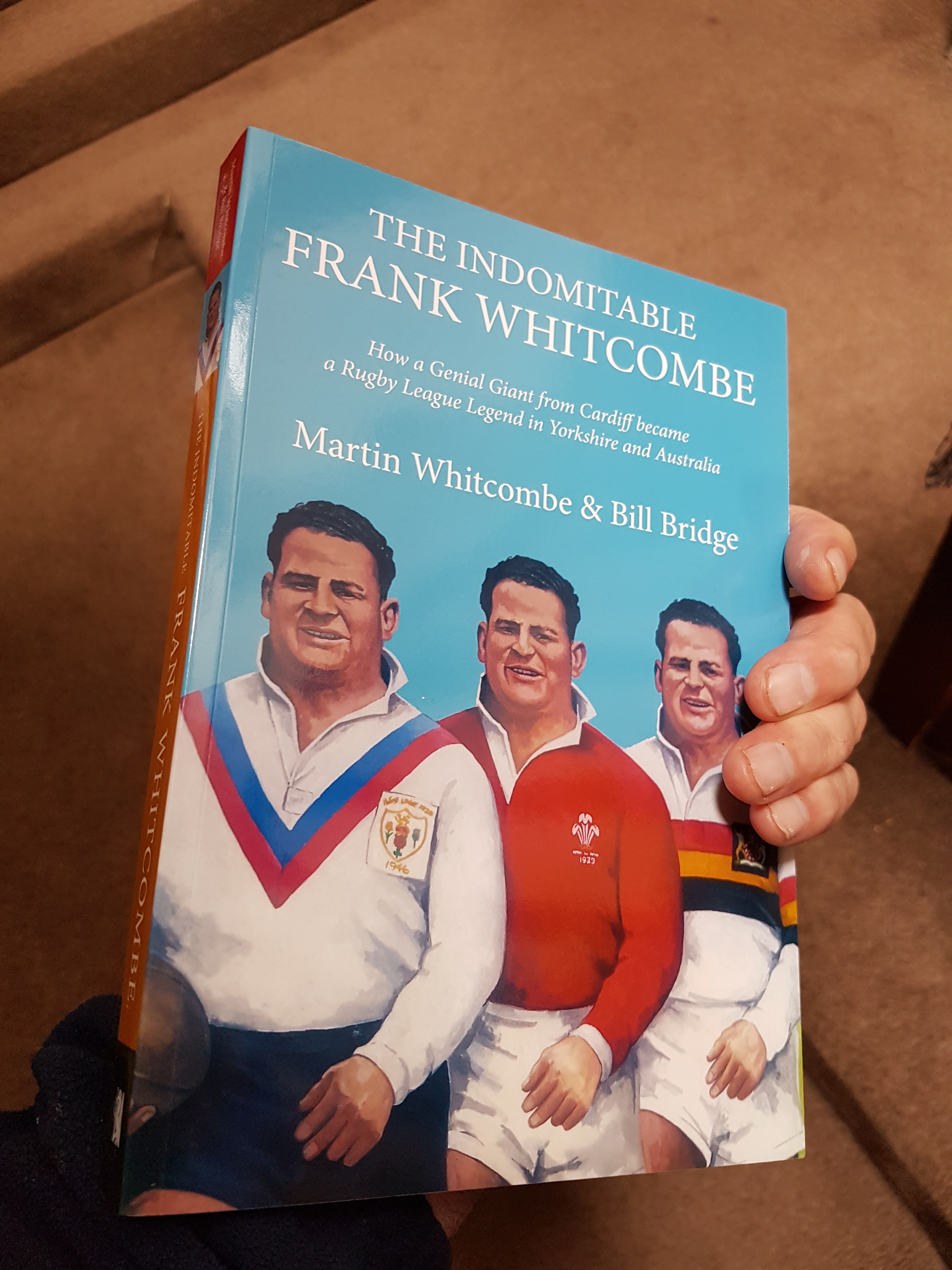
The Indomitable Frank Whitcombe

Martin Whitcombe writes about his book published in May, 2016 which will be of interest to all Rugby League followers, particularly Bradford Northern / Bulls supporters…

20160518_124635.jpg

Frank Whitcombe, described as ‘one of the greatest Welsh rugby league forwards of all time’, played for Bradford Northern, Wales, and Great Britain. Adored by Bradford supporters and admired by the rugby league fraternity, such was his prowess that he was named in the Bradford Northern all-time greats team. The Indomitable Frank Whitcombe lovingly tells the incredible story of a rugby league legend who was born and raised, as one of ten children in Grangetown, the heart of working-class Cardiff.

Frank s rugby career, after a brief and successful spell as a boxer, began in rugby union, when he played for the British Army and London Welsh, as a deceptively nimble and skilful 18 stone forward. His talents were quickly spotted by rugby league scouts, and Frank was persuaded to go north for £100 and two new suits, although the cost of buying himself out of the Army left him just £10, and the suits! Frank was made for rugby league and he enjoyed a glittering career in professional rugby, winning the RL Challenge Cup three times, the RL Championship three times and was capped 14 times by Wales. He quickly created a big impression on the Great Britain selectors and he was chosen for the famous 1946 Indomitables tour of Australia.

Frank excelled as the tourists made history and won plaudits from antipodean fans and media alike as the team became the first, and to date only GB tourists, to win a rugby league Test Series, undefeated, down under.

After 331 games, Frank bowed-out of rugby with Bradford Northern, four days after playing in a Challenge Cup final at Wembley, in his last match at Odsal; a game which attracted 19,000 fans. He then turned to life as an RL administrator and publican before his life was tragically cut short by pneumonia at the age of only 44. Frank was a true giant of rugby league and this is the first book to tell his remarkable story.

1st-test-4_17061946_0020_cr-2

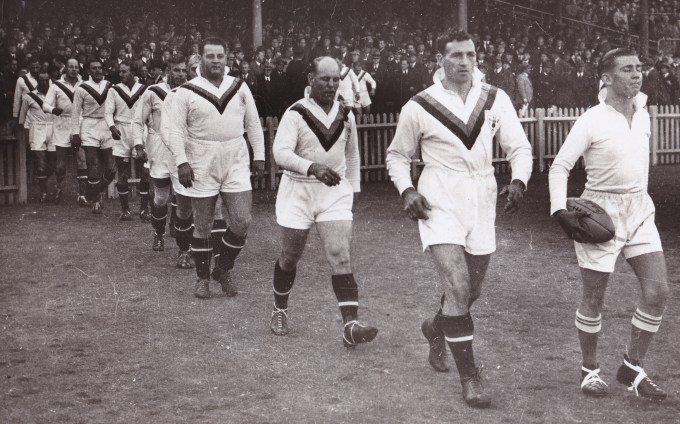
1946 1st Test Sydney England v Australia Tour captain Gus Risman (Salford)  leads the team on to the field at the Sydney cricket ground followed by Tommy McCue (Widnes) and Frank Whitcombe (Bradford Northern)

Reviews of the book have been very positive…

‘We both played for Cardiff RFC and for Bradford Northern RLFC; we both played at Wembley in Challenge Cup finals; and we both played for Wales and Great Britain. We were both prop forwards and when our playing careers were over we both went into the licensed trade. I am so proud to have walked the same path as this wonderful man did.’
Jim Mills, Cardiff RFC, Bradford Northern, Wales & Great Britain

‘Frank Whitcombe became a Welsh international and a Great Britain tourist. He is widely regarded as an all-time great of rugby league. Dad always enthused, not only about his scrummaging and play in the loose; but that he was very light on his feet for a huge man, a surprisingly good place kicker and an excellent tactical kicker of the ball. This was unheard of back then and even now it is rare to see such skills from a prop forward.’
Fran Cotton, Sale, England and British Lions

‘Frank Whitcombe was a rugby league cult hero in the days before there were cult heroes. An eighteen-stone battle tank of a prop forward, he graduated from Welsh rugby union to become a pillar of the great Bradford pack of the 1940s. In the process, he became the first forward to win the Lance Todd Trophy, a member of the 1946 Indomitable Lions touring team to Australasia and had even driven the team bus to Wembley when Bradford won the 1947 Challenge Cup Final. This book is his story – it is essential reading for anyone interested in the history of rugby and the amazing men who made the game.’
Prof. Tony Collins, De Montfort University, author of ‘The Oval World’.

2015-07-29 16.52.26.jpg
Roll out the barrel, Frank Whitcombe in his cellar at  the Hallfield Hotel,  a Melbourne Breweries Ale House on Trafalgar Street, Bradford
 1948-01-17-wigan-v-bfd-northern
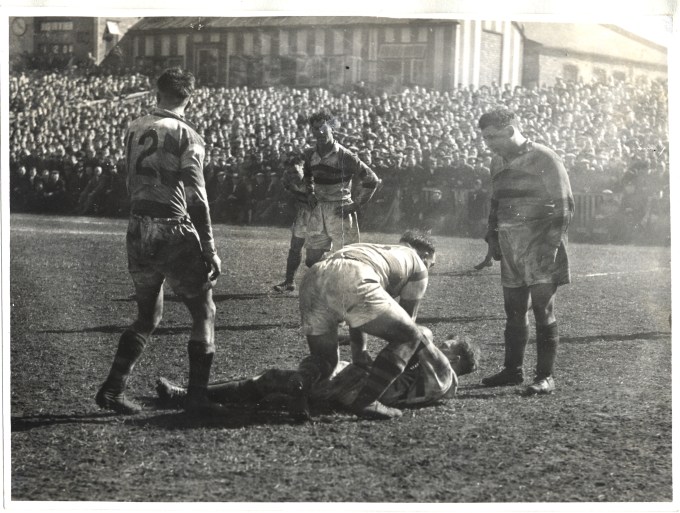
17th January 1948, Central Park Wigan: Wigan 14 7 Bradford Northern. Wigan forward Ken Gee standing over the tackler and Billy Blan are watched closely by Bradford Northern players R-L Frank Whitcombe, Trevor Foster and Herbert Smith  


About the Author
Martin Whitcombe is Frank’s grandson, who also enjoyed a successful rugby (union) career with Leicester Tigers, and England B. Today he lives in West Yorkshire and is a keen follower of both rugby union & rugby league. Bill Bridge is a retired journalist who was Sports Editor of the Yorkshire Post for almost 30 years and wrote about rugby union for 25 years. He met the Whitcombe family whilst working for the Keighley News and remains a family friend.

The book is published by St David’s Press Cardiff and is available direct from them at £19.99 or Amazon, Waterstones on line, Bradford and Cardiff Waterstones stores.

f-hughes-f-whitcombe-bordeaux-cipxhypuuae3obu1

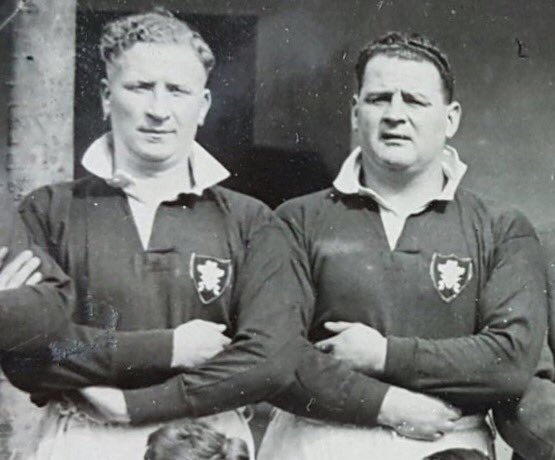
Welsh prop forwards Fred Hughes (Workington) and Frank Whitcombe (Bradford Northern) Fred was Emlyns Dad, the Liverpool FC and England football captain

The Worst of Times – A Look at Bradford City’s Lowest point in League Football

by Ian Hemmens

The 1960s proved to be a very odd decade for the club starting with a relegation to the bottom tier of the Football League, a promotion at the end of the decade and in between, 3 near misses in the promotion race and more ominously, 2 seasons with the ignominy of having to go cap in hand to the fellow league clubs for their support as the club had to apply for re-election. Add to all this the obligatory financial crisis and it seems like business as usual for City.

Thankfully, the club has never felt the shame of finishing at the foot of the whole football league but on 2 occasions it came pretty close. Two 23rd place finishes in the 1960s made the decade a low point of the clubs history. In fact, for Bradford it was a desperately poor sporting decade. Speedway had packed up for the 2nd time, City struggled and cross-city rivals Bradford Park Avenue hit the skids mid-decade and never recovered getting the boot from league football in the 1969-70 season and finally having to call time in 1974 crushed by mis-management, financial trouble and Council indifference from the City authorities.

City themselves under the managership of Bob Brocklebank who had arrived in May 1961 had a real roller coaster of a time under his tutelage. City had been relegated to the new Division 4 in 1961 under the long serving Peter Jackson snr. and Brocklebank inherited a side with a decent amount of talent with a goalscorer in David Layne, a solid reliable defence with Flockett, Mollatt, Harland & Mike Smith. There were also the shoots of a promising youth policy with Trevor Hockey, Bruce Stowell, Brian Kelly, Roy Ellam & England schools keeper David Roper all starting to make claims for a place in the side.

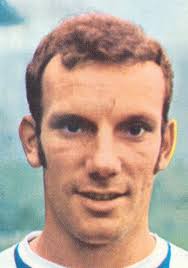
John McCole.jpg

Added to that was return of former record goalscorer & crowd favourite John McCole (pictured) from Leeds United and the solid signings of Barry Tait & Tommy Hoyland. Farewells were said to long term favourites Johnny Reid, Bobby Webb & Derek Hawksworth & sadly, through injury, Jim Lawlor as Brocklebank shaped his side. A superb run from New Years Day 1962 with only 2 defeats saw the side agonisingly miss out on promotion by 1 point. Even ‘Bronco’ Layne smashing the clubs goalscoring record with 34 league goals ably backed up by McCole & Tait couldn’t compensate for the agony of missing out.

 The following close season saw the inevitable departure of star striker Layne to Sheffield Wednesday who would later gain notoriety for his part in the betting scandal  of the mid 60s which would cost him not only his career but also, for a while, his liberty. The young upcoming star Trevor Hockey was also sold for a record £15000 fee to Nottingham Forest. Journeyman Barry Tait also left but Bob Brocklebank was left with the core of his side still available to him. Incoming signings included inside forward Barry Webster from Rotherham & Peter Bircumshaw from Notts County and a young winger who had been on amateur forms signed his first professional contract. He would go on to be a major part of Citys history in the decade, his name John Hall. It was anticipated that Johnny McCole would take over the goalscoring mantle of the departed Layne but sadly, the combination of a previous broken leg and even more sadly a burgeoning drink problem saw him far less effective than his previous spell at the club where he had achieved his rightful place as a City legend by breaking the long term scoring record of FA Cup hero Frank O’Rourke.

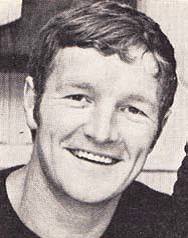
The 1962-63 season began fairly decently with only 2 defeats in the first 8 games although McCole only managed 1 goal, it appeared that the team might well be challenging again and showed no sign of a hangover after the near miss of the previous season. The goals were being shared around the team which had a settled look but towards the end of September the side started hitting runs of games without picking points up several times having runs of 4 games without a point as they started to slide down the table. Manager Brocklebank was never under pressure jobwise with the board showing commendable faith in him to put it right as he shuffled the pack to get the side back on track. Youngster Hall was given his debut and fellow youngsters Ellam (pictured), Kelly & Stowell all had runs in the side but nothing seemed to work as City struggled to find any form at all. During the season, never once did the team go more than 4 games without a defeat and that included 3 draws. Consecutive defeats on the other hand were a regular occurrence as the team struggled to find any form at all. John McCole’s disappointing 5 goals from 20 games was a huge shock to City fans who had idolised ‘King McCole’ 5 seasons earlier. A sad end to club legend came in January when he left for Rotherham but his career never hit the same heights again and sadly he was a shadow of the goal machine of his younger days. City needed goals urgently and City looked over to Horton for McCole’s replacement. Avenues bustling striker Rodney Green came across the City to provide more firepower and presence to a frankly, lightweight attack.

roy-ellam

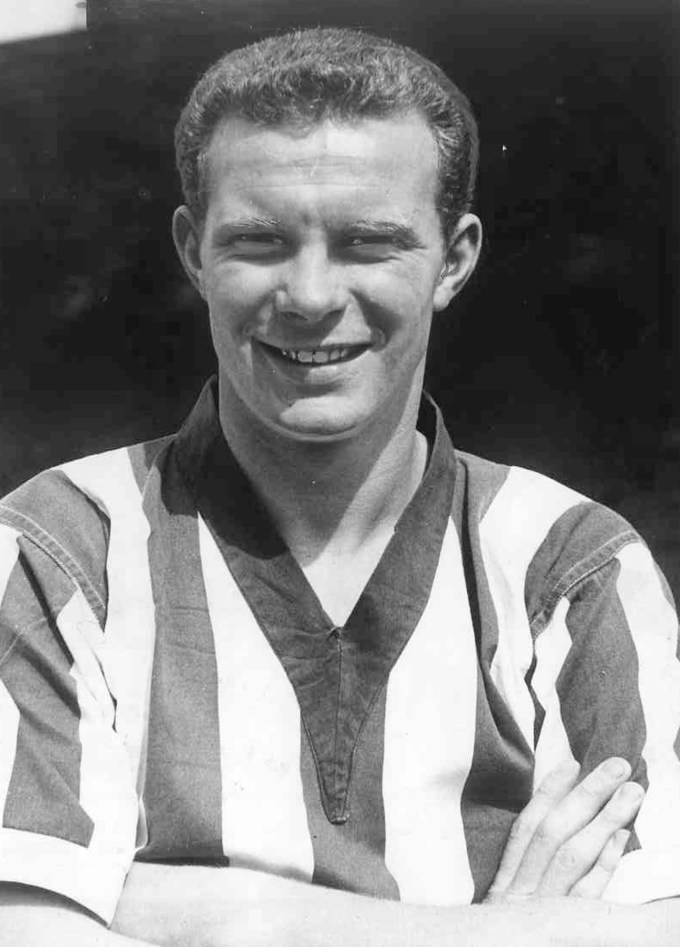
 Due to the harsh winter of 1962-63 football was hit hard and City went nearly 3 months without a game and despite signing in December, Green (pictured) had to wait until March 1963 to make his debut in an auspicious 0-5 defeat away at Crewe. It didn’t look good for the restart and a push for safety from re-election. He got off the mark in his second game and the scored a brace at home to Chester but it proved a false dawn as the side then went on a 3 game losing streak.

Rodney Green.jpg

The return after a 5 month injury break of Mike Smith proved another false hope as Manager Brocklebank ‘tinkered’ with personnel and formations to find a combination that worked and during the second half of the season, nobody actually gave City a big beating, several losses being by the odd goal but a record of only 4 wins in the second half of the season since the enforced lay-off  showed the clubs problem. Green finished with a creditable 10 goals from 22 games in a struggling side and decent support was given by midfielder Harland & winger Webster with 8 goals apiece but a distinct lack of goals and a tendency to give away cheap goals at the other end proved their downfall as the club finished in an all time lowly position of 23rd in the bottom division of English football. At least it was saved the embarrassment of actually finishing bottom by a 7 point gap to perennial strugglers Hartlepool United to the shame felt by fans at the clubs decline over the years from a 1st Division side and FA Cup winners to bottom division strugglers was hard to take although it was probably the past fame and good name in the game which saved them when it came to applying for re-election and going cap in hand to Football League to save their status. Although nothing could be said, it would have been embarrassing for the League to kick out a former Cup Winner albeit a long 50 years earlier and thankfully the club were duly re-elected. It proved a bad season for Bradford football all round as neighbours Park Avenue were relegated from Division 3 to renew the Wool City rivalry the following season. It was possibly the start of Avenue’s decline and subsequent demise.

Looking back now, the 1962-63 season appears to be a blip and a bit of a freak set of results as the season after City were in the fight for promotion until 2 crucial defeats at the end to rivals Workington & York City saw them finish again in 5th place 2 points shy of a place in the 3rd division. Rod Green rampaged his way through the season scoring 29 league goals and newcomer Dudley Price added 15 of own. Only 19 players were used as a consistent team including several of the youngsters coming of age in the team showed a maturity probably borne of the struggles of the season previous. Kelly, Ellam, Stowell & Hall all playing significant parts in the ‘nearly’ season.

 The club suffered by selling star striker ‘Bronco’ Layne (pictured) in 61-62 and it made the same mistake in 64 selling Green to Gillingham in July 64 although finances probably dictated the move. The 1960s proved a turbulent decade for the City club until Stafford Heginbotham took over the club and despite an early struggle lead the club to its first promotion for 40 years as the decade neared its end.

DavidLayneweb.jpg

1965-66 saw City once again finish in 23rd position before the ‘rebirth’ under Stafford but the playing record was marginally better despite finishing only 2 points better off than bottom club Wrexham. Statistically 62-62 was the worst finish on record in the clubs history and the club seriously flirted with both being kicked out of the league and financial meltdown. Thankfully the club survived to create more history in the forthcoming years although sadly it would do it alone as Avenue went into terminal decline in the 1960s from which it never recovered finally closing in 1974. The Wool City Rivalry was over but for City the season had been to quote a famous saying ‘The Worst of Times’

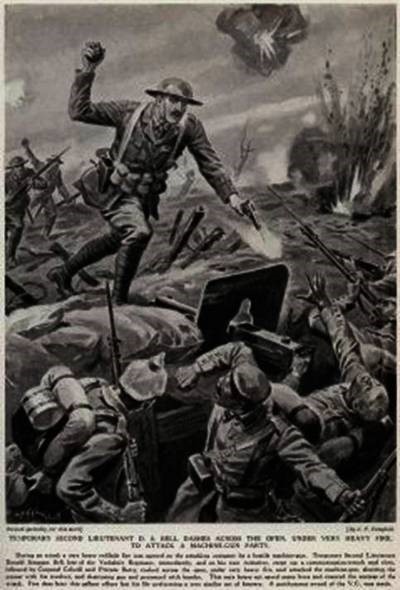
Donald Simpson Bell – the Bradford footballer awarded the Victoria Cross, tribute by Mike Stead

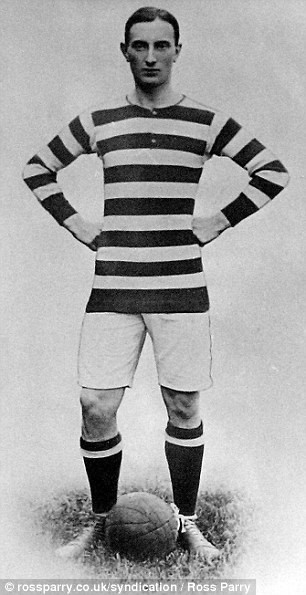
Donald Simpson Bell, born 1890; died 10 July 1916 (Age 25). Place of Death: Contalmaison, the Somme, Northern France. Bradford Park Avenue Footballer and Schoolteacher.

donald-bell-1

London Gazette Notice of Death 9th September 1916: Temp. 2nd Lt. Donald Simpson Bell, late York. R. For most conspicuous bravery. During an attack a very heavy enfilade fire was opened on the attacking company by a hostile -machine gun. 2nd Lt. Bell immediately, and on his own initiative, crept up a communication trench and then, followed by Corpl. Colwill and Pte. Batey, rushed across the open under very heavy fire and attacked the machine gun,, shooting the firer with his revolver, and ‘destroying gun and personnel with bombs. This very brave act saved many lives and -ensured the success of the attack. Five days later this gallant officer lost his life performing a very similar act of bravery.

Tribute from Lieutenant Colonel HG Holmes: “He was a great example, given at a time it was most needed, and in his honour, the spot where he lies and which is now a redoubt, has been officially named Bell’s Redoubt. He is a great loss to the Battalion and also to me personally, and I consider him one of the finest officers I’ve ever seen”.

Donald Bell was just 24 and starting out on his professional football career in 1914 when the world broke out into war. He had played five first team games at Bradford Park Avenue under the manager and great orator Tommy Maley as Bradford reached the top division (today Premier League) for the first and only time. Of 5,000 estimated professional footballers in 1914, 2,000 are estimated to have taken some part in the hostilities of war.

Donald Bell was one of two professional footballers to be awarded the Victoria Cross (Graeme Wright advises that the other was William Angus of Wishaw Thistle who had transferred to that club as a professional in 1912 from Glasgow Celtic). No higher medal can be awarded in respect of acts of supreme bravery/gallantry. So famous is this man, that the Professional Fooballers Association paid over £252,000 to purchase his medal just five years ago and this can be viewed in the Football Museum Manchester.

The Battle of The Somme is where our hero Donald lost his life and achieved in death his world wide fame. Over one million people were to lose their life at the Somme.

Donald a junior officer saw his colleague wiped out with machine gun fire and his athletic prowess was quickly put to use as he first crawled up a trench then ran across open ground at speed towards the German machine gun post.

As he approached he threw his Mills bomb into the defence killing some 50 Germans and shot with his pistol the gunners that had been killing his men. This was on the 5th July 1916.
donald-bell-2
Five days later he attempted the act again and lost his life.

He had been married just 5 weeks to Rhonda. They lived at Harrogate and Donald was also a schoolteacher at the Starbeck School near Knaresborough. Donald’s regiment was the 9th Battalion Yorkshire Regiment better known as The Green Howards.

After his heroic act he quickly and very modestly wrote home to mum from the Western Front. He wrote to his mother two days later: ‘I must confess it was the biggest fluke alive and I did nothing. I only chucked one bomb but it did the trick… my athletics came in handy this trip.’


Donald Bell’s VC medal can be seen at the National Football Museum in Manchester, near Victoria  Railway Station.

He died trying to save his men. Men that he was very close to, many who never returned to their families. R.I.P. Donald Bell. A truly inspirational man who gave of his life in that others may live.

Mike Stead 2016

Recognition of Bradford’s rugby heritage

The news that the RL museum is to be based in Bradford may have come as a surprise to many people who considered places such as Huddersfield (the ‘birthplace’ of the Northern Union) and Wigan (a town with an identity defined by rugby) to have a stronger call. However it overlooks the fact that Bradford was a leading centre for the development of rugby football in nineteenth century England and that its two senior clubs, Bradford FC and Manningham FC – forerunners of Bradford (Park Avenue) and Bradford City association football clubs – were among the 22 founder members of the Northern Union in August, 1895.

Both clubs played a major role in determining the history of rugby in this country. Theirs was the story of two competing businesses who struggled to co-exist. Fundamentally they were more alike than their followers cared to admit. Their differences were defined principally by urban geography as opposed to social class. Bradford FC, based at Park Avenue – a Victorian cathedral of sport – was the high church alternative to Manningham FC, its non-conformist rival. Between them they represent case studies of how rugby became established as an entertainment industry in the Victorian era. In this regard the example of the Bradford clubs was foremost as an illustration of how a sport became commercialised.

During the nineteenth century Bradford had been one of the fastest growing urban centres in Britain and it was essentially an industrial frontier town. Sport played a massive role in helping to shape the town’s identity and civic patriotism. Both Bradford FC and Manningham FC had a big part in this and provide a unique study of how sporting culture evolved alongside urbanisation and the maturation of a town. In this sense, rugby was as much a product of industrial revolution as an industry in itself. The two Bradford clubs bore witness to a sporting revolution and the transformation of a game based on the supply of enthusiasts to one based on the demand (or otherwise) of spectators.

The Bradford club could trace its origins in 1863 although did not play a competitive game with another club until the winter of 1866/67. To that extent the city of Bradford can boast a sequence of 150 years of competitive rugby. However it was not until around 1872 when things became fairly serious and fixtures were a matter of civic pride against other emergent clubs in Yorkshire. By the mid-1870s Bradford FC under the captaincy of Harry Garnett had established a reputation as one of the leading clubs in the county. Consistent with its new found status, Bradford FC actively promoted the formation of the Yorkshire Challenge Cup competition in 1876 which proved to be a catalyst for the formation of clubs elsewhere in Yorkshire. Bradford FC was also a prominent member of the Yorkshire County Football Club from 1874, the organisation which managed the affairs of rugby in Yorkshire, later reconstituted as the Yorkshire Rugby Union. As the oldest club in the county, Bradford FC saw itself as an aristocrat of the game and was boastful of its role acting to encourage its spread.

In my opinion, it was a matter of accident that rugby – as opposed to soccer – came to be played in Bradford. The example of the town’s senior club undoubtedly encouraged the choice of code and once established, the option of soccer was limited by virtue of the fact that there were insufficient playing areas to accommodate both games. In fact, such was the demand for rugby – known in West Yorkshire simply as ‘football’ – that soccer was crowded out.

It was the opening of Park Avenue in 1880 as home to the newly formed Bradford Cricket, Athletic & Football Club that had a further impact on the growth of rugby through commercialising the game. The new ground and development of facilities made it possible for unprecedented crowds to attend. Park Avenue provided Bradford FC with economic advantage and within ten years the club was considered the wealthiest in England, even subject to tax investigation in 1893. By winning the Yorkshire Challenge Cup in 1884, Bradford FC made rugby fashionable in the district and it was this achievement that led to the formation of junior clubs in every surrounding village and the popularity of the local Charity Cup competition.

Manningham FC had emerged in 1880, in circumstances indirectly related to the opening of Park Avenue and the changes that this created to the composition of other local sides. By 1885 Manningham FC had reached the final of the Yorkshire Cup and established itself as a rival of Bradford FC. That rivalry would become increasingly bitter, akin to a blood feud and this defined the future relationship of the two successor football clubs.

There were numerous incidents that antagonised relations between the two but fundamentally the rivalry was that of business competitors. With relocation to Valley Parade in 1886, Manningham FC became established as a genuine economic threat to Bradford FC which resented the loss of its monopoly. It was not without substance that Manningham members perceived attempts by the Park Avenue organisation to extinguish their own club. Neither missed the opportunity to undermine its rival when the opportunity presented itself and collectively their conduct made a mockery of notions of Victorian sportsmanship.

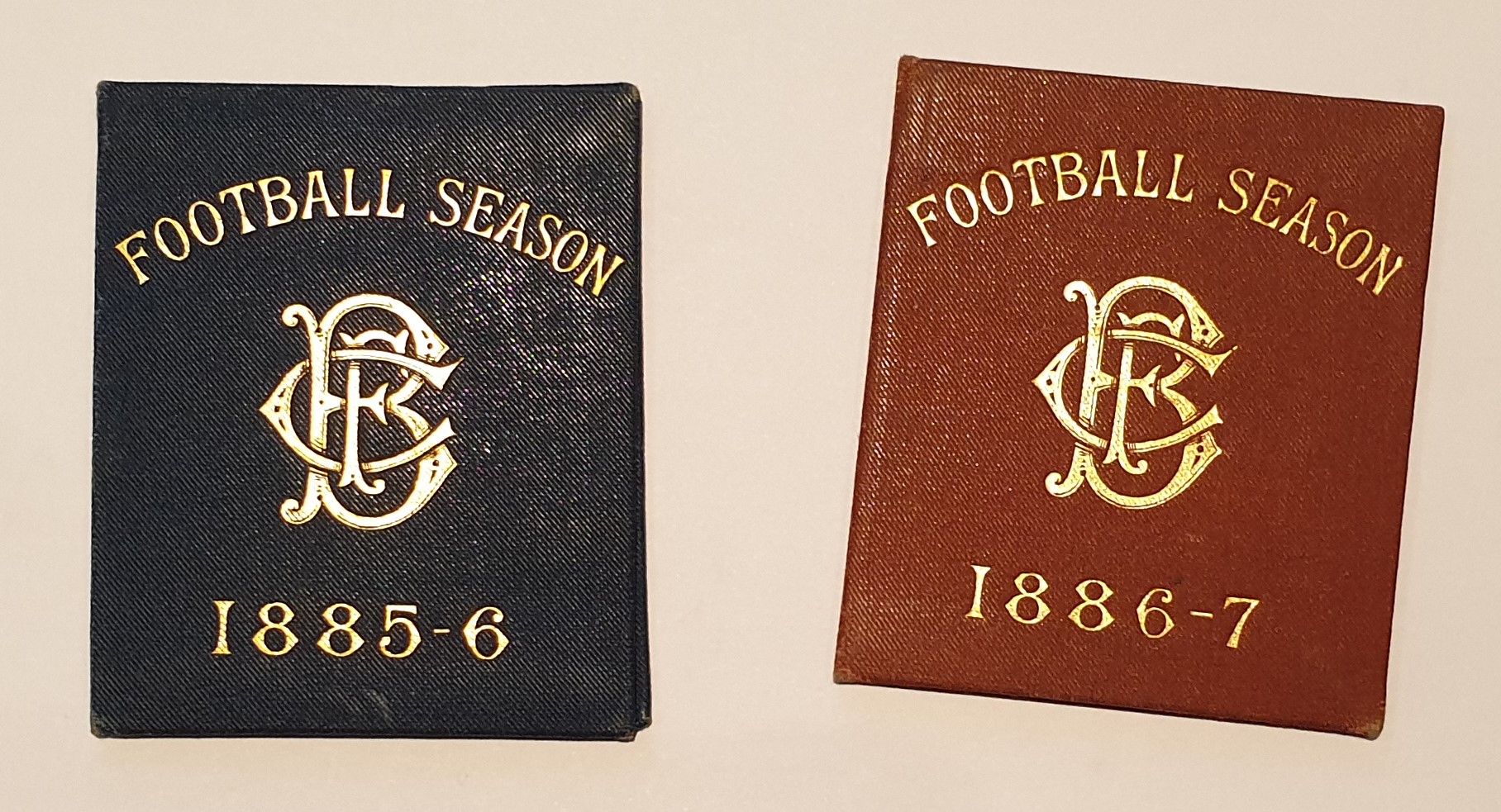
Bfd FC monogram crest - member season passes.jpg

Of the two, Bradford FC remained the senior and during the ten years prior to 1895 consistently provided at least two members in the England XV. In fact, of all the northern clubs it was Bradford FC that contributed the most internationals during this period. Yorkshire was by far the strongest county when it came to rugby and outsiders viewed Bradford FC as the biggest club in the Broad Acres. Indeed, Bradford FC came to be regarded as one of the leading clubs in Britain alongside Newport, Blackheath and Edinburgh Academicals and could command the most prestigious fixtures of all.

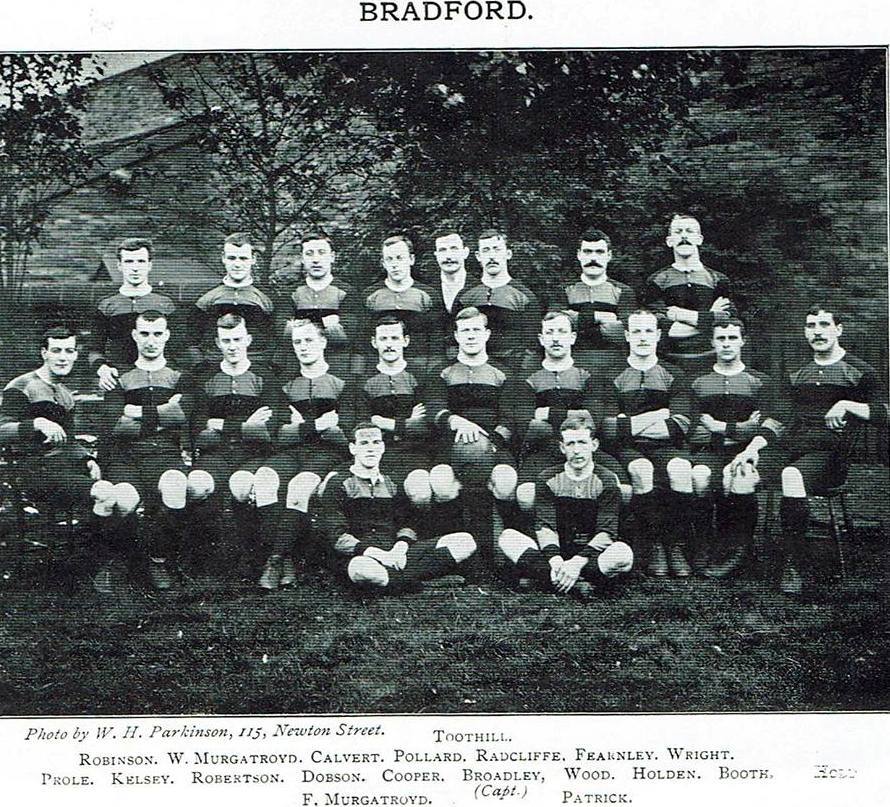
BFC 1901 (2018_07_29 21_34_58 UTC)

In 1895 the two Bradford clubs became founder members of the Northern Union. The commitment of Bradford FC was not confirmed until the final moment and when rugby was later abandoned at Park Avenue in 1907 the club was unfairly described as having always been lukewarm towards the breakaway competition. In 1909 this led to remaining members in the Northern Union seeking to withdraw ‘founder status’ from the phoenix Bradford Northern club at Birch Lane. Bitterness also surrounded the defection of Manningham FC in 1903 and the formation of Bradford City AFC in the same year; the fact that Manningham FC had been winners of the inaugural Northern Union championship tended to be overlooked. In both cases, soccer was adopted at Valley Parade and Park Avenue because rugby was no longer a game that would pay.

After the end of World War One rugby enjoyed a revival in Bradford but it was the amateur Rugby Union club, Bradford RFC rather than Bradford Northern – so called to highlight the fact that it was a member of the Northern Union – who stole the headlines. In fact Bradford Northern struggled for most of its first twenty-five years to remain solvent. The club’s fortunes were transformed by the opening of the Odsal Stadium in 1934, the potential of which captured the imagination of the Rugby League community as a northern alternative to Wembley. That potential was demonstrated in 1954 by a record, reported 102,000 crowd at Odsal for the Challenge Cup Final replay. The prestige offered by playing the annual Challenge Cup Final at Wembley meant that the London venue was retained and this, as well as jealousies within the Rugby League ultimately robbed Odsal of its opportunity to stage massive crowds on a more regular basis.

Bradford Northern struggled with the financial commitment to maintain the stadium, let alone to develop it extensively. The affairs of Bradford Northern became closely interlinked with the economics of Odsal. After establishing itself as a leading club in the Rugby League just after World War Two, by the second half of the 1950’s Bradford Northern was struggling and by 1964 succumbed to insolvency and disappeared from fixture lists for a year.

The record of Bradford Northern during the 1970s and 1980s was pretty undistinguished but the club was revitalised by the Super League in 1996 and reincarnated as Bradford Bulls. At last it seemed that the Odsal side could benefit from the size of the city that it represented. In 1996 the Bulls were inaugural champions of the Super League and in 2002 crowned as World Club Champions. For reasons best explained by others the last five years have been a period of financial difficulty and the Bulls have suffered the wrong type of headlines. Yet the fact that the Bradford side no longer dominates the Rugby League does not detract from the fact that it symbolises the ongoing struggle of professional rugby to compete with the soccer juggernaut. The very financial failings of Bradford FC / Bradford Northern / Bulls are testament to the competitive environment in which Rugby League has had to co-exist with soccer. As an added twist to the story, Bradford FC was among other West Yorkshire clubs who briefly promoted soccer alongside rugby as a form of commercial insurance in the latter half of the 1890s.

The history of Bradford rugby has demonstrated all the extremes that sport can offer – from success to disappointment, from profit to loss. Yet it was not just the story of two senior clubs because Bradford was home to a good number of junior clubs. Notable is that virtually all of them had disappeared within five years of the launch of the Northern Union; interestingly, none of them had been enthusiastic about the breakaway competition in 1895. A closer look at the experience of those smaller clubs offers fresh perspectives about the Northern Union and a challenge to some of the myths that have surrounded its early years.

The sporting reputation of Bradford has been coloured by the record of its clubs in the twentieth century for whom underperformance and financial failure was the norm – not to mention the Valley Parade disaster in 1985 which was itself a product of financial failings. The historic heritage of Bradford as a pioneering sports town has sadly been overlooked but I welcome the opening of the National Rugby League museum in 2020 as a form of recognition for the part that Bradford played in the sporting revolution of the nineteenth century. Although I write as a soccer enthusiast, the common football heritage of rugby and soccer in the city should not be ignored and in particular the events of the decades that preceded the formation of the Northern Union in 1895. Above all, the history of Bradford FC and Manningham FC explains exactly why the Northern Union was formed in the first place and its uneasy co-existence with soccer from the very beginning.

John Dewhirst

John is the author of ROOM AT THE TOP and LIFE AT THE TOP which tell the story of the origins of football in Bradford, the development of Park Avenue and Valley Parade and the later conversion from rugby to soccer.

Details of the books in the Bantamspast History Revisited series

His blog: Wool City Rivals

POSTSCRIPT: Feature on World Rugby Museum website

Other online articles about Bradford sport by the same author

The drop down menu above provides links to other content about the history of rugby in Bradford.

***Sadly the plans to bring the museum to Bradford came to nothing, a result of funding constraints.

——————————————————

Bradford football: Taking the Long View

A reputation of failure?

One can be forgiven the observation that the modern history of Bradford football – by which I mean rugby and soccer – has been dominated by financial failure and disaster. In the last hundred years there has been a financial scare involving at least one of the three professional clubs – City, Avenue or Northern – in each decade. It is a truly astonishing record; quite literally there have been more crisis appeals and fund-raising initiatives than league or cup triumphs. And only in the last few weeks have we heard news about winding-up petitions leading to speculation about the solvency and future of Bradford Bulls RLFC.

Since the start of this century there have been crises at both Valley Parade and Odsal. Indeed, neither Bradford City nor Bradford Bulls are strangers to administration procedures. In the space of twenty years, the city’s three senior clubs all succumbed to insolvency. In 1964, the former Bradford Northern club was dissolved and went out of existence for twelve months. Ten years after that came the liquidation of Bradford (Park Avenue) AFC and the following decade saw the collapse of Bradford City in 1983.

Yet if Bradford has the unwanted reputation as the city in which professional sport has been more prone to failure, consider the fact that in the forty years preceding World War One it was considered a centre of sporting excellence and a pioneering sports town in West Yorkshire. Its cricket club – formed in 1836 – had a reputation for ‘pluck’ and was among the leading sides in Yorkshire. Bradford FC was the oldest rugby club in the county with its origins dating to 1863 and at the beginning of the 1890s was regarded as one of the leading sides in the country, consistently boasting at least a couple of players in the England XV. Its two clubs – Bradford FC and Manningham FC – were founder members of the Northern Union breakaway in 1895 and the Paraders were inaugural champions in 1896. With the abandonment of rugby by Manningham FC in 1903, Bradford City was the first soccer club in West Yorkshire, promoted to Division One five years later and winning the FA Cup three years after that.

It was not just footballing activity that enhanced Bradford’s reputation. Bradfordians were known for their capability and enthusiasm in other sports that ranged from cricket to cycling, gymnastics and for that matter, chess. All told the city became known for the sheer vibrancy of activity, exemplified by the popularity of grass roots soccer under the umbrella of the Bradford & District FA at the beginning of the twentieth century. The success of the Bradford Cricket League after 1903 is another example of the enthusiasm for sport in the area measured by levels of participation as well as spectator attendance at local games.

Bradford was also known for the fact that its clubs were recognised for pioneering the commercialisation of sport. The original Bradford Cricket Club had been the first in this direction during the 1850s and 1860s but it was the opening of Park Avenue for cricket and football in 1880 that took it to a new level. By 1890 Bradford FC was reputedly the richest sports club in England, the subject of tax investigations in 1893.

Why did it go wrong?

The success of Bradford sport prior to World War One is in contrast to the general malaise of the city’s professional clubs that existed during the next 75 years. Ironically the one club which enjoyed sustained success during this period was the – amateur – Rugby Union side, Bradford RFC between 1919 and the mid-1930s.

The explanation for the barren decades of the twentieth century was not because the people of Bradford were uninterested in sport. Far from it. Failure came principally because sporting efforts and resources in the district were fragmented between four competing clubs – Bradford City and Bradford Park Avenue in the Football League and then Bradford Northern RLFC and Bradford RFC participating in the two rugby codes. Little wonder that the city struggled to support them all. Notwithstanding that financial collapse of City, Avenue and Northern arose in the first instance from the failure of financial management in those clubs, the odds for success were ultimately stacked against them.

The emergence of Manningham FC had led people to ask in the early 1880s whether Bradford could support two clubs and it was the success of Manningham in cup competition that persuaded people that there was room for more than Bradford FC. Indeed, it was this confidence that led to the commitment to develop Valley Parade in 1886. Twenty years later people were no longer convinced and in 1907, an argument for the merger of Bradford City with Bradford FC – and with it, relocation to Park Avenue – was based on the fact that Bradford could not support two senior football clubs.

A taste of the future had been provided in 1896 when even the Bradford club was forced to appeal for funds from the public to avert a financial crisis. The commitment to purchase and develop Park Avenue proved onerous and the financial challenge was all the greater because of the competition from Manningham FC for floating spectators in the city. The rivalry of the two clubs was intense, akin to that of a blood feud but the relationship between them is better understood as that of business rivals. The economic reality is that whilst they each had a hardcore of partisan followers they appealed to the wider Bradford public who picked and chose respective fixtures to attend at either Valley Parade or Park Avenue.

The so-called ‘Great Betrayal‘ in 1907 and the abandonment of rugby at Park Avenue defined the future of sport in Bradford. That year brought the formation of a second soccer club – Bradford Park Avenue and the formation of a new northern union side – Bradford Northern. Those who favoured the amateur rugby code decamped to the likes of Bradford Wanderers RUFC (then based at Red Beck Fields, Shipley) or Horton RUFC (at Lidget Green). The sports-loving public was indulged with a choice of options and the different clubs were left to compete for their pennies.

The last hundred years

In the immediate aftermath of World War One, both Bradford City and Bradford Park Avenue were handicapped by the lack of financial resources to sustain success. The death of Harry Briggs in 1920 removed the Park Avenue benefactor and from being rivals in Division One in 1920/21 the two Bradford clubs were both relegated to Division Three (North). It was relatively unheard of, not just that former members of Division One could collapse this way, but that they failed to bounce back immediately. Timing was crucial. The beneficiaries of the demise of City and Avenue were the likes of Bradford RFC, Huddersfield Town and Leeds who stole their custom. Bradford Northern meanwhile continued on a hand-to-mouth existence through the inter-war period, albeit given a fresh momentum by relocating to Odsal in 1934.

Having won promotion back to Division Two, City and Avenue hit a glass ceiling. It left supporters and directors alike frustrated. Attendances were subject to a gradual decline and both became known as selling-clubs. It defined once and for all the relationship between the Bradford public and its soccer clubs, characterised by cynicism and negativity. Crucially Bradford lost the opportunity for one of its clubs to establish itself as a higher division side, similar to the likes of Wolverhampton, Coventry or even Blackburn and Huddersfield. Seen from this perspective, the story of the last thirty years has been about trying to catch-up for those lost decades.

Once again wartime restrictions impacted adversely on the finances of both City and Avenue. The Paraders had been relegated back to Division Three (North) in 1937 and Avenue followed in 1950. In the immediate post-war period they suffered equally from the popularity of speedway at Odsal and the success of Bradford Northern who appeared in three successive Wembley cup finals between 1947-49. By this stage, the Rugby League variant had become the dominant rugby code in Bradford and thereafter, Bradford RFC rarely attracted large crowds to Scholemoor.

As a winter sport, Rugby League was in direct competition with soccer for the same floating supporters. Had Bradford Northern not fallen into decline in the second half of the 1950s – culminating in the liquidation of the club in 1963 – there seems little doubt that soccer would have been delivered a fatal blow. City and Avenue were by this time in a life or death struggle between them as to who would survive. At the beginning of the 1960s it looked as though City would succumb but in the end, after being forced to sell star striker Kevin Hector, it was Avenue who failed to get re-election to the Football League in 1970 and then disappeared altogether in 1974 after a prolonged decline.

Bradford Northern’s own history prior to the appointment of Peter Fox as manager in 1977 was hardly distinguished but the club returned to prominence by winning the Rugby League championship in successive seasons, 1979/80 and 1980/81. Ultimately it was the Super League that revitalised the club and raised public interest after 1995. Across the city, it took a decade and a new generation of soccer supporters to get behind Bradford City who now had the monopoly as the sole surviving Football League side. It was not an easy struggle to overcome the negativity and lack of self-belief of the Bradford public, many of whom had established allegiances with sides based elsewhere. In tragic circumstances, in 1985 Bradford City returned to the second division for the first time in 48 years.

When Bradford City found themselves in the Premier League in 1999, at the same time that the renamed Bradford Bulls were dominating the Super League, it seemed that history had been rewritten. Prior to then, one club – or one code of football – had achieved success only at the expense of another. But of course the glory days didn’t last and both City and the Bulls fell to earth with the hangover of debts to be repaid.

Is it more than a coincidence that the demise of the Bulls in the last five years or so has coincided with the resurgence and reinvention of Bradford City? The main tactic adopted to attract crowds to Valley Parade has been the same as that which had been used previously at Odsal – that is, cheap affordable season tickets and the attraction of a lively, family atmosphere. The Bulls, it seems, have been out-bulled by the Bantams and it represents a particular problem for that club in its current situation given it can hardly afford to heavily discount its prices.

Back in 1905, the leadership at Park Avenue concluded that the Northern Union rugby game could not compete with soccer. It was consistent with what other pundits were saying elsewhere in Yorkshire and Lancashire, leading to radical changes such as outright professionalism and thirteen aside teams to rekindle public interest in the face of the assault from the rival game. Indeed, the introduction of the Super League in 1996 and with it, summer rugby was similarly a response to compete with soccer. In Bradford, for a time it appeared to have succeeded but who would bet on second division Rugby League being an attractive option for the local public as the Bulls face up to a third season outside the upper tier?

Is there now any way back for Bradford Bulls to regain the ascendancy in the city, other than through the collapse of the Bantams at Valley Parade? Leicester, Wigan and Bristol are examples of places where first class rugby has co-existed alongside soccer at a high level. The case of Leicester could be cited as particularly inspirational but what characterises these three examples is that in each case there is the financial backing of a multi-millionaire. A more pertinent comparison is closer to home – in Leeds the Rhinos have undoubtedly succeeded whilst the team from Beeston has been in the doldrums.

Realistically, the only way for both Bradford clubs to simultaneously enjoy success is for them to enjoy the largesse of one or more benefactors. It is generally accepted that for Bradford City to sustain itself in the Championship the increase in wage costs will need to be bankrolled. The same could surely be said of Bradford Bulls.

Sadly the Bradford of today is not one in which millionaires are commonplace. For that matter, even in the decades preceding World War One there was only ever one man – Harry Briggs – willing to invest unconditionally in Bradford sport. The historic attitude was that football had to stand on its own feet.

The record of Bradford football in the twentieth century was insufficient to attract new investors. In fact, it was considered so toxic that it positively dissuaded wealthy men from getting involved by either guaranteeing bank borrowings or underwriting losses. Despite things having changed considerably for the better at Valley Parade it is notable that when ownership of Bradford City was eventually transferred this year, the buyer was ‘not from these parts’. There still seems an aversion among Bradford businessmen to invest.

The ground question

A seeming constant theme in the history of Bradford football has been the ground question and speculation about the relocation of City, Avenue and Northern. At some stage each club has been linked with each of the two other stadia in Bradford although actual periods of relocation have been fleeting. Northern staged occasional high profile games at Valley Parade prior to the opening of Odsal and the Bulls played there in 2001 whilst Odsal was ‘redeveloped’. Avenue spent a solitary, final season at Valley Parade in 1973/74 and of course City played at Odsal between 1985-86 whilst Valley Parade was being rebuilt.

Like a pendulum, the ground question swings back and forth. After the speculation about City moving to Odsal, the difficulties of the Bulls have prompted the suggestion that they will move to Valley Parade. Yet despite the commercial logic of ground-sharing it has never been a permanent arrangement and talk of it is invariably denounced by partisan supporters. Will it continue to be thus if no-one is prepared to underwrite the Bulls? For all the much-vaunted potential and history of Odsal Stadium can the ground really be afforded?

What of the future for Bradford rugby?

Ground-sharing is an obvious financial solution to safeguard senior rugby in Bradford and maintain a tradition that goes back to the 1866/67 season when a Bradford club first played a competitive fixture with representatives of another town (Leeds). Arguably a 150 year tradition is at stake if the rumours of financial difficulty at Odsal Stadium are correct. My own solution is slightly more radical than simply ground-sharing. I would favour the option of creating a ‘Bradford Sporting Club‘, an umbrella organisation embracing not only professional football (rugby and soccer) but amateur sides also.

The original Bradford Cricket, Athletic & Football Club established in 1880 provided the precedent and its success during the 1880s was seen as an expression of Bradford patriotism in what was then an industrial frontier town. It was an organisation that originally existed to promote sport and athleticism in Bradford and forge a civic sporting identity. The modern day variant would similarly promote a single Bradford identity or brand that was shared by every participating sports club in the district. At one extreme this might involve shared financial stakes in Bradford Bulls and Bradford City. At the other extreme a loose confederation of clubs. Arrangements might exist for the professionals to actively encourage amateur sides through coaching support and use of training facilities. It would represent active community involvement. The idea is that every Bradford club – if not, a select group of representative clubs – would then promote a common, shared identity or brand that sat alongside club identities. This would manifest itself with a shared crest or logo on shirts irrespective whether the team competed professionally or in a local Sunday league. If we accept that Bradford’s problem is not one of image, as opposed to identity, sport could be galvanised to promote unity and a degree of social cohesion.

John Dewhirst

John is the author of Room at the Top and Life at the Top which tell the story of the origins of football in Bradford and the rivalry of Manningham FC and Bradford FC. Further details can be found at www.johndewhirst.wordpress.com


Other online articles about Bradford sport by the same author

John contributes to the Bradford City match day programme and his features are also published on his blog Wool City Rivals  

=======================================================================

Details about the BANTAMSPAST HISTORY REVISITED BOOKS

=======================================================================


Never Forget – 1916

As I think of the words to construct this article, my mind drifts back one hundred years to the Battle of the Somme. For it was on this day, 01 July 1916, that one of the most famous battles during World War One commenced. It is reported that nearly 20,000 soldiers, mainly from Britain and Ireland along with India and South Africa lost their lives on the first day of this bloody battle. By the time the Battle of the Somme, which took place in northern France, had ended five months later, over one million soldiers from both sides of the war had either lost their lives or been injured. I find it hard to imagine what the conditions must have been like for the soldiers in the trenches.

During the BBC1 news programme which aired at 10pm on 29 June 2016, there was a news feature focussing on the Battle of the Somme. Within this piece, the news reporter highlighted that Evelyn Lintott was one of those who tragically lost their life on the first day of the Battle of the Somme. The news item correctly stated that Evelyn played football for Queens Park Rangers and England, but unfortunately they didn’t mention that Evelyn also played for Bradford City.

Why am I referring to World War One and a former Bradford City player? Well, please let me continue my story. In early 2015, Andrew Ashcroft and Stephen Onions who are also Bradford City supporters, along with me decided that we would try to obtain some tickets for the Euro 2016 tournament. Indeed, Andrew and I had been to Switzerland and Austria in 2008 to attend a couple of matches during the Euro 2008 event. Thanks to the efforts of Andrew, we obtained tickets via the official UEFA website, for a game in Paris which would take place on 13 June 2016. At this point in time, the draw had not been made for Euro 2016 so we didn’t know who we were going to see play. However, in early December 2015 the draw was made and we knew then that we were going to see the Republic of Ireland play Sweden. Ironically, Andrew and I had seen Sweden lose to eventual winners Spain, back in 2008.

As time moved on, Andrew was keen to obtain tickets for another game as he had originally applied for tickets for three games. In 2016, further tickets were released by UEFA and we were fortunate enough to purchase tickets for the Germany verses Ukraine game which would be played in Lille on Sunday 12 June 2016. During the planning stages for our trip, we decided that we would visit Dochy Farm New British Cemetery. As many well informed readers of this article will know, our goal scoring captain from the 1911 FA Cup winning team, Jimmy Speirs, is laid to rest at this cemetery near Ypres in Belgium.

The morning of Saturday 11 June 2016 arrived. Andrew came to pick Stephen and I up then off we headed to Kent. As we were booked on the 8:30am ferry from Dover to Calais on 12 June, we decided that it would be better to stay in Kent on the evening of 11 June. That evening a few pints from the Shepherd Neame brewery were consumed in the Binger’s Finger pub in Canterbury whilst watching England’s first game in Euro 2016. A last minute goal was conceded against Russia and things were only going to end one way for Roy Hodgson’s squad in this tournament!

We departed the Travelodge at 6:30am on 12 June, much to the surprise of the staff member on the desk. Little did they know that later on that day we were going to pay our respects to Jimmy Speirs and many other soldiers at Dochy Farm New British Cemetery.

The ferry crossing passed by without any problems apart from queuing for nearly one hour to get on to the ferry owing to the 700 cyclists who were also travelling on the same ferry as us. So into Calais we arrived and then we travelled across northern France and over the border into Belgium. I hadn’t appreciated how many cemeteries there are in southern Belgium where thousands of soldiers are buried. We eventually saw a road sign for Dochy Farm New British Cemetery. I don’t know what I was quite expecting at the cemetery apart from row after row of headstones. As we drove down a rural road, we came across Dochy Farm New British Cemetery on our left hand side with a stone bearing the words: THEIR NAME LIVETH FOR EVER MORE. To be honest, the cemetery was smaller than I had expected even though there are nearly 1,500 headstones there. What I remember most is how quiet and peaceful the cemetery was. The only noise that the three of us could hear was that of melancholic birdsong. Our research had involved locating the headstone for Jimmy Speirs prior to our visit so we had an idea of where Jimmy had been buried. After a few minutes of walking we found his resting place. For a while, Andrew, Stephen and I didn’t speak to one another and stopped to take in our surroundings. I don’t know what Andrew and Stephen were thinking at that moment in time but I imagined how different this landscape must have been a century ago and how less than seven years after winning the world’s greatest cup competition, Jimmy Speirs was killed serving his country. During these sombre moments, I also thought about my mum along with Andrew’s mum, who had unfortunately both passed away in the previous eight months. I can’t remember exactly how long we stayed at the cemetery for, but prior to leaving we did write a note in the visitors book. We also noticed other individuals who had made reference to Jimmy Speirs in the visitors book. Owing to time constraints we didn’t visit any of the other cemeteries in southern Belgium, however we were pleased that we’d found Dochy Farm New British Cemetery.

During World War One Jimmy Speirs achieved promotion to Sergeant with the Cameron Highlanders and was said to show great leadership qualities. Maybe he took these with him from the football pitch? He was also awarded the Military Medal for his bravery. Aged just 31 years young, Jimmy Speirs was killed in August 1917. He achieved so much in a life that ended far too soon. We should never forget or underestimate the sacrifices that many people made in World War One and as Bradford City supporters, we must never forget Jimmy Speirs.

Richard Wardell

Dochy Farm 7


Photo of Jimmy Speirs’ grave by Mark Parkinson below:

IMG_2913

Welcome to VINCIT an online journal of Bradford Sport History

Articles about Bradford sport history, written by enthusiasts.

We will feature any sport and welcome contributions.

← Back

Thank you for your response. ✨