The Pioneers: The story of Keighley AFC, 1886-89

By Rob Grillo

On October 1st 1886 the Keighley Herald newspaper reported that an association team had existed in the town the previous season, but that it had ‘winked up in a short time’. One can assume, therefore, that the side never got as far as playing any competitive fixtures. It was said that local board school teachers ‘not patronised as they ought to have been’ were behind the failed venture.

However, on October 6th of that year, a meeting at the Acorn Coffee House in Keighley led to the formation of a new club in town. Thus the first properly organised ‘Keighley AFC’ was born. The newly formed club managed to procure a field on Highfield Lane, adopting blue & white as their colours and making use of the Oddfellows Arms as their headquarters. A Mr.Loftus was appointed as secretary, and it was announced that several players already had experience at the game, having played in Lancashire, already an association hotspot at the time. Experience at which sport is debatable, as practice matches were marred by those same players unable to resist the temptation of handling the ball!

What was probably the club’s first ever competitive match was a 1-4 defeat at Meanwood (Leeds). Other defeats followed against Oulton and Meanwood (again), with only one victory reported – against their own second team. The second team did play other sides such as Murton & Varley Employees, and a number of one-off scratch sides were starting to experiment with the game too. A ‘Keighley Britannia’ team is reported to have defeated Newtown Free Wanderers to the tune of 23-1, although Newtown also played informal rugby games in and about town too.

The Keighley AFC first team defeated Earby 7-1 in February 1887, displaying improved form for the rest of the season. Whyte scored four in that game, with Town, Tempest and Drabble also on the scoresheet.

The line up against Earby was: J.Bowker (goal), J.Hodgson, T.Sexton – captain, (backs), F.Stott, A.Morris, E.Britton (half backs), JS Tempest, https://t.co/KFbUgU8mLv, JT Whyte, FA Drabble & J.Williamson (forwards).

The side rarely reported their defeats to the local press, and the next reported game was a 7-1 rout of Barrowford. Other victories over East Lancashire opposition followed, but a measure of their improvement during the season was a narrow 0-1 defeat at home to Burnley reserves in what was seen as a prestigious match for the town.

Lancashire clubs provided much of the opposition the following season. This is not surprising given the radid development of the game in that region, and the ease of access given that there was a direct rail link between Skipton and Colne at the time.

The 1887-88 season opened with a good 3-3 draw against future football league side Nelson FC, then considered one of the top ‘junior’ (in status, not age) clubs in Lancashire. Goalkeeper Bowker was reported as having a poor game against Nelson, this is the day when goalkeeping was a dangerous occupation! Meanwhile, the side had moved a short distance to a ground on West Lane, and had reportedly secured the services of Terry from Darlington and Foxall from Aston Villa.

On October 1887, Keighley travelled to Barnsley Charity Cup holders Ardsley, and went down to a single goal, although they were said to have objected to the fact that the ball was the wrong shape (‘elliptical’). A return fixture with Burnley fell foul of the weather before a match at York City before the end of October where Foxall is known to have broken his arm (result unknown).

The club’s second team also played regular fixtures against East Lancashire opponents as the club gradually raised its status and attendances increased. A fixture at Nelson late in October was cancelled when Keighley could not raise a team, but all worries were dispelled the following month when Leeds AFC travelled to West Lane and was roundly defeated to the tune of 5-0. The game had not really taken off in Leeds yet, and this particular Leeds AFC did not last long.

Travelling was obviously becoming a problem, only nine men made the journey to Staincross, near Barnsley late in November (0-1), and then one week later Leeds Clergy brought the same number to Keighley and went home without their prayers unanswered, defeated 3-1. The following week Keighley arrived late at Robin Hood Swifts (Colne) and as a result the game was shortened. Further games included a win and defeat against Earby (Whyte scored a hat-trick in the 4-1 win), a victory at Kirkstall against a poor Leeds AFC team, and a draw against Ardsley. Burnley reserves defeated Keighley 2-0 at home. Other games again went unreported.

Keighley AFC briefly found itself without a field to play on at the start of the 1888-89 season. Reports suggested that attendances were now on the wane as rugby continued as the ‘boom’ sport in town, and that many potential supporters avoided paying the entrance fee to the West Lane ground – once they had finally managed to secure the field again – by standing on a patch of land on Devonshire Street, which obviously overlooked the ground. A home game was played on the Keighley Parish Church rugby ground, which resulted in a single goal reverse to Morecambe. Morecambe to Keighley was a not inconsiderable distance to travel for a friendly fixture, so it must have been a happy journey home for the Lancastrians.

After a 1-4 reverse at Colne, Keighley returned to winning ways and defeated a newly formed Bradford AFC at Thornbury by 2 goals to nil, enjoying 5-1 victories over Burnley Druids and Burnley Rovers before Christmas, and Leeds Albion later in the season. Again, despite fixtures being played most week, many games were not reported to the local press, although one defeat that did make the pages of local newspapers was a 0-8 defeat at the Blue House ground of Sunderland Albion. Albion was a break-away club from the professional Sunderland FC and in due course went on to become one of the strongest non-league teams in the North East. That the Keighley players were prepared to travel that far, and indeed claim a fixture against such a strong club, is a reflection of the strength of the locals, who must surely have made a weekend of their journey northwards. It was claimed in the press at this time that Keighley AFC was equal to any other in Yorkshire, although this claim is probably not too far from the truth as the ‘association’ game had yet to take off in the county, lagging well behind the progress made in Lancashire and the North East.

One week after the Sunderland game, an improved Bradford AFC left West Lane with a 1-0 defeat, Whyte scoring possibly the last ever goal for the Keighley club.

On April 13th 1889 a West Riding County team took on their East Riding counterparts at the Recreation ground, Scarborough in front of 2000 spectators. The West Riding team consisted of players from just three clubs – Leeds, Leeds Albion and Keighley. In fact, no less than five of the team that won 3-2 played for Keighley: Hodgson, Sexton, Driver (who scored the opening goal), Drabble and Whyte.

Keighley’s claims to be the best in the county can therefore be borne out to be true. That the club suddenly disappeared is therefore disappointing, but perhaps not surprising given that attendances were often meagre compared to the four figure crowds expected at important local rugby games. The public had yet to catch on fully, and the first Keighley AFC died a quiet death in the summer of 1889, ironically just as organised league football was taking off. One wonders what would have happened if the club had thrived, the history of soccer in Keighley and district could have been very, very different.

It was another seven years before another attempt to form a soccer team in the town, and it was not until the early 1900s that Keighley’s public were prepared to accept the sport in anything like the numbers that were sufficient to sustain momentum. By then, the town had missed the boat.

Rob Grillo continues the story of Keighley soccer also on VINCIT

=======================================

You will find articles about a broad range of sports on VINCIT with new features published monthly. We welcome contributions about the sporting history of Bradford and are happy to feature any sport or club provided it has a local heritage.

A planned future article on VINCIT will feature the story of Bradford soccer in the 1880s and 1890s.

Forgotten and forlorn: The Belle Vue Hotel

It is nearly 25 years since the Belle Vue Hotel opposite Valley Parade was a part of the pre-match routine of supporters. By the time it closed as a pub in 1994 it had long since fallen out of fashion. Certainly it would not have appealed to a family audience having resorted to female strippers and a topless DJ in the 1970s as a means of attracting custom. Neither was its reputation enhanced by the proximity of the red light area of Lumb Lane and Peter Sutcliffe, the Yorkshire Ripper is understood to have been a regular drinker in the pub.
Despite its disrepute of the modern era and the numerous urban legends about what went on behind its doors, the Belle Vue Hotel deserves recognition for having played a big part in the history of Manningham FC and the early existence of Bradford City AFC. This is where club dinners were held and where Manningham FC members celebrated the achievements of their team. In 1903 it is where club officials discussed the conversion to soccer. It is also remembered for the fact that on 11 May, 1985 it was a gathering point for survivors and relatives in the aftermath of the Valley Parade fire.
The building was listed in 1983, described by the www.britishlistedbuildings.co.uk website as ‘Circa 1870-80 public house of slightly French Chateau design, possibly by Milnes & France in view of corner treatment comparable with Bavaria Place Police Station. Two storeys, fine quality sandstone ashlar with mansard slate attic. The south corner forms a circular tower carried up into the mansard attic with a conical slate roof. A first floor balustered balcony is carried round the tower and over porch with florid Composite columns. Canted bay to north end of ground floor. Dormers in attic.’ (NB According to the Leeds Times of 27 May, 1876, the architects were Andrews & Pepper.)
(Floor plans for the hotel from 1875 are featured in a blog by Bradford Museums & Libraries from this link.)
Another claim to fame of the building is that it features a cut mark for mapping purposes and this can be seen on the second course of stone blocks to the right of the cellar beer chute on Drill Parade. The modern day garage on the opposite side of Drill Parade was probably the stabling block for the hotel. As the advert below from 1911 shows, this was converted to a garage before World War One.
It was boasted that the bay windows of the hotel afforded an unprecedented view along Manningham Lane down to North Parade and hence the opportunity to watch the comings and goings along Bradford’s northward boulevard. The building was constructed over a quarry that gave it deep cellars. However this proved problematic in 1882 when there was a serious issue with subsidence of the foundations at the rear of the building; this forced the licensing authorities to withdraw a music licence on account of it being unsafe.
The Belle Vue Hotel took its name from the nearby terrace (that dates from around 1840) which was said to enjoy an excellent panorama of Bradford and surrounding countryside from its raised elevation. On the site of neighbouring school was once the Belle Vue cricket pitch. In 1855 there is mention in the local press of an earlier Belle Vue Hotel on Manningham Lane although investigation of maps does not suggest that it was in the same location.

Whilst few supporters would have remembered the Belle Vue as a respectable venue, when it was opened in May, 1876 it was considered one of Bradford’s premier hotels and restaurants, advertising itself as a venue catering for commercial and family guests. In its prime as a Victorian establishment, the Belle Vue Hotel would probably have been better described as a public house that had large function rooms and dining provision with overnight accommodation being a secondary offer. Indeed, in 1880 the proprietor, Robert Breuer was on record that the bedrooms were rarely fully booked. Furthermore, the second floor attic rooms on the south side of the building appear never to have been plastered, suggesting only occasional use in their time.

The architecture of the building in the style of a French chateau and the carving of grapes on the vine over the front entrance offers clues about the original commercial strategy for the venture. Indeed, early adverts boasted about the choice of wines available and it seems a fair bet that it had similar culinary standards supported by its large basement kitchen. On the first floor of the building were two large function rooms that would have allowed for the likes of private dining parties, smoking concerts, business meetings and/or club committee meetings. On the ground floor was a billiard room.
The Belle Vue Hotel hosted an extensive range of gatherings. Other than social events it hosted commercial auctions, formal meetings of creditors and also political assemblies. On match days at Valley Parade the same function rooms were probably used by journalists and match day officials.
The Belle Vue Hotel was also well situated to meet the social needs of the officers of the Rifle Volunteers at the nearby barracks. (Background about the Bradford Rifles from this link) For others it may have served as a private gentlemens club and by virtue of being within walking distance of Manningham’s middle class villas, it was well situated to attract wealthier customers.
For those requiring accommodation, it was claimed that there were twenty bedrooms across the second floor and in the rear of the building. Those at the front overlook Valley Parade and would have provided vantage of the pitch. Press reports confirm that the hotel was utilised by touring sides playing at Valley Parade.
In January, 1882 the proprietor Robert Breuer was declared bankrupt. This resulted from the foreclosure by a building society of a mortgage on the Prince’s Theatre on Morley Street, Bradford in respect of which Breuer was a part-guarantor. His problems had been compounded by the subsidence issue mentioned above that required rectification. Hence it is possible that looming financial difficulties encouraged him to be more entrepreneurial, something which was probably continued by his successors who embraced Manningham FC.
A good example of such initiative and opportunism was the advertising of balcony rooms overlooking Manningham Lane for those seeking a view of the Royal visit parade in June, 1882. However it likely meant that the Belle Vue Hotel never attained the social exclusivity that its original owner had presumably aspired to. For example the dram shop which operated in 1882 adjacent to the side door of the building and the tap room was a distinctly down-market venture. In February, 1894 neither would perceptions of the Belle Vue have been enhanced by a drunk being found in possession of a firearm on the premises. Nevertheless, JB Priestley is understood to have named the Belle Vue as one of his favourite pubs in Bradford.
Even before the opening of Valley Parade in 1886, the Belle Vue Hotel was popular with Bradford sportsmen – not only rugby players but athletes, harriers (runners), cyclists, cricketers and rowers – and it was used by a good number of clubs for meetings and dinners. The Belle Vue also came to be adopted in 1894 by the Bradford & District Junior Football League for its meetings and later the Bradford & District FA. Its proximity with the adjacent barracks reinforced its links with local sportsmen given that many of them were also involved with the Rifle Volunteers based at the drill hall. The status of the Belle Vue in the Bradford sporting community was further illustrated by it being the destination of the popular cyclists’ lantern parade from the Branch Hotel, Shipley in October, 1889.
The hotel’s proximity to the new football ground ensured that links with Manningham FC would be strengthened. Newspaper reports infer that Manningham FC kept club records and paperwork at the hotel from which we can assume that there was a room dedicated for use as an office. I believe that this was probably on the ground floor near the side entrance which would have been convenient on match days. Tickets for games at Valley Parade were also sold at the Belle Vue.

Advert from BCAFC Handbook, 1911
In his history of Bradford City published in 1927 William Sawyer referred to the (Manningham FC) players changing in the outbuildings at the rear of the Belle Vue Hotel. Quite likely these would have been in what is now the car park, bordering the barracks. Thus for Manningham FC and later Bradford City AFC, the Belle Vue Hotel would have served extremely well as a headquarters and it was a venue distinct from most other town pubs. In terms of the pecking order that existed among Bradford hotels it was a credible, if not functional alternative to the more prestigious Talbot Hotel on Kirkgate or the Alexander Hotel, Morley Street which were favoured by Bradford FC.
It was a convenient arrangement for Manningham FC to take advantage of the facilities provided by the Belle Vue Hotel that allowed the club to avoid the expense of developing its own meeting areas and offices at Valley Parade. Prior to relocation Manningham FC had used the Carlisle Hotel on Carlisle Road as its headquarters and dressing facilities. In 1886, changing rooms (which were said to have included baths and lavatories) had been incorporated under the grandstand at Valley Parade but these were likely to have been fairly basic and of questionable adequacy.
Manningham FC had previously had an arrangement with the Thorncliffe Hotel at 148 Manningham Lane and in December, 1884, the club opened its own rooms there. The Thorncliffe Hotel was a fairly large establishment with 14 bedrooms, a large billiard room, sitting rooms, stabling for 24 horses and carriage accommodation for 12 vehicles. In April, 1882 however its owner had been refused (for a second time) a licence to sell alcohol. The refusal was on account of the proximity of the Belle Vue, 210 yards away on the opposite side of the road. Other local pubs included The Spotted House, 880 yards distant and The Standard which was 814 yards away in the direction of town.
By modern standards Bradford already had a considerable number of pubs and hotels and in March, 1899 the Bradford Daily Telegraph claimed there to have been 538 hotels and beerhouses in Bradford in 1875, equivalent to one per 313 people in the town. This number undoubtedly fostered keen competition among publicans and the owner of the Thorncliffe had presumably turned to Manningham FC as an alternative source of income. In 1884, the Thorncliffe Hotel was already being used by the Bradford Harriers and from the perspective of Manningham FC it offered a means of gaining facilities at limited cost to enhance its respectability and status. The same club rooms were later used by Airedale Harriers and Manningham Cycling Club, reinforcing links between the respective sporting organisations.

The initiative by Manningham FC had been intended to attract new members and it reflects the spirit of the club that at the time it considered itself a recreational body catering to the needs of its members. Although Manningham FC boasted that it was the only football club with its own reading rooms, the comments of a member at the club’s AGM in May, 1887 suggests that the same rooms were used for other entertainments: ‘A member said he thought there was a great deal of harm done by card-playing at the club. He had been several times and had been sorry to see young men sitting at card tables with heaps of money beside them. He thought if parents knew that their sons went to the club to do such things they would forbid them being members.’ The Yorkshireman of 26 May, 1887 reported that ‘I am assured that when gambling did occur the stakes were so trifling that a modest threepenny bit would cover a night’s run of hard luck. However, it has been decided that in future halfpenny naps and other allurements shall be summarily suppressed.

Nevertheless, the cost of the club rooms became onerous as a result of declining patronage and four years after opening, the club was forced to renegotiate terms. At the club’s AGM in May, 1887 the cost of the room was stated as £56 which was more than double the rent that the club ended up paying at Valley Parade. Although Manningham FC and later Bradford City AFC staged social events at the Belle Vue Hotel there is no record that reading rooms for members were again secured but this reflected how Manningham FC had matured. By the late 1880s for instance, the club was much less a recreational body as an emergent business that was channelling resources into the upkeep of Valley Parade.
Thus the Belle Vue enjoyed an ascendancy over the Thorncliffe Hotel by virtue of its alcohol licence. Had the Thorncliffe Hotel thrived there is a chance that Manningham FC might never have moved to Valley Parade. Faced with eviction from its Carlisle Road ground in 1886 the Manningham FC officials identified Valley Parade as an alternative site which had been virtually abandoned by the Midland Railway who owned the land. The Midland had originally planned to develop a consignment warehouse but the trade depression in Bradford after the imposition of French tariffs in 1873 forced a rethink. By 1876 the cost of the recently completed St Pancras Hotel as well as the construction of the Settle & Carlisle railway had impacted on the company’s finances and the Midland was forced to revisit its plans. The collapse in the Bradford property market for example meant that the Midland was unlikely to benefit from its real estate ambitions along an extended Midland Road through Manningham and Frizinghall towards Shipley (which would have cross-subsidised the building of the new warehouse).
Prior to occupation by Manningham FC the Valley Parade site had been let for temporary, ad hoc uses. For example it had been used for grazing horses by the proprietor of Thorncliffe Hotel and in May, 1886 it had even staged a travelling circus. Had the Thorncliffe been able to secure an alcohol licence it is quite possible that Valley Parade would have continued to be used for stabling by the hotel but it was the popularity of the Belle Vue and the proximity of other local hostelries that forced the licensing authority to reject the application. Likewise, the proprietor of the Belle Vue Hotel had lobbied for such a decision to optimise his commercial position.
The redevelopment of Valley Parade in 1908 and the opening of club offices and dressing rooms on Burlington Terrace meant that Bradford City AFC finally became self-sufficient. However, the formal links between the club and the Belle Vue Hotel were effectively severed in 1906. A Football League Management Committee enquiry into the riot at Valley Parade in the February of that year ruled that Bradford City could not have its offices in a licensed premises.

The economics of the Belle Vue Hotel business would have suffered from the flight of middle classes out of Manningham, a trend that began just as it opened and one that accelerated with the improved tram connections to Frizinghall, Heaton and beyond as well as the growing attraction of a house in Ilkley, accessible by train. The Belle Vue found itself isolated, an urban pub on the edge of the central town area and increasingly reliant upon custom from the football and the territorial barracks to survive.
With each decade the downward slide of the once proud Belle Vue Hotel continued and by the end of 1960s its viability was becoming threatened. With the influx of muslim immigrants, the demise of Manningham as an attractive residential district and for that matter the drop in spectators at Valley Parade, it had to resort to other ways of attracting drinkers. The reliance upon female strippers in the 1970s was an act of commercial desperation but one that also condemned the reputation of the pub for the rest of its existence.
Its listing as a building of architectural importance probably also represented a financial burden. Therefore in 1994 it was hardly surprising that the owners of the Belle Vue should decide that it no longer had a future – of all the tied houses it was one of the least likely to survive.

Until the last couple of years the former Belle Vue Hotel has been used as a muslim religious school. Retrospective planning permission was granted in 1998 out of an enforcement action taken in the same year for it being used as a community centre without consent.

In the rooms where once there had been meetings of Manningham and Bradford City club officials, and in the main bar where strippers used to do their thing, there are finely woven islamic carpets for community praying. The building itself is in a poor state of repair and attic rooms are infested with pigeons and bird lime. The former Belle Vue Hotel has thus become a metaphor for Bradford and poor Robert Breuer would turn in his grave if he knew what had happened to his proud hotel.

Above, BCAFC programme advert 1929
At the time of writing (February, 2018) the Belle Vue stands empty awaiting a new use and a buyer with £0.5m to buy the freehold and yet more to fund renovations. If money was no object I can’t think of a better place for a Bradford City AFC club museum and heritage bar / diner. For that matter it could become a museum of Manningham to tell the fascinating history of the area and allow BCAFC to reconnect with its roots in the neighbourhood. The agents are Starkeys on Manor Row, Bradford 01274 307910
By John Dewhirst
You will find plenty of myths and superficial narratives online about the history of Bradford sport . VINCIT provides a thorough and evidence based account of key events that shaped the development of sport in the district . The site embraces all codes and teams and contributions are welcome. Refer the drop down menus above for links to other features. For example, read also about other historic pubs in Bradford and their links to the early development of football .
John has contributed to and written a number of books about Bradford City, the origins of sport in Bradford and the rivalry of the Park Avenue and Valley Parade clubs. His most recent titles are ROOM AT THE TOP and LIFE AT THE TOP, both published as part of the BANTAMSPAST HISTORY REVISITED series. He is currently working on a new book about the twentieth century rivalry of Bradford City and Bradford Park Avenue. He tweets from @jpdewhirst and his blog can be found from this link: https://johndewhirst.blog
Other online articles about Bradford sport by the same author
John contributes to the Bradford City match day programme and his features are also published on his blog Wool City Rivals
On Saturday 19 May, 2018 John is giving a talk in the Bradford Local Studies Library on the origins of spectator sport in nineteenth century Bradford and the development of the city’s sporting culture and identity. This will cover principally cricket, rugby and football and include a Q&A session.
Further details tbc.
Tweets @jpdewhirst
====================================================================
Post Script: Feature in the Bradford Telegraph & Argus about the Belle Vue Hotel 09-Jan-22
====================================================================
Photo gallery:
Turret bedroom and rooms on upper floor overlooking Belle Vue (Tesco); former ground floor bars; former basement function room; toilets and exterior view.

To be Avenue or City?

By Reg Nelson

Growing up as a child in the late 50’s, and early 60’s in Manningham we played backstreet football until it was too dark to see the ball. Our heroes were Stanley Matthews and Tom Finney, but we were also aware of that giant of a man John Charles. We were told about Duncan Edwards and the Munich tragedy, and how he would have become the greatest player on the planet. Our elders talked about seeing the genius of Len Shackleton at Avenue, and how he was sold `for a song’. Then we witnessed that marvellous double-winning Spurs side that seemed to take football to a new level.

As far as far-flung football was concerned we were infatuated by the great Real Madrid. We saw live on television the night Eintracht Frankfurt had the audacity to take the lead in the 1960 European Cup Final against them. What followed next was unbelievable artistry from Di Stefano and Gento.

Living in Bradford we were fed a diet of lower division soccer- but we still followed the local teams.

My father was an Avenue fan- but he had the democratic idea of introducing me to live football at Park Avenue one week, and Valley Parade the next. Not once did he try to influence me into being an Avenue fan. He was probably mindful of our location which comprised of mainly claret and amber fans. In my young, naive mind I found nothing wrong in supporting both teams, and my resourceful mother knit me scarves and `pom-pom’ hats in both green and white, and claret and amber.

Looking back, much of the football was dire, but there were two magical events which caught my imagination. City was on a great FA Cup run in the 1959/1960 season, and wiped out First Division Everton 3-0 in the Third Round. I remember little Bobby Collins struggling in midfield as the play bypassed him.     After a Fourth Round win against Bournemouth, City was paired with Burnley in an epic Fifth Round tie at Valley Parade.

Burnley, who was champions elect of the top flight, was regarded alongside Tottenham Hotspur as the artisans of the English game. Players like Jimmy Mcilroy, Ray Pointer, Jimmy Adamson and John Connelly were household names. I went to the match assuming City would lose, but looking forward to seeing these star palyers.

Astonishingly City took a 2-goal lead and was heading for victory until the very last minute when Burnley equalised from a disputed free-kick.  I headed home in utter shock and I learnt at an early age (8) that life can be so cruel. Later I heard that Burnley said that it was a mud bath and things would be different in the reply. It was!

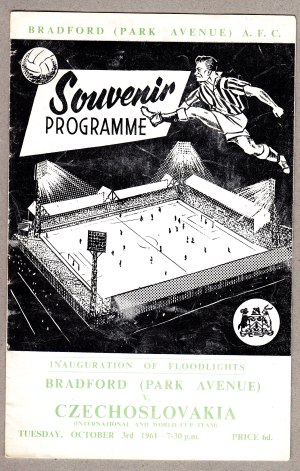
The second magical event was Avenue’s promotion under Jimmy Scoular in the 1960/1961 season. That season, Peterborough was flying in their first season in the Football League and Millwall were also excellent.  Avenue was always in touch and made it after beating the aforementioned sides late in the season in front of big crowds at home. Another highlight was when the Czechoslovakia national team played Avenue in the inaugural Floodlight match. Still got the programme!

IMG_0098.jpg

Is this the only instance of a programme featuring a defunct club and a defunct nation?

This was the period when the more `discerning’ football supporter in Bradford went on Wallace Arnold bus  trips to see Huddersfield Town, Leeds United or Burnley who all played in higher standard football.  I must confess that my father took me to all these grounds when they were playing the `big guns’ in their division.   However, although the lower division stuff might not have compared with the old 2nd division where Ivor Allchurch and Johnny Haynes were weaving magic with their feet, there were still plenty of Bradford footballers I admired.

City had some fantastic centre forwards- John McCole, Derek Stokes and Bronco Layne, and also had in Bobby Webb a right winger I rated highly. I always thought Tom Flockett was rather `rustic’ but I liked the dependable wing-half Bruce Stowell. It puzzled me why the City fans should barrack the Jackson twins (Peter & David) the way they did, and they did! Maybe because their father was the manager!

As for Avenue, I admired Charlie Atkinson who had silky skills in midfield, and of course the hard man Jimmy Scoular. There was the tricky little winger Jimmy Anders, the young inside forward Ian Gibson and the ball-playing centre forward John Allan.  I rated the goalie Bert Gebbie and Don McCalman must have been one of the best centre halves in the lower division.

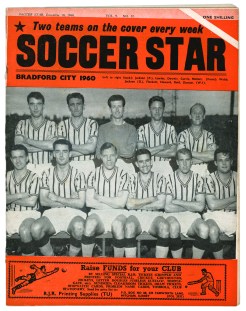
soccer star dec-1960

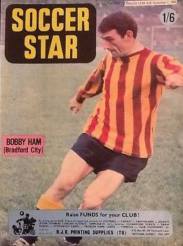
It would be almost a `collector’s item’ if one of the Bradford clubs appeared in my cherished Soccer Star and Football Monthly, but they did! What magazines! Soccer Star featured every team player, attendance and goal-scorer in every match in the Football League, and much more. One can argue that one can find this online today for nothing, but it means flicking in and out of screens forever!

bobby ham

The Football Monthly was probably more appealing for youngsters because many pictures were in glorious colour. This is of course common place today, but in those days it was really something else. On Christmas Day the only present I ever wanted was the Charles Buchan Topical Times Book of Football.

In those days one could get the Yorkshire Sports by 5:35pm at the local newsagents. This would give you every score, updated league tables and even an action pic of the Avenue or City home match. Talk about low tech in those days! How did they do it? Of course, after the match, my ear was glued to my `tranny’ to hear the running scores, and then there was the 5’o clock comprehensive results.  But, the day wasn’t complete without the Sports!

One Saturday evening as I queued for the Sports there was a long line of City supporters who noticed my green and white scarf.  These were mature men rather than teenagers, and in turn they abused me for daring to support both clubs. As an impressionable 12-year old I was quite distraught, but very puzzled how anybody could take offence at me supporting both clubs!

I had noticed that some City supporters cheered at half-time if Avenue were losing and I once heard the Avenue chant CITY-SHITTY break out. I could understand the rivalry but not the hostility. But, when I started to get grief at school from both sides of the Bradford football world I realised I couldn’t continue like this.

I couldn’t pinpoint one reason why I chose Avenue to support. My father had recently forbid to stand on the Spion Kop after one match when a burly City supporter nearly strangled me while he stole my scarfe (a City scarfe I hasten to add). I remember my father saying, “What kind of people stand on the Kop and don’t intervene in a case like that?” That did disturb me, but there were other factors in my decision.

I preferred Avenue’s ground, I also had affection for Park Avenue cricket-  and the rebel in me wanted to defy the City supporters at school that outnumbered the `green & white’ fans 10-1.

However, I still went in turn to City and Avenue alternative weeks and can’t remember suddenly `hating’ City or wanting them to lose. Of course, that all changed when the Bradford derbies recommenced!

The Hector era was magnificent and I believe he was virtually `given away’. Avenue scored loads of goals, but conceded almost as many. When the great man went the end was in sight.

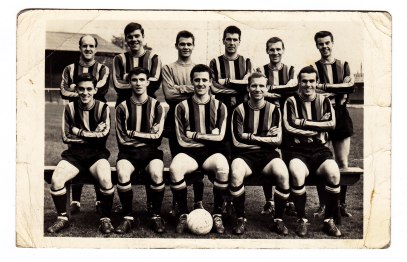
bpa 1963-64

Kevin Hector is pictured 2nd from left, front row in this 1963/64 photo with Avenue wearing their change red, amber and black striped shirts.

Leeds United was becoming really huge at that time and I went a few times with the newly converted United fans.  I had no prejudice against Leeds through geographical reasons, but I hated the mean-spirited, over-physical approach and their reliance on an obsessive Revie-inspired gamesmanship. I’m convinced that this approach negated their trophy winning prowess. The trophy count could have been much more.

So when Avenue lost the right to play at Park Avenue that was me done with football.

Did I make the right decision in choosing Avenue over City? Most people will say NO emphatically. But, cricket became my No.1 sport and I regret nothing, and I am now quite happy watching grassroots pyramid stuff at Campion AFC or Eccleshill AFC.  This level needs to be supported- remember James Hanson?

Of course, I can now understand why people thought I was mad supporting both teams, especially as bigotry in soccer has now gone off the scale and is so pronounced that Everton fans object to Santa Claus because he wears red. But, a friend of my acquaintance who always supported City, and still does, openly admits he went to cheer on Leeds United in their glory days, and today roots for Huddersfield’s survival in the Premier League. Now that won’t go down very well with many City fans, but is it really a crime?

In modern times City have surpassed hugely the times I remembered back in the day. They have had genuine international footballers in their ranks and have re-invented the club entirely. There is no comparison to the aforementioned days. But, players like John Reid, Stan Harland, Ken Leek, Trevor Hockey, John Hall and Brian Kelly hold a special memory for me as they plied their trade in that ageing, basic ground.

The birth of Bradford Northern

By Ian Hemmens

By the 1904-05 season which in hindsight could be said to be the last season in which the Bradford RFC could be classed as a leading club. Past glories as one of the countries leading club were fading fast. An aging side, an opposition to the new Northern Union rule to reduce numbers from 15 a side to 13, falling attendances and possibly above all, envious eyes being cast across the city towards Valley Parade where old rivals Manningham had earlier taken the step to convert to the Association code under the name of Bradford City AFC where attendances were more than treble those turning up at Park Avenue to watch an ambitious new club performing in a National competition could not be ignored.

In the eyes of the Park Avenue hierarchy, they had always been the towns club, the representatives holding all the prestige of past glories in the sporting world. The neighbours from Manningham had in recent years not only caught up with them but overtaken them on the rugby field. Now, their conversion to ‘Soccer’ had taken them into a new, exciting, growing phenomenon which in time would become the countries national sport. Huge sums of money had been spent bringing Park Avenue up to a standard becoming a leading club and it couldn’t be left behind. The power behind the throne at Park Avenue, A. Harry Briggs was watching events at Valley Parade and under the name of ‘amalgamation’ suggested the Bradford City club move up to Park Avenue.

He hadn’t considered the strength of opposition by dyed in the wool ‘Manninghamites’ who remembered the fierce rivalry and sometime bitter enmity between the two clubs . When the proposed ‘amalgamation’ was voted down, Briggs decided the only way forward was to form his own Association club at Park Avenue but even then, there were traditionalists who wanted a return to the old ‘Union’ rules as a way back to the old glories. The problem here lie with the intransigence of the Rugby Union who declared that whilst they would welcome Bradford back into the fold, it would need to be a new team as the existing players were ‘professionals’ and could not be allowed to revert to amateur status.

Things were coming to a head and a meeting was called where the options were laid out in front of a hostile crowd on April 15th 1907. They could either

  1. a) carry on in the Northern Union and try to ride out the problem
  2. b) Apply to the ERU but need to find a new team, or
  3. c) Change to the fast growing Association code.

The vote was taken to by around 80% to return to the ERU but this caused anger amongst the general membership who felt they hadn’t been consulted. The clubs solicitors also declared the result void and against club rules. Further talks with the powers at Valley Parade then took place but again, the opposition shown made this option also a non starter. Matters came to a head at a General meeting called on May 6th 1907 when a 3 to1 majority voted to change to the Association code and thereby cast out Rugby which had been played at Park Avenue since 1881. This meeting would go down in Bradford Rugby history circles as ‘The Great Betrayal’.

Within a couple of days, a provisional committee had been set up by ‘rugbyites’ fans and former players to try and salvage the sport in the City. Firstly a ground was needed that would be suitable for the standard required. A meeting on 24th May at the Mechanics Institute in Bradford invited all interested parties to attend. A site off Otley Road was discussed as a home and good news came from the Northern Union who placed a transfer  ban on Bradford’s players to other clubs in a bid to keep the prospective new club competitive. The new club didn’t have a single penny in the bank and asked for a gesture from the Park Avenue hierarchy for the now un-needed kit, balls, goalposts and other rugby paraphernalia which was duly given and was much welcomed saving in expenditure.

By June the new club had agreed a rent of £8 with Whitakers Brewery to use the Greenfield Athletic & Trotting arena at Dudley Hill. Their HQ was at the Greenfield Hotel and a substantial amount was spent levelling the ground and building new covered accommodation for up to 8000 fans.

Then, just when it seemed things were going well, several of the clubs senior players refused to throw in their lot with the new club. The 2 highest try scorers from the previous season Dechan & Dunbavin along with Captain, G. Marsden & Greenwood were the main absentees. In fact , Dunbavin elected to change codes altogether and stay at Park Avenue to lay the new with the new ‘Soccerites’. A call was sent out to the local NU clubs for players to try out to bolster the ranks alongside those who had chosen to stay. Club stalwarts like Mann, Gunn, Surman, Brear & Laidlaw would prove invaluable for the new club finding its feet after the early Summer turmoil.

September 7th 1907 saw the new club play its first game in front of a sparse crowd of 4000 at Greenfield against a Huddersfield club 5-8 and it wasn’t until 5 matches later that a home fixture would show a ‘W’ in the column beating a Hull side 11-5.

Gomer Gunn

Gomer Gunn, Bradford Northern RFC

It was realised that there might in the publics eyes be an amount of confusion about the whole affair so it was announced on September 10th that the club would now be called Bradford Northern as a nod to the fact that it was the Northern Union code being followed. This was originally going to be a temporary measure until the club established itself but the name was never actually rescinded. There was also initial confusion due to the clubs new name and the fact they played in the south of the City!

By the end of October the club were languishing at the bottom of the table with no little amount of public glee being shown by former ‘Avenuites’ and other critics of the newly formed club. Several new players were signed and a number of ‘reserves’ were given their chance which saw the club eventually finish in a credible 12th place in their initial season. One low point had been a 50 point thrashing by Wigan, the first time any Bradford club had shipped so many points in one game. Highlights had included a trip to Wales against another fledgling NU club from Merthyr Tydfil, a wonderful 22-11 win away at rivals Leeds and to top the lot a superb 7-2 victory against the touring New Zealand side after a dour struggle .

A final record at Greenfield of 18 games, 12 victories and 6 defeats was an adequate return for the new club and fairly solid base to build on but at the clubs AGM, the Committee announced the club was once again on the move, this time to the West Bowling location of Birch Lane. Supporters were puzzled why the club were leaving a ground with only £8 annual rent, a strong Brewery sponsor and a considerable amount spent on the ground itself, for a location with very Spartan facilities and an annual rent of  £30.

The committee justified the move by saying the location was nearer the City centre, on a major Bus & Tram route and it had more potential to develop the area for the new, ambitious club. With the adjacent Cricket ground of Bowling Old Lane I wonder if memories of great days past at Park Avenue had coloured the thoughts of the committee men?

Thomas_Surman_-_circa-1900_-_Baines

Thomas Surman, Bfd Northern

So after a fairly momentous season on and off the field, Bradford Northern Rugby League Club was born, Greenfield was left behind to become a Greyhound and Speedway stadium which lasted until the 1960s

The club moved to Birch Lane and never did return to the peak of the game until the move to the Odsal bowl and the glory days of the 1940s but those are other stories to be told. Bradford (Park Avenue) FC failed to be elected to the Football League and had to start, somewhat bizarrely in the Southern League before finally achieving League Football after one, long, travel weary season. The old die hard RU faction at Park Avenue were attracted to the Horton RU club which merged with Bradford Wanderers in 1919 to become Bradford RFC at Lidget Green. The new organisation enjoyed an era of glory during the 1920s where they had Several England trialists, a plethora of Yorkshire players, A superstar of the 1920s in Eddie Myers and a team who were amongst the best in the country once again playing regularly to 5 figure crowds.


You will find articles about a broad range of sports on VINCIT with new features published monthly. We welcome contributions about the sporting history of Bradford and are happy to feature any sport or club provided it has a Bradford heritage.

Planned articles in the next few months include features on the impact of the railways on Bradford sport; the story of Keighley AFC; Bradford soccer clubs in the 1880s and 1890s; Bradford soccer in the late 50s / early 60s; the origins of cricket in Bradford; the story of Shipley FC; the meltdown of Bradford PA in the 1960s; the impact of social networks on the early development of Bradford sport; and the early politics of Bradford CC.

The history of the Bradford Cricket League

By Reg Nelson

The Bradford Cricket League was formed on Wednesday, 17th September 1902 at the prestigious Queens Hotel in the city centre. Seven clubs from the West Bradford League including Allerton, Clayton, Great Horton, Lidget Green, Manningham Mills, Queensbury and Thornton, met to discuss their future.

The outcome of the meeting was that a new league should be formed called the Bradford League with a view of increasing competition from prospective new clubs.  This proved to be a wise move as the initial seven clubs were joined by Bankfoot, Dudley Hill, Eccleshill, Shelf and Undercliffe. The new 12-strong league commenced in 1903 enjoying healthy gates with Shelf the inaugural title winners.

The league grew rapidly with Saltaire and Windhill joining in 1905, and Bingley, Esholt, East Bierley, Baildon, Farsley and Bowling Old Lane following during the next ten years to create a 2-division set-up.

Great Horton was the early dominant team with four title wins, led by Joe Haley who topped the League Bowling Averages in 1903, taking 52 wickets at 7.25.

The leading batsman in the early years was undoubtedly Schofield Swithenbank who was a prolific run-getter for Yorkshire 2X1. He topped the league’s batting for Saltaire in successive seasons, and also scored the highest innings in the season on four occasions.

The league soon developed into a truly competitive set-up, but the golden years were just around the corner as the First World War saw the cancellation of county cricket. Many First Class cricketers looked at the Bradford League as the next best option to county cricket, and  Sydney Barnes played at Saltaire, and Jack Hobbs at Idle, both travelling considerable distances by train.

These were world class players and they faced the likes of Frank Woolley, Herbert Sutcliffe, Cecil Parkin and Percy Holmes in a league that lured the best.

Idle, Saltaire and Bowling Old Lane were successful teams after the Great Horton era, but in the late twenties Bradford (Park Avenue) became the first team to dominate the league for a long period.

Bradford won the title five times in eight seasons, including a hat-trick of titles between 1927 and 1929. Their star players were Frank Luckhurst, Stanley Douglas, Alfred Hutton and Jack Crossley.

Brighouse took over Bradford’s mantle by recording a hat-trick of title wins between 1930 and 1932, while Undercliffe prevailed in 1935 inspired by Yorkshire bowler Alec `Sandy’ Jacques who in 1932 took all ten wickets for 25 against Bankfoot- all clean bowled.

Remarkably, the hat-trick of title wins feat was achieved again when Windhill clinched the top place during the years 1937 to 1939, and extended the sequence to five by 1941.

Leg spinner Johnny Lawrence, who later played for Somerset, was the main star in 1937, opening the bowling with Squire Render.

Windhill ensured their great run would continue when they made arguably the biggest signing in the league’s history when Learie Constantine arrived at Busy Lane. The world class all-rounder drew big crowds home and away as he helped Windhill to unheard of domination in the league.

The league might have imported brilliant players beyond the Broad Acres, but they continued to breed their own. Len Hutton established himself at Pudsey St Lawrence in the early 1930’s, and Jim Laker arrived at Saltaire in 1938. In the next decade Ray Illingworth would also emerge.

On Friday 1 September 1939, the British government issued its warning to Hitler and two days later war was declared. On that same Friday, first-class cricket in England ground to a halt, and it was to be nearly seven years before it resumed in 1946. The cricket leagues of the north and midlands were the happy beneficiaries.

The Birmingham League prospered, becoming a top competition virtually overnight. It was, however, the Bradford League which really attracted the stars and, in turn, pulled in the crowds. It was reminiscent of the 1914-18 seasons when Jack Hobbs, George Gunn and Frank Woolley had acted as professionals in the northern leagues. Wisden spoke wistfully of, `the talent which migrated to the Bradford neighbourhood’.

Despite the exigencies of war service and war work and the troublesome nature of public transport, practically all the Bradford clubs fielded Test and county personalities, and sometimes two or three of them.

There were some devastating all-round performances. Learie Constantine took 76 wickets and made 366 runs- including a century in less than an hour, for Windhill and Derbyshire’s George Pope had 88 wickets and 641 runs for Lidget Green. Wilf Barber, of Yorkshire scored a thousand runs in league and cup games for Brighouse, including a hundred in thirty-six minutes against Bradford.

D.Smith (Derby & Lidget Green), A.Mitchell (Yorkshire & Baildon Green) and L.G.Berry (Leicester & East Bierley) were three more local heroes. Len Hutton returned to his home township and opened the batting for Pudsey St Lawrence. However, it was Eddie Paynter (Keighley) who took the chief honours, scoring 1,040 runs in league matches alone, a feat only performed once before, by Oldroyd for Pudsey in 1933. Every Saturday one could watch three, four, sometimes five established cricketers, alongside a decent sprinkling of excellent club cricketers, ambitious to keep pace with the maestros.

During the war years there was no charter for elite clubs to rule the roost. Virtually every club would be a threat with their assortment of `guest’ players. This made the very ethos of the league very open. The powerful Windhill sides enjoyed glory but so did Saltaire and Spen Victoria who won the First Division title in 1943 and 1944 respectively. Eddie Paynter eventually scored 4,426 wartime runs with Wilf Barber (3,746) his nearest batting rival.

The Derbyshire trio of G.H.Pope, A.V.Pope and W.Copson were the most successful bowlers. In addition to taking 445 wickets, George Pope also scored 2,236 runs in Bradford League cricket. D.Smith, another Derbyshire player, scored 2731 runs. A record number of 70 first-class cricketers were engaged in the Bradford League in 1943, among them eleven England and three West Indian Test cricketers.

Crowds flocked to the league grounds and the grass banking at Roberts Park, Saltaire was often full of spectators watching First Class cricketers like Cyril Washbrook, Les Ames, Tom Goddard and Bill Copson.

The best club achiement in the war years came from Spen Victoria who pulled off the cup & league double in 1944. Amongst Spen’s best players were Will Barber, Arnold Hamer and Arthur Booth.

Throughout the league’s history quality clubs from other leagues joined the Bradford League and in doing so increasing its strength. In 1946, Salts joined the league from the Yorkshire Council and had spectacular success winning the title four times in eight seasons from 1947- 1954. Their leading players were Percy Watson, Bernard Henry and Freddie Jakeman.

One of Salts neighbouring clubs Baildon took their mantle as the leading club recording a hat-trick of title wins between 1950 and 1952, completing the double in 1952 by also winning the Priestley Cup. Led by Ronnie Burnett, who would latterly take over the captaincy of Yorkshire, they could call on Dennis Dobson, Wilf Burkinshaw and Tom Tetley.

Bradford (Park Avenue) won the Priestley Cup in years 1953 and 1954 which proved to be a springboard for future success. Gaining the reputation of cup specialists they won the cup again four times between 1957 and 1962, and also won the league title in 1958.

They had access to Yorkshire players Bill Holdsworth, Bob Platt, Mel Ryan, Phil Sharpe and Richard Hutton at differing times, as well as possessing seasoned league players of stature like Joe Phillips, Tony King, Eric Barraclough, Mike Fearnley and HV Douglas.

Into the sixties and it was Idle who carved their name in history by winning a hat-trick of titles, and performed the double in 1965. Led by Ken Woodward they took all before them with the potency of the Sherred Brothers (Richard & Martin) being often the decisive factor.

The strength of the league was tested when they entered the League Cricket Conference Cup for 1966. In a nationwide test of the best senior leagues in the country the Bradford League won. The unwieldy nature of such a competition meant that the league were not regular participants.

Amongst the best performers in the later sixties were Frank Lowson, David Batty, Barrie Leadbeater, John White and Bob Fisher.

Herbert Sutcliffe, looking back on his career and time in the league, espoused “From Land’s End to John O’Groats or from Pudsey to Brisbane you wouldn’t find a better league than the Bradford League. No one can deny that the standard of cricket throughout the league has always been of the highest, in fact at one period it almost reached county standard”.

Nobody dominated in the seventies, but Undercliffe won two titles and three Priestley Cups, whilst Pudsey St Lawrence took three titles. Bingley were gaining a reputation of being a cup team with three final victories, often indebted to the mercurial leg-spinner David Batty.

Derbyshire appeared to be using the Bradford League as a breeding school for their young and not so young players, feeding Undercliffe with amongst others David Smith, Les Jackson, Ashley Harvey-Walker, Jim Brailsford and John Harvey.

The start of the newly augmented Yorkshire Champions Club Trophy in 1976 gave the league the opportunity to boost its reputation further with Pudsey St Lawrence winning it in 1977, followed by Bowling Old Lane in 1979.

East Bierley gave a hint of what to come when in 1979 they won the Haig Village Trophy at Lords.

In 1980 Hanging Heaton joined the league after enjoying unprecedented success in the Central Yorkshire League.  By the second part of the decade they had arrived in style winning two titles, and two Priestley Cups with a team containing the virtuoso batsman Ronnie Hudson, and the penetrative seamer Harry Atkinson.

Arguably Pudsey St Lawrence were the team of the eighties decade by virtue of winning three more Yorkshire Champions Trophies to go with their two titles and one Priestley Cup. The 1984/1985 St Lawrence team was heralded as their greatest ever side with Mark Greatbatch, James Dracup and Keith Smith, Peter Graham and Mike Bailey all capable of turning a game.

Yorkshire Bank, who joined the league with Manningham Mills in 1974, began to make an impact winning the title in 1983 and the Priestley Cup in seasons 1989, 1992 and 1993. They could call on players of the calibre of Tony Page, John Marshall and Peter Graham.

However, East Bierley took over the mantle of the league’s top side when they won the elusive league & cup double in 1981.

They went on to win the title again in 1988, 1993, 1994 and 1996, and also the cup in 1984 and 1991. Bierley had a talented side in this era and had Murphy Walwyn, David Jay, Andy Cutts and Dermot McGrath in their ranks. To illustrate their power at the time they won the Yorkshire Champions Club Trophy on three occasions.

The aforementioned competition became a prolific trophy for Bradford League clubs as they enjoyed a spell of 13 wins in eighteen seasons. Spen Victoria, Hanging Heaton and Bradford & Bingley (twice) also won it in this period.

The league, who in the post-war years provided Ronnie Burnett, Vic Wilson, Brian Close, Raymond Illingworth, David Bairstow and Phil Carrick as captains of Yorkshire, continued to breed and nurture players for county cricket. Ashley Metcalfe, Kevin Sharp, Neil Hartley, Steve Rhodes, Richard Illingworth and Phil Robinson all started in the league, while Neil Mallender, Nick Cook and Les Taylor gained experience for other counties.

When Chris Gott of Pudsey St Lawrence was appointed captain of the league’s representative side he pulled together a side that would win the Yorkshire Senior Knock-out five times on the trot (1993-1997). Gott was a virtuoso all-rounder who could get the best players to make themselves available for the task, and with the likes of Murphy Walwyn, Richard Robinson, John Carruthers, Neville Lindsay and Alan Mynett at his disposal they were unbeatable.

In 1987 Pudsey Congs and Ben Rhydding were elected to the league, and they could not have had more contrasting fortunes to come.   Congs won their first trophy in 1994 when they beat Yeadon in a one-sided Final, but it was East Bierley who really made their mark in this famous competition. They performed the first ever hat-trick of cup wins between 1998 and 2000.

Hanging Heaton negotiated a way for Bradford League clubs to participate in the Heavy Woollen Cup competition from 1995. The league clubs began to dominate this competition with nine successive wins between 1996 and 2004, and Hanging Heaton reaching four finals and winning it once in 2000.

Hanging Heaton, who had won the league title in 1999, went on to perform a unique double of winning both the Heavy Woollen Cup and the Yorkshire Champions Club Trophy in 2000. This team was built on seasoned campaigners which included Steve Foster, John Carruthers, Alan Mynett, Steven Bartle and Elliot Noble.

In 2000, Matthew Doidge skippered Pudsey Congs to the title and began a run of unprecedented success- the like not seen before in the league’s history. They won five successive titles, and also won the Priestley Cup five times in six years, playing a well-drilled, but entertaining style of cricket.

To further prove their class they also took the Yorkshire Champions Club Trophy four times during a spell of five successive finals. During the period just after the Yorkshire ECB County Premier League was set up in 1999, the Congs were ironically proving to be the county’s top league side.

It was a team for all seasons with no passengers, but the five constants in the team throughout this era were Matthew Doidge, Neil Gill, Barbar Butt, Gary Brook and Andy Bethel. The influence of Pakistani pace bowler Rana-ul Hassan was massive, but equally important was Glen Roberts who later captained the side to the 2010 title after the good times were supposedly over.

Woodlands, who had joined the league in 2001, became the Congs closest rivals, and by 2005 had taken over as the league’s outstanding side. Having won the Heavy Woollen Cup in 2004, they then proceeded to win the title for four successive years, adding the Priestley Cup in 2006. They also added the Yorkshire Champions Club Trophy to their collection in 2006 and 2007.

These were Woodlands peak years when their bowling strength was arguably the best in the league in the post-war years with Sarfraz Ahmed, Pieter Swanepoel and Chris Brice proving too good for most batting sides. Led by Lancastrian Tim Orrell, who could also call on batsmen of the calibre of Richard Pyrah, Russell Murray and Scott Richardson, they ran Pudsey Congs close as the outstanding side of the 21st century.

Although they were past their peak years Pudsey Congs again won the title in 2010 and Woodlands also did in 2011 and 2012, and later won the Priestley Cup in 2016.

In 2006 the league issued a blueprint for an updated Management Board and also made radical changes to the points system. All matches would have a positive result if both innings had the same amount of overs and the old `playing for the draw’ would no longer be possible.

A total of 20 points for a win could be obtained depending on a team acquiring maximum batting/bowling points. It also gave a team facing defeat every incentive to play to the end in pursuit of bonus points.

In an age of higher emphasis on entertainment with the burgeoning of interest in Twenty/20 cricket, it was the appropriate time for a change and the clubs endorsed the idea.

The Bradford League instigated a Twenty/20 competition in 2009 after hosting experimental challenge matches under floodlights at Cleckheaton. The first Final, played at Bradford & Bingley CC under floodlights saw Pudsey St Lawrence win the inaugural competition.

Cleckheaton who joined the league in 1976 tasted silverware for the first time winning the title in 2013 and 2014 under the captaincy of John Wood.

In 2011 Pudsey St Lawrence set on a path of glory by winning the Priestley Cup, and repeated the feat in 2014. This proved to be a forerunner for things to come when they won back-to back titles in 2015 and 2016. Led by James Smith, he provided the power batting after the consistent openers Adam Waite and Mark Robertshaw had invariably laid the foundation.

Several inner-city clubs had disappeared from the Bradford League landscape over recent decades- Eccleshill, Laisterdyke, Lidget Green, Great Horton and Manningham Mills to name just a few, but well-run clubs were joining from the Central Yorkshire League. After the arrival of Cleckheaton (1976) and Hanging Heaton (1980), others followed- Gomersal, Morley, Woodlands and more recently New Farnley and Scholes.

With further applications from Methley and Birstall forthcoming, it was clear that the Central Yorkshire League were in trouble. This coincided with the period when the Yorkshire Cricket Board considered changes to the Yorkshire ECB County Premier League. This league suffered with two famous clubs preferring to play in other leagues in an era when the vast travelling distances in the fixture list took its toll on player’s availability.

It was agreed that the Bradford League would be an ECB Premier League effectively covering the West Yorkshire area. The Central Yorkshire League agreed to come on board and filter into the newly named Bradford Premier League. In addition, the Halifax League agreed to become a feeder league.

This was the most radical move in the league’s history and led to a Premier, 2-tier Championship and Conference set-up of 48 clubs beginning in 2016.

The consequence of the new Yorkshire Premier League structure led to an end of season Play-Off between the champions of the four leagues, and Pudsey St Lawrence reached the final after beating the North Yorkshire/South Durham Premier League representatives Great Ayton at Headingley. In the Final they were beaten in a high scoring final in Abu Dhabi by South Yorkshire Premier League champions Wakefield Thornes.

Amidst numerous new rules for 2017, the match point system was amended to allow clubs maximum points even when chasing a small total. In addition, the Duckworth Lewis Stern method would be used to calculate the result in rain affected matches in the Premier League.

It was a golden year for Gary Fellow’s Hanging Heaton in 2017 after his side became the first Bradford League winners of the Yorkshire Premier League end of season Play-Offs to decide the champion club of Yorkshire. This was the icing on the cake after they had convincingly won the title, and also the Twenty/20 Trophy.

Callum Geldart had an inspired Headingley `Play-Off’ weekend when he scored the decisive innings in the defeats of York and Wakefield Thornes. Nick Connelly had a season to remember with 1,165 league runs, and with Fellows formed the most prolific opening partnership.

The demise of the historic Idle club during November 2017, due to financial factors, was a blow to the league.

Some of the traditional inner-city Bradford clubs continued to struggle with few volunteers and team make-ups of players that don’t patronise the bar or take part in fund-raising. The more rural clubs that have joined the new set-up might have played in lesser standards historically, but their community based ethics have engendered real progress on and off the field. This might be a simplistic appraisal, but there is real evidence that this is the case.

Two years on from the enlarged Bradford League, it is clear that the Premier League has the potential to be stronger than the old First Division, and Championship 1 is certainly a higher standard than the old Second Division.

Increased travelling is an issue, but the decision to include the old Central Yorkshire League clubs was made when the leading clubs from that league was applying to join the Bradford League, and leaving their league in disarray. As a result, there are several small clubs who would not normally have been accepted into the Bradford League, but given the opportunity to build from the Conference division.

Reg Nelson has had lifetime involvement with Bradford League cricket and is currently the history writer on the BCL Website. He is a Life Member of Saltaire CC and currently League Representative for Woodlands CC.

You will find articles about a broad range of sports on VINCIT with new features published monthly. We welcome contributions about the sporting history of Bradford and are happy to feature any sport or club provided it has a Bradford heritage.

Planned articles in the next few months include features on the story of Bradford Northern’s season at Greenfield; the story of Keighley AFC; Bradford soccer clubs in the 1880s and 1890s; Bradford soccer in the late 50s / early 60s; the impact of the railways on Bradford sport; the origins of cricket in Bradford; the story of Shipley FC; the meltdown of Bradford PA in the 1960s; the impact of social networks on the early development of Bradford sport; and the politics of Bradford CC. 

Compendium of historic Bradford sports club names

by John Dewhirst

scan_20190616 (12) - copy54762346614631981..jpg

Have you ever considered what other names might have been adopted by Bradford’s leading football clubs. Might Bradford City have been Bradford United, Bradford Albion or Bradford Rovers for example? The following is a summary of the Bradford identities adopted by the football clubs in the district and considers how they came about. The detail is derived from my research into the origins of football in Bradford in the nineteenth century.

Rugby heritage

Until the end of the nineteenth century Bradford was very much a rugby centre and its earliest clubs were exclusively rugby sides. Many of those converted to soccer – a good example of which was Manningham FC in 1903 – and it was a common phenomenon for local rugby clubs to abandon their code of football at the turn of the century.

In Bradford there was a strong sense of hierarchy among the rugby clubs from the outset. Bradford FC had been the first club to be established in Bradford and considered it unnecessary and undesirable to adopt a suffix because it considered itself to be the Bradford football club. In Germany the club would have been known as 1FC Bradford (meaning the first or leading side in the town).

Manningham FC was not established until much later (formed in 1880) and emerged as a challenger to Bradford FC even if it had not originally been intended to compete against the Park Avenue club. The rivalry between the Bradford and Manningham clubs was intense and a dimension of it was the bragging rights as the town’s representative. Manningham FC for example resented the attempts by Bradford FC to derive the monopoly status as the town club to the exclusion of itself. When soccer was introduced to Valley Parade in 1903 the club was anxious to stamp its own authority as the city club and hence the name Bradford City AFC was an unsurprising choice. After its own conversion in 1907, the Park Avenue club clung to its identity as Bradford FC as a demonstration of its historical status.

During the 1870s, emergent rugby clubs following in the wake of Bradford FC all tended to have Bradford names. By the 1880s however most of those had disappeared and the majority of second tier rugby clubs who sat in the pecking order below the two senior clubs in Bradford tended to have geographic names linked to their village or suburb such as Bowling FC, Heaton FC, Wibsey FC or Shipley FC which identified that club as representative of its home area. Notable is that none of the second tier or so-called ‘junior’ clubs, Manningham FC included, adopted a Bradford identity. It might have been because there were too many of them to adopt the Bradford name and besides, a village identity was more distinctive. Instead, a Bradford name tended to be the preserve of lower ranking or ‘local’ sides and it was almost as if there was a naming convention that deterred anyone from having a Bradford name, presumably because a village or township name became the norm for the juniors and modesty prevented the use of a Bradford identity.

(NB In 1906, the emergence of Horton RUFC as a challenger to the then dominant Bradford rugby union side, Bradford Wanderers aped that of Manningham FC in relation to Bradford FC – another case of a club with a township identity becoming a direct competitor and rival to the senior town club in Bradford.)

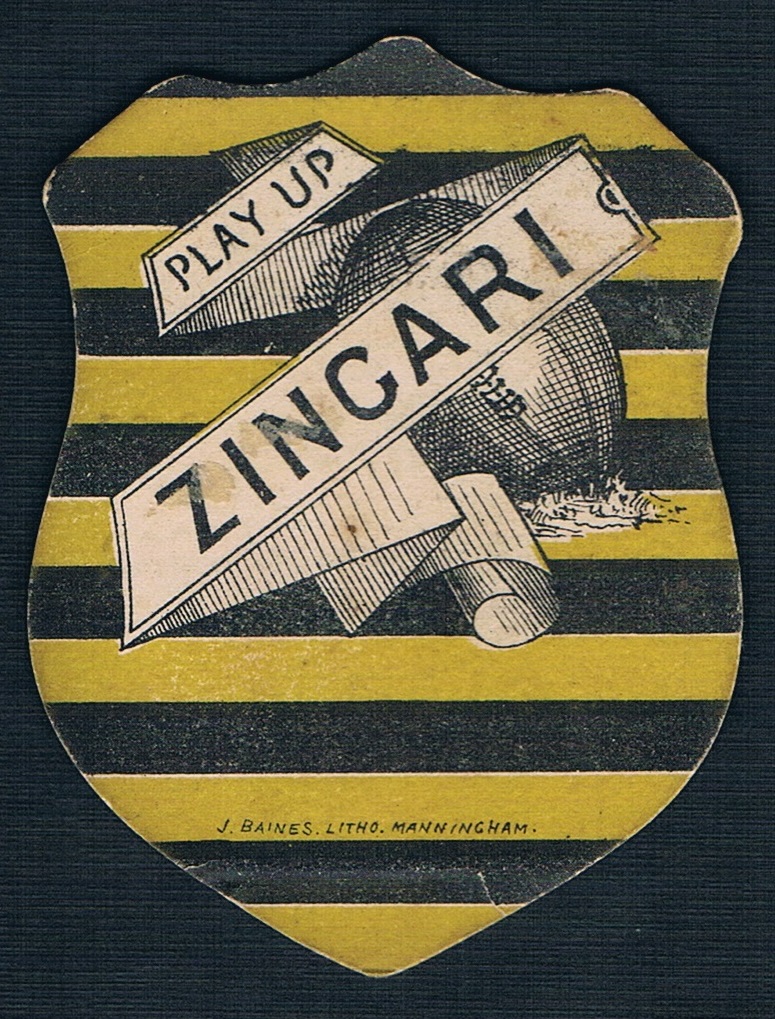
Of those Bradford identities, a good proportion of the names are derived from political or patriotic affinity (ie Bradford Primrose, Clarence, Churchill, Caledonian, Celtic, Britannia or Albion) as well as generic reference to the playing of sport (ie Bradford Recreation) and the practice of travel to play games in different places (ie Bradford Rangers, Rovers, Wanderers or Zingari). Similarly, Bradford Rifles is a name that reveals the military heritage of sport in Bradford. Other names were more esoteric such as Bradford Spartans or Bradford Hornets. Bradford Trinity was a name quite possibly inspired by the example of Wakefield Trinity FC rather than as a result of a church connection. Bradford Star Rangers may have been promoted by a public house, if so the only example of a ‘Bradford named’ club named in this way that I am aware of.

It would be interesting to compare the naming conventions in Bradford with those in other towns. My assumption is that many of the names of Football League clubs betray not only their origins, but their early history. In certain cases the identity of ‘ United’ can be traced to the merger of clubs (ie Newcastle and Rotherham). Clubs without a suffix or adopting the name ‘Town’ or ‘City’ can most likely be assumed to have enjoyed dominance – if not, aspired to it – as the leading side where they came from. Blackburn may provide an interesting comparison with Bradford on account of the development of sport in the two towns in the 1870s. At that time, Bradford FC was dominant in Bradford whereas in the Lancashire town there was rivalry between Blackburn Rovers and Blackburn Olympic. Notable is that neither Blackburn side had assumed a name that suggested being the principal town club as in Blackburn Town FC or just Blackburn FC.

Bradford FC

The origins of Bradford FC can be traced to 1863 but a formal organisation appears to date from the beginning of the 1866/67 season. On this basis the foundation date of the club is 1863 but the formation date of the club as a formal organisation is more appropriately stated as 1866.

Games were originally played at the then home of Bradford Cricket Club at Laisteridge Lane off Great Horton Road, moving to Peel Park in spring, 1871 and then North Park Road in 1871/72. Between 1872-74 the club was based at Four Lane Ends, Girlington before renting a field at Apperley Bridge between 1874-80. The club merged with the reformed Bradford CC at Park Avenue in 1880 to become a constituent section of the Bradford Cricket, Athletic & Football Club.

The club was originally a winter section of the Bradford Cricket Club. A distinct identity as Bradford FC did not arise until the start of the 1872/73 season when the club signed a formal lease for its playing field at Four Lane Ends, Girlington.

Conversion to soccer in 1907 led to the formation of Bradford (PA) AFC at Park Avenue and Bradford Northern RLFC (which spent its first season at the Greenfield Athletic ground but moved to Birch Lane in 1908 prior to relocating to Odsal in 1934).

The origins of Bradford RFC, established in 1919 and based at Scholemoor, Lidget Green from 1919 can be traced back to the launch of the Bradford Wanderers rugby union club in 1899 and the revival of interest in Rugby Union in the district. All descendants of Bradford FC shared common red, amber and black colours with dark blue serge knickers. (Bradford RFC was known as ‘Bradford Rugby’ and merged with Bingley RUFC at Wagon Lane, Cottingley in 1982 to become Bradford & Bingley RUFC.)

Bradford AFC

In 1895 the Bradford Cricket, Athletic & Football Club launched a soccer section as a contingency option given the uncertainty about the future of English rugby. The Buckstone Park club that played at Apperley Bridge was co-opted to form the team which competed as Bradford AFC. The initiative lasted until 1899 when it was closed down by the parent (rugby) club.

Another soccer club preceded Bradford AFC. Established in 1888 – quite possibly inspired by the formation of the Football League – it had been known as Bradford Association and played at Thornbury. This club played intermittent fixtures during three separate seasons before disbanding at the end of 1890 having struggled to attract either players or spectators.

After the abandonment of rugby at Park Avenue in 1907 the new soccer club was also known as Bradford AFC although its formal title was Bradford (Park Avenue) AFC.

The other Bradfords

The following is a summary of all the different Bradford clubs of which I am aware. The date of origin refers to the first use of the name as a football identity in Bradford. Where the date of formation is uncertain, the year in which the club was first reported is stated in brackets. Feedback is welcome to allow this listing to be updated.

Further detail can be found in ROOM AT THE TOP (bantamspast, 2016) by John Dewhirst which tells the history of the origins of sport in Bradford.

Bradford (Manningham) FC – 1876 / Rugby

Comprised former members of the Bradford Juniors and Bradford Zingari clubs. Games played in Manningham Park before merger with Bradford Zingari in 1879. No connection with the subsequent formation of Manningham FC in 1880 although a number of common members.

Bradford Albion – 1875 / Rugby

Part of Bradford Albion Cricket Club which had been established in 1855. Based Little Horton Green, headquarters at the Old Red Lion Inn. Cricket club wound up in 1886 but football club ceased activity in 1882, presumably the impact of Park Avenue having opened nearby in 1880. Albion is the historic name for Great Britain. Identity revived by a local rugby side in 1896.

Bradford Borough – n/a

Name never adopted. Bradford FC as the recognised ‘town club’ in Bradford was also the de facto Bradford Borough representative so the name was unnecessary.

Bradford Britannia – 1886 / Rugby

Based Bunker’s Hill, Otley Road. Members of the Bradford Junior rugby league. Linked to cricket club of same name.

Bradford Caledonian – 1873 / Rugby

Competitive fixtures from 1874, club dissolved 1879 prompted by senior players joining Bradford FC. Initially based in Manningham Park, latterly Girlington from 1877. The name betrays Scottish links given a sizeable Scots immigrant community in Bradford and a Bradford Caledonian Society can be traced to 1837. Bradford Caledonian curling and cricket clubs preceded the (rugby) football club.

Bradford Celtic – 1896 / Rugby

By 1900 identity of a local soccer team in the Bradford & District League, presumably comprising players of Irish descent. Possibly linked to social missionary efforts of the Catholic churches in Bradford.

Bradford Churchill – 1893 / Rugby

Local rugby team, members of Bradford & District Rugby Union and founder members of Bradford Junior League in 1894 switching to Northern Union in 1896. By 1898 conversion to soccer, in 1899 members of Bradford & District FA Division Two based at Harewood Street and from 1902 based at Greenfield. There was similarly a Churchill United club. Another identity, Bradford Church Hill is recorded as the name of a junior rugby team which was presumably the same. The different spelling causes uncertainty over origins, whether derived from a place name (ie Church Hill) or derived in tribute to the Conservative Party leader, Lord Randolph Henry Spencer-Churchill (1849-95). Churchill had actively promoted the Primrose League which was popular in Bradford and among those involved with football clubs – for example officials of both Manningham FC and Bradford FC were active in the Primrose League. (Lord Churchill visited Bradford in November, 1893.)

Bradford City – 1901 / Soccer

Identity launched in 1901 by Harewood Recreation AFC, members of the Bradford & District FA, who sought to relaunch themselves to take advantage of the growing enthusiasm for soccer. The club relocated from Boldshay Fields, (off Barkerend Road) to Greenfield (Dudley Hill). It was a close competitor with Girlington AFC who had similar ambitions and relocated in the same year to Valley Parade. The original Bradford City club resigned from the Bradford League in 1902 in circumstances that may have been linked to an aborted attempt to launch a new club in Bradford to compete at a much higher level. During the 1902/03 season a team of the same name played a number of friendlies against local opposition in an ad hoc revival of the identity. The name ‘Bradford City’ was then adopted by Manningham FC at Valley Parade in 1903. It was considered the prize name to denote the leading soccer team in the city and not surprisingly was the choice of the new club which sought membership of the Football League. In all likelihood the identity was encouraged by the leadership of the Bradford & District FA but Manningham FC would have been equally anxious to secure a name that would signify representation of the city. Notwithstanding, other names were considered for the new club and the shortlist also comprised Bradford Wanderers and Bradford United. The former was abandoned due to its association with rugby union and the existence at the time of the Bradford Wanderers rugby club. The Bradford United name was presumably considered because it would emphasise an appeal to all Bradfordians. Of course, both ‘Wanderers’ and ‘United’ were prominent soccer names in 1903.

Bradford City Athletic – 1903 / Soccer

Suggested identity for St Jude’s team if adopted as reserves for Bradford City AFC. Proposal rejected.

Bradford Clarence – 1894 / Rugby

The name Clarence alludes to the monarch, William IV (1830-37) who preceded Queen Victoria. The third son of George III was created Duke of Clarence in 1789 before acceding to the throne. As king, William was associated with reform of Parliamentary voting, child labour, Poor Law provision and the abolition of slavery and the adoption of the suffix ‘Clarence’ was a form of popular tribute to him. (NB Manningham Clarence CC had links to the formation of Manningham Albion FC in 1879 and Manningham FC in 1880.) Bradford Clarence had become a soccer club by 1899. Clarence was one of the most popular names for local sides among members of the Bradford & District FA in 1900 with the Bradford Moor Clarence, Undercliffe Clarence, Keighley Clarence, Menston Clarence and Pudsey Clarence clubs. Similarly, Clarence Rangers, Horton Clarence, Idle Clarence and Whetley Clarence were examples of earlier rugby sides in Bradford.

Bradford Corinthians – (1902) / Soccer

Established in 1904 and based at Ingleby Road, Brownroyd and members of Bradford & District FA albeit competing at a lower level. A club of the same name existed in 1902/03 but unclear if it was connected. The name was presumably inspired by the amateur Corinthians club who had played in Bradford at Park Avenue in December, 1897 defeating the hosts – Bradford AFC which was the soccer section of the Bradford Cricket, Athletic & Football Club – by 6-1. Notable is that whilst this was a prestige fixture it attracted only 500 spectators.

Bradford Drillers – (1905) / US Baseball

Not West Yorkshire but Pennsylvania! The Bradford Drillers was a minor league baseball team that played in the Inter-State League (PA) and Inter-State League (USA) between 1905 and 1916. The name was derived from the city’s association with the Pennsylvania oil rush in the late nineteenth century.

Bradford Gaelic – (1893) / Rugby

Origins unknown, likely a transient club linked to Catholic social missionary efforts. Reported existence in 1893 through to at least 1896 as a junior Bradford rugby team.

Bradford Grammar School FC – 1872 / Rugby

School team that originally played its games at Carlisle Road, the ground later adopted by Manningham FC in 1880. First recorded game November, 1872 against Bradford FC reserves but particularly active in the second half of the 1872/73 season when rugby appears to have been embraced. By the beginning of the twentieth century Bradford GS had established a reputation as one of the strongest rugby-playing schools in the north.

Bradford Harlequins – (1894) / Rugby

Origins unknown, likely a transient club. Reported existence between 1894-1897 as a junior Bradford rugby team. Derivation of the name is unknown. There was no historic connection between Bradford rugby clubs and Harlequins RFC (est 1866 and a founder member of the RFU).

Bradford Home Club – 1876 / Rugby

Formed by Manningham resident members of Bradford FC who sought to establish a club based locally (instead of Apperley Bridge). Games played in Frizinghall (current Bradford GS field, Frizinghall Road). Existed for one season only.

Bradford Hornets – 1881 / Rugby

Based at Bunker’s Hill, Otley Road. Merged with Bradford Trinity in 1883. Name presumably copied from Rochdale Hornets, a club established in 1871 and with a strong reputation.

Bradford Juniors – 1871 / Rugby

Second (rugby) football club in Bradford, origins 1871 but first competitive fixtures with other clubs not until 1873. Based at Peel Park, relocated to Four Lane Ends and renamed as Bradford Rangers in 1880. The name ‘Juniors’ may have been selected to distinguish the club from the senior side in Bradford at the time, that is Bradford FC. Similarly, the name could have been dropped in 1880 arising from growing self-confidence and ambition.

Bradford Metro – 1974 / Soccer

Proposed name for a relaunch of soccer in Bradford after liquidation of Bradford (PA) and the formation of new municipal authority in the same year. Identity rejected by supporters of Bradford City.

Bradford Nationals – (1894) / Rugby

Origins unknown, likely a transient club. Reported existence in 1894 as a junior Bradford rugby team.

Bradford Northern – 1907 / Rugby

Phoenix Northern Union club established after the ‘Great Betrayal’ at Park Avenue resulted in soccer being played at the ground instead of rugby which had been staged since 1880. The name was selected to highlight the fact that Northern Union was still played in Bradford after the Great Betrayal of 1907. The Northern Union had also insisted that the name Bradford FC could not be used.

Bradford Parish Church – 1901 / Soccer

1901 members of Bradford District League Division Four. Name suggests a church sponsored social initiative to deter young men away from drink and anti-social activity. In Leeds, the Leeds Parish Church club had been a prominent rugby side whereas the Bradford Parish Church side was very much a low level entity.

Bradford Park Avenue / Bradford (Park Avenue) – 1907 / Soccer

Following the abandonment of rugby at Park Avenue in 1907, the football section of the Bradford Cricket, Athletic & Football Club became known in the press as Bradford Park Avenue to distinguish from Bradford City. Notwithstanding, the identity Bradford AFC had been registered with the FA in 1905. As a compromise, to satisfy the Football League requirement for clubs in the same town to have distinct identities, ‘Bradford (Park Avenue) AFC’ was adopted as the formal identity of the club which continued to be referred to as ‘Bradford’ by its supporters.

Bradford Primrose – 1899 / Rugby

Name betrays sympathy for / sponsorship of local Primrose League in Bradford. Conservative Party supporters traditionally influential in Bradford sport. By 1900 identity of soccer team.

Bradford Rangers – 1880 / Rugby

Successor club to Bradford Juniors. Games played at Apperley Bridge in 1880/81, relocating to Girlington 1881 and then ceasing to exist at the end of the 1881/82 season. Match reports during that final season refer to the team having been much less successful. The reasons for the club’s demise are unclear but presumably linked to difficulties raising a team, not helped by the club moving grounds which could not have been convenient to all members.

Even in the 1880/81 season, Rangers had considered itself an equal to Bradford FC. However with the latter gaining the advantage of the Park Avenue ground, those associated with Rangers may have considered ongoing rivalry to be futile and this may have been a demotivating factor when faced with the challenge of sustaining the club in a nomadic existence.

In 1883 the club identity was adopted by a junior, third tier club at Ingleby Road which merged with Horton Alexandra but it is unclear whether there was any common membership with the original Rangers organisation. The last record of existence was 1896/97 although it is unclear whether there was continuing existence in this period. The identity was again revived in 1904 as a Rugby Union club based at Lidget Green but survived for only two seasons. The name Rangers, like Rovers and Wanderers, alludes to playing games in different places.

Bradford Recreation – 1896 / Rugby

Origins unknown, likely a transient club. Reported existence in 1896 as a junior Bradford rugby team.

Bradford Rifles – 1875 / Rugby

Team formed by members of the 3rd West Yorkshire Rifle Volunteer Corps. Played at Four Lane Ends, irregular fixtures after 1880 and last game reported in 1887.

Bradford Rovers – 1901 / Soccer

Originally joined Bradford & District FA Division Four and progressed to join West Riding County Amateur League in 1934. Originally based at Spier Fields, Fagley by 1904 the club had progressed sufficiently to merit tenancy at Greenfield, Dudley Hill. Later played at Lower Lane / Parry Lane (shared with Bradford (PA) ‘A’ team) before winding-up in 1979. Ground currently used by Dudley Hill ARLFC.

NB A Bradford Airedale club is believed to have been formed at Spier Fields, Fagley in 1904 when the Rovers vacated. No further details available.

Bradford Salem RUFC – 1923 / Rugby Union

Local rugby union club established in 1923 as Salem Rugby FC, renamed Bradford Salem RFC in 1926. Based originally at Leylands Lane, Heaton but relocated to current ground at Shay Lane in 1983. The origins of the club came in the context of the revival of interest in rugby union after the end of World War One. (Refer here to the revival of Bradford Rugby in 1919.) The club had links to the Salem Sports Club which was connected to the Salem Congregational Church. The name Salem is believed to derive from Jerusalem. NB Salem Street in Bradford was the site of the first gymnasium in Bradford, established in 1853.

Bradford Spartans – 1893 / Soccer

Played at Boldshay Fields. Origins may have been a team formed by local schoolboys taught the game by Albert Slater, a teacher who came to Bradford in 1891 and is understood to have encouraged the sport locally at a time when rugby was the dominant code of football in West Yorkshire. Considered a pioneering soccer club, the Bradford Spartans disbanded in 1898. (The club’s disappearance came a year before the launch of the Bradford & District FA which was to give a considerable boost to association football in the area.)

The name Spartans was derived from Greek mythology, attributed to fighting prowess and collective strength.

Bradford Star Rangers – 1886 / Rugby

Local rugby club, first mention of which in 1886 – presumably one of the many clubs emerging around that time at the height of enthusiasm for rugby in Bradford. A club by the name of Star Rangers was in existence as a member of the Bradford District Rugby Union in 1907 but it is unclear whether it was the same. Origins unknown, possibly connected to the Star Inn on Westgate, Bradford?

Bradford Town – n/a

Name never adopted. In the latter half of the nineteenth century it would have offended local sensibilities for a club to have adopted the suffix ‘Town’ and unlikely after granting of city status to Bradford in 1897.

Bradford Trinity – 1880 / Rugby

Based in Undercliffe, originally at Peel Park and then after merger with Bradford Hornets in 1883, on Otley Road before relocating to Undercliffe CC in 1885. Converted to soccer and founder members of the Bradford & District FA in 1899. A cross country club, Bradford Trinity Harriers existed in the 1890s. No evidence that the name was derived from connections with a church and instead may have been copied from Wakefield Trinity FC which was at that time a leading rugby side in Yorkshire and fierce rivals of Bradford FC.

Bradford United – 1878 / Rugby

Identity adopted by 3rd XI of Bradford Cricket Club in 1865. Adopted in 1878 by a (rugby) team comprising players of other Bradford clubs (excluding Bradford FC) to contest the Yorkshire Challenge Cup.

There was speculation in 1905 that the identity might be adopted by a merged City / Park Avenue soccer club and the name was subsequently associated with proposals for an amalgamation of the two clubs, again referred to in the 1920s. By the late 1960s the name ‘Bradford United’ had become a metaphor for merger.

The same identity was used by a semi-pro club competing in Yorkshire League, 1945-51 that played at Hunsworth Lane, East Bierley (ground subsequently adopted by Dudley Hill Athletic). Bradford United AFC emerged out of East Bierley AFC, both having been promoted by the same benefactor, local businessman Harold Rhodes.

In 1903 the Bradford United identity was considered by the Manningham FC committee as a name for the proposed association side before selection of Bradford City.

Bradford Victoria – 1893 / Rugby

Name in tribute to the monarch, 1837-1901.

Bradford Wanderers – 1891 / Rugby

An identity adopted across a number of sports but better known for its association with rugby union. A club of the same name existed between 1891-94 but it is unknown whether there was common lineage with the club that was launched in 1899 at Birch Lane. Bowling Old Lane FC disbanded at the end of 1898/99 and Bradford Wanderers occupied Birch Lane between 1899-1903 before moving to Red Beck Fields (the ground used by Manningham Albion in 1879/80 before the launch of Manningham FC at Carlisle Road in 1880) where they were known colloquially as the Red Beck Amataeurs.

In 1906 the club merged with the revived Bradford Rangers on account that the two clubs were struggling to recruit new players. Contemporary reports stated that the combined club had hoped to secure the Lidget Green ground of Rangers but instead it was based at Red Beck Fields.

Following merger the club became known to rugby followers as plain ‘Bradford’ whose principal rival was Horton RUFC. In 1908 the club renamed itself as Shipley (R)FC before reverting back to Bradford Wanderers two years later and moving to Apperley Bridge, a traditional home of Bradford rugby and soccer. Bradford Wanderers disbanded in 1912 and then reformed shortly after. Remaining members of the club merged with Horton RUFC to form Bradford RFC in 1919.

I have found evidence of a cricket club with the same name between 1893-99 and a cycling club adopted the identity in 1894 but it is conjecture whether these organisations had common membership with the rugby body. In 1898/99 there was also a football association club known as Bradford Wanderers and it won the championship of the newly-formed Bradford Junior League in a play-off at Valley Parade. Surprisingly the soccer club disbanded after only one season and whether this had anything to do with the revival of rugby union in 1899 is again speculation, intriguing nonetheless as it would have been in contrast to other situations where rugby was being abandoned in favour of association. (Notable is that in September, 1899 the club cited its inability to raise a team as the reason for withdrawal from competition. With the formation of the Bradford & District FA League in 1899 it seems likely that Wanderers suffered from the poaching of its players by other clubs.)

As above (refer comments re ‘Bradford City’) the name was considered as an identity for the new association side by Manningham FC in 1903 but discounted on account of it being used at the time by the rugby union club.

Further detail about Bradford Wanderers and its Shipley connection from this link.

Bradford Wednesday – (1903) / Soccer

Isolated report of fund raising in April, 1903 by Bradford Wednesday FC but in the absence of any other mention in the local press around that time this may have been a one-off event and it is possible that the club was transient. Unclear whether the Bradford Wednesday team that played at the White Hart ground, East Bowling (as photographed in 1913 below) was the same as the one referred to in 1903. In Bradford, Wednesday was the traditional midweek half-day closing… and the club was a member of the Bradford Half-Day Football League.
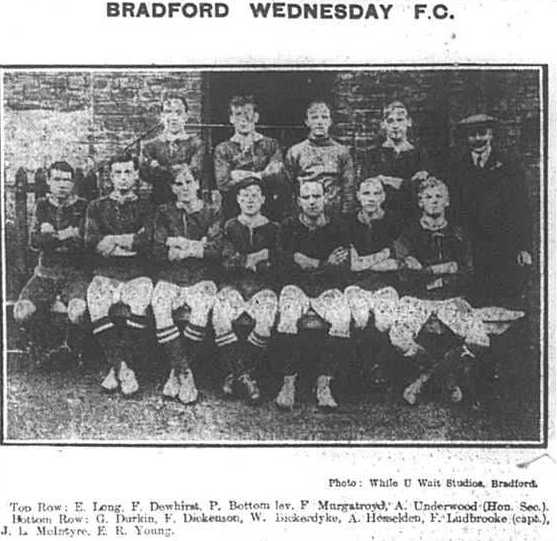
Bfd Wednesday AFC 1913

Bradford Worstedopolis – never adopted

What a name for a club this could have been – in the style of Middlesbrough Ironopolis FC (1889-94).

Bradford Zingari – 1874 / Rugby

Initially played in Manningham Park, then Frizinghall Road from 1875. Club dissolved 1881. The name is Italian for gypsies, adopted by sports teams in the second half of the nineteenth century on account of playing at different grounds (NB in this case the club had its own regular home venue.) Hosted the first floodlit match in the Bradford district on 4th November, 1878.

Featured below a Bradford Zingari Baines card from c1882. 


You can find further detail about these clubs and the grounds they played on in my books ROOM AT THE TOP and LIFE AT THE TOP which tell the story of the origins of football and sport in Bradford and subsequent rivalry of the Park Avenue and Valley Parade clubs. For information about where to buy them refer www.bantamspast.net Tweets @jpdewhirst

A future article on VINCIT will feature the historic sports grounds of Bradford. Contributions welcome to add further detail to this compendium.

Other online articles about Bradford sport by the same author

John contributes to the Bradford City match day programme. His articles, as well as book reviews and features about the history of Bradford football, are published on his blog Wool City Rivals

=======================================================================

Details about the BANTAMSPAST HISTORY REVISITED BOOKS

=======================================================================

A most inspired signing

By Ian Hemmens

Towards the end of 1927-28, Bradford City faced a very real threat of liquidation. Players didn’t receive wages, debts were mounting and the bank refused the club further funds. This situation led to no recruitment plans for the following season and the club was in a state of limbo as shareholders waited to see what, if any, future the club had.
A chance meeting in the Midland Hotel between City historian and journalist W. H. Sawyer and that enigmatic mover and shaker Tom Paton would have a significant effect on the clubs future. Paton, in his usual way discussed the problems with Sawyer and came up with a plan to save the club. If Sawyer could persuade the Board to resign en bloc and form a new one, Paton would provide the money to get the club through the tough close season which would give them time to explore other ways of finding the necessary finance to continue as long as his name was kept out of the public sphere. This was the way Paton had always worked since the club’s formation, in the background without fuss or publicity but he was a highly respected figure within football.

Sawyer managed to do all he was asked and the season approached with a new Board and funds in the bank. They had also taken the significant step of appointing the legendary Peter O’Rourke as Secretary-Manager for his second spell at the club. He got to work with his vast knowledge and book of scouting contacts to get a team together for the start of what would be one of the most incredible seasons in the clubs history.

The season started at Valley Parade with an amazing 11-0 victory over Yorkshire neighbours Rotherham United with hat-tricks for both Corny White & Trevor Edmunds, both debutants. O’Rourke also cannily signed the likes of Cochrane, Randall, Moon & Summers who along with the vastly experienced Tommy Cairns and a youthful Sam Barkas, existing stalwarts Wattie Shirlaw, Sam Russell & Billy Watson would form the core of the team for a season which wouldn’t be settled until the final fixture of the season after a duel with Stockport County for the single promotion spot.

After Christmas 1928, it became clear that the team needed new impetus to maintain its challenge as several players had been tried as the teams strike leader with all doing ok but misfiring in several matches and O’Rourke soon found his man in February with the signing of Liverpool reserve Bert Whitehurst for a fee of £525. He was a proven goalscorer at this level holding the scoring record at Rochdale but not quite able to make the grade at the Anfield club.

His debut came at Sincil Bank on February 28th 1929 against Lincoln City on a snow covered pitch and he immediately began to repay his fee with a couple of goals in a 4-3 victory. He led the line perfectly being fed superbly by wingers Moon & Randall. His home debut the following week saw another brace in front of a 16000 crowd as it appeared City were back on track but what came a month later was incredible and probably won’t ever be repeated again. The team remained unbeaten to the end of the season just pipping Stockport to top spot and scoring a record 128 goals in the process. In one 5 match spell in March the club recorded results of 8-0, 8-0, 5-0, 5-0, and 3-0 and Bert Whitehurst hit 17 of those goals including a club record 7 goals in the 8-0 demolition of Tranmere Rovers on March 6th. At the seasons end, he had scored an incredible 24 goals in only 15 games and broke the club scoring record of 21 held jointly by Frank O’Rourke and Bob Whittingham. If ever there was a more inspired signing i’d love to see it. A season that almost didn’t start, midway looked like fading away ended with records galore falling as the club won promotion back to Division 2 to renew relations with neighbours Bradford Park Avenue.

As for Bert Whitehurst he couldn’t possibly maintain that form and indeed his future at City was blighted by injury as he quietly faded out of the scene before being sold to the team he tormented in March 1929, Tranmere Rovers. Once again the canny Peter O’Rourke had shown his mettle in problem solving for the teams benefit and the signing of Bert Whitehurst must surely have given him great satisfaction and the after the potential troubles and turmoil of the previous summer a great debt is owed to the likes of Paton & Sawyer that our club is still here for future generations to support.

The late development of soccer in Bradford

Introduction

In relation to clubs in other parts of the country – West Yorkshire aside – Bradford City, formed as recently as 1903 is a decidedly modern club lacking the nineteenth century pedigree of those as diverse as Blackburn Rovers, Notts County, Reading, Southampton, Sheffield United or Walsall.

Overlooking for one moment that the club’s origins can be traced to Manningham FC – a rugby organisation established in 1880 – when it came to soccer, Bradford was left behind in terms of what was happening elsewhere. Nevertheless, it is a myth that Bradford was less sports-loving than anywhere else; in fact the record suggests quite the opposite. So why was it that soccer was so late in becoming established in Bradford?

One factor was the urban geography of the district combined with the rapid expansion of Bradford in the nineteenth century. Flat ground was at a premium and such was the extent of urban development that cricket and football tended to be staged on remainder ground. In West Yorkshire however, football was the colloquial term for rugby such was the popularity of the sport. It meant that soccer was crowded out with nowhere to play and it was only when rugby declined in popularity at the beginning of the twentieth century that there was momentum behind the spread of soccer in Bradford and rugby was displaced from the playing fields of the district.

Another dimension to the story is that rugby enthusiasts sought to choke the competitor code before it gained a foothold and this was a consistent, recurring theme in the two decades before Bradford City AFC was conceived. At the beginning of the 1880s there was a very real chance that soccer could have made inroads and Bradford might then have become known as a hotspot of the round – as opposed to the oval – ball game. This article examines the circumstances surrounding the exhibition game involving two Blackburn teams that was staged at Park Avenue in September, 1882. It was the first soccer spectator event to be staged in Bradford and it proved enormously significant to the direction in which sport developed in the town that the game seemingly made little impact on public opinion.

A lingering fascination with soccer

The Park Avenue enclosure had opened in 1880 as a joint cricket and football ground capable of hosting athletic events. The ground was essentially designed with cricket in mind and the football section occupied the bottom one third of the site. Bradford FC who had latterly played at Apperley Bridge merged with the revived Bradford Cricket Club to form the Bradford Cricket, Athletic & Football Club in 1880. The expectation was that it would mark a new era for Bradford football and there was expectation that the town club would win the Yorkshire Challenge Cup. However the first two seasons at Park Avenue proved a disappointment. Early elimination in the Yorkshire Cup and the lack of anticipated success was a cause of considerable frustration and dissatisfaction within the club.

Yet if Association football had been suggested as an alternative option, the report of the Leeds Mercury on 27 September, 1881 was a reminder that West Yorkshire was a rugby stronghold with no immediate likelihood of a change in the state of affairs:

The football season of 1881-82 opens with every prospect of surpassing all its predecessors in point of excellence. The increased popularity of the game as an athletic exercise is abundantly evidenced by the large number of new clubs which have recently sprung into existence with almost mushroom-like celerity, and judging from the support accorded to it, the future of the Rugby Union game in Yorkshire seems peculiarly hopeful. The prodigious strides that football has made during the last few years are truly remarkable. But a short time ago the only exponents of the game to be met with in this county of broad acres were some half-dozen organisations having their respective headquarters in the principal towns such as Leeds, Hull, York, Huddersfield and Bradford, from which our oldest clubs took their rise. Today there is scarcely a single village in the West Riding that has not a representative club, and in the towns they flourish by the score. It is only the rugby game, however that this can be said, for north of Sheffield Association football is but little played, and, considering the merits of the dribbling game, this is somewhat remarkable; but once having fallen behind in the run of popularity, it would appear that a general stimulus in its flavour can hardly set in without the simultaneous formation of several new clubs, for the impediment and difficulty would-be organisers of Association clubs in this district now have to contend against is that there are so very few Yorkshire clubs, at convenient distances, with which they could arrange matches.’

The comments about the difficulty faced by soccer (ie association football) to become established in the area are pertinent. Within the region ‘north of Sheffield’ association football lacked critical mass and for a club in Bradford to be a viable option it needed local rivals to emerge. Once rugby became established – and available grounds were taken up – it made it less likely that association football could be introduced. It would be another twenty years before a change of circumstances made it feasible.

Notwithstanding there appears to have been a lingering fascination with association football in West Yorkshire, the existence of which may have prompted the editorial in the Leeds Mercury editorial about the prospects for soccer. In February, 1881 Harry Garnett and several other prominent rugby players were reported to have been members of the Leeds FC (rugby) team that played soccer against a Durham side. This may have been on a purely recreational basis although I suspect that it reflected a disenchantment among old rugby players about the evolution of their game. Much in the same way rugby players became involved with lacrosse as if to explore a different option. At that stage association football may similarly have had appeal as an alternative, athletic sport that had not been commercialised to the same degree as rugby in West Yorkshire.

In March, 1882 the FA Cup semi-final between Sheffield Wednesday and Blackburn Rovers was staged at Fartown, Huddersfield (a ground which had been opened in 1878). The venue was probably selected on account of geography, being equidistant between Sheffield and Blackburn, but it also offered the opportunity for an exhibition game of association football within the rugby heartlands.

Subsequent reports from the Huddersfield Chronicle suggested latent support for association football as follows: The football match at Fartown yesterday between Blackburn Rovers and Sheffield Wednesday, under Association Rules, was a grand exhibition of the noble winter’s game. Neither side won, and both teams were well appreciated. On all hands remarks were to be heard in praise of the Association game in preference to the Rugby game, the former being prettier, manlier, more scientific, and easier for bystanders to follow, besides being unattended with so much danger to life and limb. Huddersfield does not often see an Association game, but what was witnessed yesterday cannot fail to give impetus to the proposed reform of the Rugby rules. Football should be foot-ball and not hand-ball, which is too much the case with the votaries of Rugby.’ (7 March, 1882)

And from 11 March, 1882: ‘…great interest was manifested in the encounter, and not only was there a large attendance of people from Huddersfield, Halifax, and Bradford, but the Blackburn and Sheffield patrons of football also attended in large contingents, and when the time for the kick-off arrived, some 5,000 or 6,000 persons had assembled.’ However, it also recorded: ‘The play throughout was very exciting, but those present not thoroughly conversant with the Association rules appeared to regard the game unequal in point of interest to the Rugby Union code.’

There are two points that can be taken from the evidence of the Fartown game. The first is that for Bradford people to have attended they clearly had an interest in association football. The second is that traditional ‘rugbyites’ were keen to dismiss the rival game. The attendance was respectable given that the semi-final was played on a Monday and the replay of the game, staged at Whalley Range (home of Manchester (rugby) FC) attracted only eight thousand spectators. Hence it could hardly be said that West Yorkshire people were disinterested by the spectacle.

An exhibition game at Park Avenue

The committee of Bradford FC organised an exhibition game of association football at Park Avenue between representatives of Blackburn Rovers and Blackburn District on 16 September, 1882 as a curtain raiser to the new season (with the first rugby fixture taking place a fortnight later). It is hard to believe that this was not connected in some way to the game at Fartown and according to the Sheffield & Rotherham Independent on 18 September, 1882: ‘the committee of the Bradford club was desirous of introducing into that part of Yorkshire, of which Bradford forms the centre, the association game.’  Besides, the Bradford Cricket, Athletics & Football Club would not have wanted Huddersfield to steal the limelight and claim the status as the only senior ground in West Yorkshire to have staged soccer.

The motives of Bradford FC are worthy of speculation. It is unclear whether the initiative came from Blackburn on a proselytising basis or from Bradford. The motives to stage association at Park Avenue were various, the least contentious of which was that Park Avenue existed to promote athleticism in the town, of which association football was another form. There may have been commercial incentive to optimise the use of the ground.

There was also growing frustration and disenchantment about rugby. There was a local expectation that Bradford FC should win the Yorkshire Challenge Cup but in 1881/82, the club had suffered the indignity of a giant-killing in the first round at Horbury. To add salt to the wound, neighbours Manningham FC had reached the third round quarter final stage in only their first season as entrants. Enthusiasm for rugby may also have been undermined by perceptions that the game was becoming ‘too rough’.

The Blackburn fixture therefore provided an opportunity to gauge public reaction to association football in Bradford and can be identified as a decisive moment in the history of ‘football’ (a term applied to both rugby and association rules) in the district. (Blackburn was by this time recognised as an association football stronghold with Rovers having been beaten FA Cup finalists in 1882 and then subsequent winners in 1884, 1885 and 1886 whilst Olympic won the FA Cup in 1883. It is notable that the contestants in the exhibition game were Blackburn Rovers and representatives of ‘Blackburn & District’ as opposed to being a showdown being the two leading sides in Blackburn, Rovers and Olympic. The fact that it was Rovers, as opposed to Olympic, headlining the fixture is also notable and the fixture may have been an initiative for Rovers to stake its claim to be the leading club in Blackburn. That a contest between Olympic and Rovers was avoided presumably allowed neither club to lose face.)

Blackburn exhibition game advert Bfd Obs 16-Sep-82

The adverts above appeared in the Bradford Daily Telegraph. Note the arrangement for the Bradford FC rugby players to have a practice on the field after the soccer match which suggests that they would have been present to see (at least some of) the exhibition soccer game. Note also the training plans of Manningham FC , the club which later became Bradford City AFC. Manningham FC had been formed in 1880 and played its games at Carlisle Road, moving to Valley Parade in 1886. 

Explaining the Association game

The Athletic News of 13 September, 1882 announced that ‘Although Bradford is one of the strongholds of Rugby Union, the game is exciting much interest in the worsted town.’ Few people would have been familiar with the game other than a small number who had played ‘socker’ at university and who might indulge in it as a break from – or indeed, preparation for – rugby. The Bradford Daily Telegraph provided the following description of Association football for the enlightenment of its readers on 15 September, 1882:

‘On Saturday next the first football match played in Bradford under what are known as Association rules will take place at Park Avenue; the idea of the committee of the Bradford Football Club being to afford the public generally an opportunity of judging of the respective merits of the Association and Rugby game. Hitherto Bradfordians have only been able to witness or take part in football matches governed by the Rugby laws, and as the advocates of each claim for their own system a superiority, arrangements have been made with the Blackburn Rovers – a crack Lancashire team – to visit Bradford and play a game with a team representing Blackburn and district. We have been asked to explain the salient points of difference in the two sets of laws; but we may state generally that the chief difference is that in the Association game no handling of the ball is allowed by any of the players other than the goal-keepers; nor are the contending sides allowed to ‘maul’ each other. Then there are no ‘scrimmages,’ and the only points that can be scored by association players are goals pure and simple, instead of the confusing scores of goals, tries, touchdowns etc. Notwithstanding these differences the Association game – for the government of which 15 laws are regarded as sufficient, as against 61 for the Rugby game – will be found, when such teams as those mentioned above meet, to possess as much interest, give rise to as much excitement, and afford as much scope for scientific play as the rival game. We should mention that whereas the field of play in the Rugby game should not exceed 110 yards in length or 75 in breadth, the maximum length of an association field is set down at 200 and the minimum 100 yards, the maximum breadth being 100 and the minimum 50 yards; while another important difference is that a goal is obtained by kicking the ball under the tape or bar in the Association game; in the Rugby game the ball has to pass over the bar. With a continuance of the present seasonable weather the match ought to be an unqualified success.’

Contradictory accounts

Blackburn Rovers won the game, 5-1 but what is bizarre is that accounts of the game were contradictory about its success. According to the Yorkshire Post on 18 September, 1882, it had drawn a large crowd ‘who watched with a great deal of interest.’ Similarly, the Blackburn Standard, on 23 September, 1882 reported: ‘in Bradford the sweetness and beauty of the dribbling style has been wafted by the gentle breezes of kindly comment which everywhere greets this fascinating pastime. The exhibition match which took place at Bradford last Saturday was of a first-rate description…I am pleased to say that the different parts of the game were sufficiently exemplified…The spectators, who were numerous, got quite enthusiastic over the fine kicking…and were delighted with the neat dribbling…’

The Athletics News of 20 September, 1882 was even more gushing: ‘So great an impression has Association football made of late in the minds of outdoor sport-loving people, that even in excluded centres of Rugby football, as Bradford, in Yorkshire, the dribbling code has caused a commotion of feeling in its favour. As an indication of this, several prominent individuals had made an engagement game in the great worsted borough. The engagement was brought off on Saturday last before a fair number of spectators. The play was such as may be calculated to infuse in the breast of those who witnessed it… xxxxno details need be given of the play, as the only point depending on the issue was to extend the Association game to Bradford, and that result will, no doubt, have been achieved.’

In complete contrast, The Yorkshireman of 23 September, 1882 reported that ‘Judging by the remarks of the spectators on Saturday, and the meagre enthusiasm displayed, it is not likely that the Association game will become popular in Bradford. There was, in fact, more interest exhibited by the spectators in the practice game of the Bradford Club than in the Association match.’ The Leeds Times of the same date reported that ‘There was not a very large gate, and little or no enthusiasm was displayed in the match, which, with the excitable incidents of the rough-and-tumble Rugby game, was considered a very hollow affair.’

Similarly, the Bradford Observer of 18 September, 1882 was relatively dismissive even to the point of questioning whether Park Avenue was a suitable venue by virtue of its size: ‘The rugby game is of course preferred far before the Association by the football spectators of the West Yorkshire district, so that in spite of the famous name which attaches to one of the teams that were to play only a couple of hundred persons witnessed the game. Although, however, the players were sadly out of condition, with the result that the game was slow, and although the ground is too small for a contest under Association rules, enough was seen to satisfy the spectators that there is plenty of science in the game and not a little amusement.’

The only explanation I can provide to reconcile these alternative versions is that the latter publications were fed misinformation in the absence of having a representative on site. The individual who had the role of reporter at the club was Edgar Charlton, formerly of Bradford Caledonian and a private in the Bradford Rifles who had joined Bradford FC in 1879. I assume that the issue of association football at Park Avenue was controversial and that these different newspaper accounts reflected internal politics. In my opinion it is evidence that certain people sought to eliminate the possibility of association football gaining a foothold in the area. Indeed, it was a criticism during the course of the next twenty years that the rugby establishment in West Yorkshire had sought to suffocate, if not control, the emergence of association football.

On 30 September, 1882 a similar exhibition game involving Blackburn Rovers against a local side was organised in Leeds. On this occasion there was no ambiguity about it proving to be a major disappointment with few spectators in attendance (albeit for which the weather was blamed). This appears to have destroyed any momentum that existed to promote association football. Although a further exhibition game took place in September, 1883 in Dewsbury featuring Darwen and Blackburn Olympic which attracted a ‘large crowd’ (and a fortnight later Wakefield Trinity and Dewsbury played a reciprocal rugby exhibition game in Blackburn) there were no further initiatives.

Rugby remains dominant

By 1883 there was no commercial reason to justify a switch from rugby to association football. The Leeds Times reported on 3 November, 1883: ‘Last Saturday’s gate at Park Avenue (vs Halifax) amounted to £144 – a rather startling piece of evidence of the popularity of the game in Bradford, and of the manner in which the town club is – not overrated, but recognised and supported ‘for the good that is in it.’ Furthermore, there was no reason to belief that association football would be any more popular than rugby football: in 1885 the attendance at the final of the FA Cup at The Oval was 12,500 whilst 15,000 attended the Yorkshire Cup involving Manningham FC and Batley at Cardigan Fields, Leeds. The latter generated receipts of £550 with many more reported to have watched the game from vantage points around the ground.

The lack of concerted efforts to promote soccer in West Yorkshire demonstrates that it was considered futile. The Football Association did not stage another semi-final in West Yorkshire (although in 1897 there were rumours about Park Avenue or Headingley being utilised). The fact that the association experiment was not repeated at Park Avenue until 1895 [told here in a feature on VINCIT] tells us that in the final event the members of Bradford FC wanted rugby.

In November, 1886 The Athletic News was dismissive about the prospects for soccer: ‘I don’t wish to be thought desirous of discouraging the efforts of the Associationists, but one cannot shut one’s eyes to the fact that Rugby is the game of the West Riding, is indigenous, as it were, to the soil, and the other football plant will always have an unhealthy growth hereabouts.’

If doubts had existed at Park Avenue about rugby football and the counter attraction of association football, the 1883/84 season put them to rest and a combination of success (including triumph in the Yorkshire Challenge Cup competition in 1884) and riches defined the direction of travel and the trajectory of growth. By 1890 Bradford FC would be one of the richest sports clubs in England. It is a tantalising thought that if history had taken a different course Bradford FC could have been a founder member of the Football League in 1888 and one of the leading soccer clubs in the country. Quite possibly it would then have continued to be one of the richest by 1900. (In the 1890s it was association football that offered the biggest market and the scale of financial transactions in that sport would dwarf those in rugby by the end of that decade.)

Conclusions

The circumstances reveal the rivalry of the two codes and it is arguable that this has continued through to the present day with Rugby League and Association football being commercial competitors in Bradford – a theme explored in an earlier article published on VINCIT CLICK HERE.

Had the Blackburn exhibition game encouraged interest and enthusiasm for soccer in Bradford, then quite possibly the town would have had its own club much sooner and one that was a pioneering member of the Football League when it was formed in 1888. [The What-ifs of Bradford football history are examined in another feature on VINCIT – follow this link.]

By John Dewhirst

  • Further articles are planned for publication on VINCIT that will examine the experience of the earliest soccer clubs in Bradford, first Bradford Association (1888-90) and then Bradford FC (the soccer section of the rugby club, 1895-99).

Discover more about the history of professional football in Bradford and the rivalry of the Valley Parade and Park Avenue clubs in ROOM AT THE TOP and LIFE AT THE TOP by John Dewhirst (Bantamspast, 2016). The author is currently working on a sequel FALL FROM THE TOP: THE WOOL CITY RIVALS which covers the rivalry of Bradford City and Bradford (Park Avenue) in the twentieth century and will feature a wealth of archive images and memorabilia relating to the two clubs. You can find details at www.johndewhirst.wordpress.com  

His earlier book A HISTORY OF BRADFORD CITY AFC IN OBJECTS published in 2014 (which also featured Bradford (PA) memorabilia) was acclaimed by Hunter Davies as ‘the best illustrated history of any club I have ever read’.

Other online articles about Bradford sport by the same author

John contributes to the Bradford City match day programme and his features are also published on his blog Wool City Rivals  

=======================================================================

Details about the BANTAMSPAST HISTORY REVISITED BOOKS

=======================================================================

The 1906 Valley Parade Riot

By Ian Hemmens

February 10th 1906 was just another day of football fixtures. His Majesty Edward VII launched HMS Dreadnought, the most modern battleship of all time ensuring Britain’s domination of the oceans would remain. Over in the United States, future silent movie star Lon Chaney Jnr was born.

Born 3 years earlier from the former Manningham Rugby Club, Bradford City Football Club were in their 3rd season in the Football League were gradually establishing themselves as a professional outfit.

Under the guidance of Secretary-Manager Robert Campbell, City were a comfortable mid-table side but the Board were ambitious for their new club and in November 1905 the club and Campbell parted company by mutual consent. Centre Half and senior player Peter O’Rourke was asked to look after the team whilst the committee decided their next move. O’Rourke dropped himself and placed Gerald Kirk at centre half. Anthony Carter at full back and Edwin Daw in Goal were the other main changes O’Rourke made as Andy Easton & Jimmy Garvey were both struggling, indeed Garvey had to retire due to his injuries.

City’s undoubted star was diminutive left winger Jimmy Conlin. A fiery character, he was the first ever City player to be sent off but he was also Citys first England International. City’s first International was Jimmy Roberts who played for Wales and beat Conlin to the honour by a week. He was a quick, tricky winger signed from Scottish club Albion Rovers the season before.

RiotC

A run of only 1 defeat in 9 games convinced the board that the new man could be in place already and Peter O’Rourke was appointed full time Manager in the February of 1906.

City had just come off a great 5-0 win over 1st Division Wolves and next at Valley Parade in a league game were promotion chasing Manchester United.
who would eventually achieve their aim finishing in 2nd place. They were quite a free scoring side with 4 players reaching double figures and their season saw the beginning of an era with the legendary half back line of Duckworth, Roberts & Bell. The United player that interests us the most though was the burly Right Back , Bob Bonthron, a no nonsense player who took no prisoners.

RiotB

United had previous at Valley Parade even before their game started. Their previous visit had finished with fans and journalists alike annoyed by their ‘brute force and shady tactics’. In the week leading up to the match Bonthron had been quoted in the press giving ‘a frank admission that he fouled opponents without worry as it was the best way to stop them scoring’. The stage was set and with the match kicking off in heavy rain, the large crowd was ready for the highly anticipated contest. The other villain of the piece was referee T. A. Campbell who was very weak and offered no protection at all to Conlin who was repeatedly kicked and barged by Bonthron.

On a pitch in shocking condition, the City attack missed several good chances whilst at the other end the Referee Mr Campbell ‘seemed oblivious’ to the offside rule. He also ruled that City keeper Edwin Daw had stepped over the goal line in collecting the ball and awarded United a controversial goal. As half time was reached United had an unbelievable 4-1 lead. The crowd’s mood was already brewing at the perceived injustices when the United Chairman Mr. J. Bentley decided to take a stroll around the pitch waving and twirling his umbrella. This perceived show of arrogance was greeted by Mr Bentley receiving a torrent of mud, stones and Orange peel.

This was nothing compared to what was to come. Chants of ‘Play the Game’ greeted the United players as they emerged for the second half but they just laughed at the crowd. City, with nothing to lose attacked and firstly Conlin having broken clear was rugby tackled to the ground. Then, after beating Bonthron again, the defender took a cowardly swing and took the wingers legs away from underneath him for which he received a caution from the Ref. The crowds mood darkened even further when United scored yet another ‘offside ‘ goal which Mr Campbell allowed. 5-1 down, little Jimmy was nothing if not feisty and when the 8st Conlin glided past the 13st Bonthron the full back took action which had the only result possible and City’s star winger was launched into the picket fence which surrounded the pitch. After his repeated offences and already being cautioned, the referee and linesman conferred and to the shock and disgust of the crowd merely gave Bonthron yet another lecture.

riotA

This was the final straw for the already irate crowd. The crowd cheered when Edwin Daw punched the ball clear and in the process knocked out United forward Clem Beddow. When the whistle finally blew for full time a possee of police constables surrounded both Bonthron and the referee to stop the onrushing crowd reaching the target of their venom. This was only a temporary respite as in those days the players had to walk up the road to the Belle Vue barracks to the changing rooms and offices.

The crowd knew this and were waiting as the players emerged from the rest room on to the streets to walk up. The United players were allowed to walk unhindered up to the barracks, the crowd had their targets. Anticipating trouble and hearing the threats the City officials tried to sneak Bonthron & the Referee out via the Burlington Terrace end of the ground, but they were spotted and the crowd blocked the way. Mr Campbell with 2 escorts , made a dash for it and was pelted with ash and mud and had his pipe knocked from his mouth. Bonthron then tried to make a dash and was hit full on by one of the mob. City director John Brunt and full back Anthony Carter went to his aid and received several blows as Carter was knocked to the ground. One more broke through and attacked Bonthron. He was held by the police but dragged clear by his fellow attackers. City Vice-President Ike Newton was then knocked to the ground and took several kicks as mob rule threatened to take over. They finally managed to reach the relative safety of the barracks despite several further attacks and being covered head to foot in mud and ash.

The carriage of United Chairman Bentley and Manager Ernest Mangnall was pelted by stones.

After a period of time, City Manager escorted Bonthron to the Exchange Station to meet up with his unharmed team mates.

The following week, both City & United stayed at the Norbreck Hotel in Blackpool on a training break and there appeared to be no ill feeling between the 2 sets of players. Even Jimmy Conlin & Bob Bonthron were seen deep in conversation on many occasions.

The Football League convined a meeting to investigate the matter and as a result Valley Parade was closed for 14 days. Bonthron had been given a chance to diffuse the situation by being offered the chance to stay behind and travel with the City team who were leaving later for Blackpool but he insisted on confronting the angry mob and returning with his own team.

Incredibly at the hearing, Bonthron got off with a stern lecture as to his behaviour and the Referee got away scot-free with his incompetence.

Post Script: The crowd didn’t forget though and a month later when United visited Leeds City the Referee was again pelted with missiles by ‘Bradford folk’ and had his face cut. 2 years later whilst officiating at Uniteds Bank Street, He sent off United Centre Forward Sandy Turnbull and was again attacked this time by United fans and in the safety of the United offices he was verbally abused by several club officials whom he reported to the FL for not offering him protection.

As for the 2 major players, they would meet again the season after. Jimmy Conlin had by then gone from strength to strength becoming Bradford Citys first England International and then in the Summer becoming the 2nd most expensive player ever when he moved to Manchester City. Bonthron was struggling to establish himself in the top division against better players and on the 1st December came the first Manchester derby in the top flight. Bonthron came up against his old nemesis and once again Conlin gave him a runaround. Conlin was ‘as tricky as a monkey’ and gave Bonthron a ‘a rare gruelling’. After being ‘left blundering behind’ once more the crowds jibes got to him and he was seen shaking his fists and threatened to see the crowd outside afterwards! He also had a slanging match with team mates Dick Duckworth & Harry Moger. Conlin had had the last laugh and enjoyed a decent career before falling foul of drink before being tragically killed in WW1. He is remembered at the Nieuwpoort Memorial in Belgium. Bob Bonthron left Manchester United at the end of the season.

Jimmy Conlin was the first superstar and darling of the fledgling Bradford City club. A quick and wonderfully tricky winger, he was slightly built but scared of no one and his skill and personality helped the club establish itself in the Football League. As mentioned he was the clubs first England International only being beaten by a week for the honour of being first ever international by Jimmy Robert’s selection for Wales. He is remembered as one of City’s Fallen heroes.

Above are Conlin & Bonthron.

The origins of Bradford Rowing Club, 1867-2017

This year marks the 150th anniversary of Bradford Amateur Rowing Club at Saltaire, founded in 1867. The club was one of a number of new sporting organisations established in Bradford during an era when there was a particular enthusiasm for ‘athleticism’ and diversification into new activities. Many of those responsible for this development were involved with the Volunteer movement in town. The Bradford Gymnastic and Athletic clubs were similarly influential with members also involved with the Bradford Football Club.

Of the twenty original members to the club in October, 1867 who subscribed £1 apiece, it has been possible to identify four as members of either the Bradford Gymnastic Club or the Bradford Young Mens Athletic Club (B Wright; R Smith; W Anderson; R Ingleby); another two as members of 3rd West Yorkshire Rifle Volunteer Corps (Lt. T H Thwaites; Captain Smith); one as a member of Bradford CC (A Nicholson); and another (J Swithenbank) as a member of Bradford Albion CC. The point is that the individuals concerned had a general interest in ‘athleticism’.

People were already familiar with the University Boat Race which had first been staged in 1829, an annual event since 1856 and it was reported in the press as both a sporting and gambling event. James Burnley’s description of rowing on the River Aire in 1870 alludes to the image of the sport which may have attracted certain people for ostentatious reasons. Writing in the Bradford Observer of 21 April, 1870 (Phases of Bradford Life: Good Friday at Shipley Glen) he mentions a couple of boats on the river at Saltaire belonging to a rowing club and ‘each are rowed by a gentleman got up in true university fashion – blue cap, flannel jacket.’ He also added that his companion had been betting on the recent University boat race.

The formation of the rowing club followed a letter in the Bradford Observer of 26 July, 1866 from ‘Gymnast’: ‘Now that we have several gymnasiums established in this town, I think it is time to imitate Leeds and establish a boating club on the Aire at Saltaire.’ It illustrates how Bradford people were keen to embrace new activities and emulate what was happening elsewhere. Noteworthy is that the letter was written a fortnight after a successful rowing regatta that had been held in Leeds.

The inaugural Leeds regatta had taken place in September, 1864 at Kirkstall Abbey involving boats from Mirfield, Thornhill and Leeds. From the start it had been organised as a holiday fete and a popular attraction was a competition to traverse a horizontal greased pole, the prize being a pig suspended in a box at the end. The third regatta in July, 1866 was on a much bigger scale with prizes of £100 and competitors came from the Tyne, Ouse, Humber and Aire. The event took place over two days attracting 7,000 and 10,000 people respectively with an excursion train advertised by the Midland departing Bradford at 2:10pm and returning at 10:30pm. In addition to the pig pole attraction there was also a swimming race which was won by a Bradford man, Professor Johnson (formerly of the Corporation Baths but recently recruited to manage the Leeds Oriental Baths in Cookridge Street) who won a £5 time piece.

From ROOM AT THE TOP by John Dewhirst 


Other online articles about Bradford sport by the same author

John contributes to the Bradford City match day programme and his features are also published on his blog Wool City Rivals