A tale of two cities: the significance of sport in the Bradford identity (pub: Jul-17)

Anticipating Glexit

Last month came the news that the West Yorkshire Combined Authority, comprising representatives of six local councils, was to be rebranded as the Leeds City Region Combined Authority with the claim that a ‘Greater Leeds‘ brand was likely to be more successful at attracting inward investment. As an aboriginal Bradfordian and as someone with a passionate interest in the history of the district it represented a dystopian nightmare. It was the equivalent of what had happened in 1974 with the creation of ‘Humberside’, imposed upon equally unenthusiastic people and remembered more for the hostility that the identity fostered than the economic benefits it delivered. Was the scheme masterminded in a bunker under the Headrow, LS1? Thankfully it turned out to be a squall in Lister Park lake and just as my thoughts were turning to campaign for ‘Glexit‘ it was announced that the proposals had been dropped. Notably a number of councillors have talked about reviving the ‘Bradford brand‘ but no-one appears to have outlined a strategy by which this might be achieved and what this might be beyond yet another fancy logo.

I acknowledge that the prospect of Bradford being an independent player in determining economic regeneration is unrealistic and no-one can be in any doubt about the current economic and political status of Bradford relative to Leeds. Whereas the last two hundred years have been a story of rivalry, mutual suspicion and uneasy co-existence between the two cities, the future demands co-operation and co-ordination to bring meaning to a northern economic powerhouse as well as to compensate for the weakness in capability and leadership within City Hall. Notwithstanding I could not stomach the prospect of ‘Greater Leeds’. Aside from the instinctive emotional response I am not convinced that the Leeds brand is really of such premium benefit – anyone who ventures beyond the bright lights of Leeds city centre will find that not everything glitters so brightly in its outlying suburbs. I also strongly believe that it is unhealthy to focus the economic regeneration of West Yorkshire on promoting a single constituent part above all others.

I know that affairs in Bradford are pretty desperate but that doesn’t mean we should ignore its past in the rush to define the future. Quite the opposite, the city’s history can teach a few lessons for anyone contemplating a rebranding exercise and surely it is better to encourage pride in a place than disown its heritage and identity? Clearly Bradford struggles with its self-image but it was a not dissimilar issue in the nineteenth century and what tends to be overlooked is the historical role that team sport played in Bradford to define a sense of belonging (described as topophilia), something that it is equally capable of today. My argument is that sport could be embraced as a means of reviving self-respect in the Bradford district and with it the associated gains in health and social well-being.

The historic rivalry of Bradford and Leeds

20190616_1255591656150917593972200.jpg

The historical relationship between Bradford and Leeds can be likened to that of two neighbouring families who have lived in adjacent properties. Of the succeeding generations the earliest inhabitants had tried to outdo each other with ever more elaborate extensions and enhancements. The Bradford family long since fell on hard times and its house is crumbling yet full of historical features.

Leeds has always been a big part in the history of Bradford and in the nineteenth century provided a spur for the development of Bradford that we know today. The city with which we are familiar is essentially a Victorian creation, including the pattern of road and rail infrastructure that we have inherited. Bradford sought to be different and to be better and what happened in Leeds provided the yardstick to be measured against. As a city, Leeds had a longer-established heritage whereas Bradford was the product of the industrial revolution. Returning to the analogy of the neighbouring families, Leeds liked to see itself as old money and sophisticated whereas Bradford was of new, self-made wealth. Indeed, the character of the self-made man with his social insecurity and compulsive need to be liked was the essence of Mr Bradford. Yet if Leeds might feel inclined towards snobbery, it was more fur coat and no knickers.

One hundred and fifty years ago there was a belief that Leeds, as the largest centre in West Yorkshire, tended to have a conflated view of its importance and that it was dismissive about the interests of other towns. In 1862 for example, the Bradford Observer mocked the Leeds Mercury for its headlines in response to firms based in other West Yorkshire towns having secured more trade medals in the British Exhibition, to the effect that ‘disgrace had befallen the largest metropolis of the West Riding‘. The Bradford Observer considered the achievement akin to a giant killing of the town’s larger neighbour and any suggestion of a ‘Greater Leeds‘ being synonymous with West Yorkshire would have been ridiculed.

The competition between Bradford and Leeds was at its peak in the second half of the nineteenth century as the two cities enjoyed the gains of the industrial revolution whilst also coping with its consequences. The rivalry was acute as they jostled to enhance their relative prestige within Yorkshire and the country at large. It was about everything and neither of the two competing powerhouses wanted to be considered the lesser. Whilst parochial in the extreme, it was a chemistry between near equals that was actually successful in driving change and civic renewal. It was equally a tragedy and a benefit that the two towns found themselves trapped in close proximity.

The development of impressive civic buildings was the most obvious consequence of the competition but one thing that distinguished the construction of civic buildings in Bradford was that it was done at less expense than in Leeds. The attitude in Bradford was that it was not simply a matter of erecting civic buildings, but to do so at least cost. Therefore, whilst a town hall was opened in Leeds in 1858 with dimensions to exceed St George’s Hall, Bradfordians mocked it for the unnecessary extravagance. The culture of parsimony in Bradford betrayed Nonconformist influence but it was also a legacy of the arguments about incorporation in 1847 and sensitivity about the burden of rates. One of the reasons given for opposing incorporation had been the likelihood of a rates rise and this became a sensitive issue and something that the corporation tried to avoid.

Although Bradford’s absolute indebtedness was less than that of Leeds, in relation to the rateable value of properties within its borders or its population, the burden was greater. The health of the respective corporation balance sheets thus became another aspect of the rivalry and of acute sensitivity to residents in both towns. As an example the Yorkshire Evening Post reported on 4 March, 1893 that ‘Once more Bradford is happy. Someone has found out that Forster Square in Bradford is about 1,877 square yards larger than the new City Square at Leeds. This is a matter which reasonably calls for great jubilation; and so they jubilate. But I believe the Leeds Corporation indebtedness beats that of Bradford, and herein we get straight with the rival town.’

The development of municipal parks in Bradford was no less significant as a bold statement of ‘Bradfordness’ and the unique character of the town. Peel Park, Manningham Park, Horton Park and Bowling Park all enjoyed favourable comment from the Leeds press when they were opened and were equally a source of pride for Bradfordians. Indeed, the construction of Park Avenue in 1880 should be seen in the context of the programme of new parks in Bradford during the preceding decade. (Feature on the origins of Park Avenue from this link)

No less impressive than the construction of buildings was the massive investment in the development of waterworks to meet the needs of Bradford’s textile industry. Whilst the crowning glory of the programme was the completion of the Scar House Reservoir in 1936, the network of reservoirs dated from the acquisition of Chellow Dene in 1855. If evidence was required of the ambition, ingenuity and can-do attitude of our Victorian forebears it was this infrastructure of which Bradford people were rightly proud.

By the end of the nineteenth century there was another dimension to the competition as the two rival cities sought to expand their boundaries. In 1897 for example, the Bradford Borough was expanded by the inclusion of outlying areas including Eccleshill, Idle, North Bierley, Thornton, Tong and Wyke. There was more to this than simply gaining influence because size provided financial benefits derived from higher rates revenue and economies of scale for infrastructure development. The various approaches made by Bradford to absorb Shipley were similarly driven by strategies to optimise water supply. In 1920 there was even an attempt to annex Calverley and the Shipley Times spoke sarcastically about the ambitions of ‘Greater Bradford‘. By the 1920s, the need to clear congested areas within Bradford created further impulse for expansion.

Leeds possessed a distinct advantage over Bradford that dictated the future course of history – a place on the railway mainline. Between 1864 and 1898 there had been various schemes for a line that ran through the heart of Bradford but none came to fruition. The latter project was put to bed in 1919 when the Midland Railway informed Bradford Corporation that it had no plans or finance to progress a connection between the Forster Square and Exchange station. It was telling that the Leeds Mercury in September, 1920 commented that when the plans for a through line (from Bradford to Royston) were revealed ‘there was a section of Leeds commercial men who opposed the scheme because they saw that it would leave Leeds on a roundabout loop‘. In the final event a through line was never attempted because the Midland Railway could not afford the project but undoubtedly the same Leeds commercial men would have lobbied against it. (Feature on the saga of the cross-Bradford rail line from this link.)

Competition with Leeds was not simply a pissing contest but went hand in hand with a sense of belonging and a distinct Bradford identity. The Bradford Observer of 4 October, 1859 for example spoke about the emergence of an esprit de corps within Bradford ‘with a justifiable pride on the part of the inhabitants in their fellow-townsmen and their town‘. An important ingredient of ‘Bradfordness’ was a sense of civic-mindedness that was demonstrated through the historic commitment to fund raising for the town’s infirmary. Indeed charity fund-raising was a big component of community spirit in Bradford in the second half of the nineteenth century that continued through to the introduction of the Welfare State in 1947. Even in 1934, the Leeds Mercury marvelled at the generosity of Bradford people and the extent of their £0.5m contribution to building of the new infirmary.

Yet surprisingly, a core element of the Bradford-Leeds rivalry and local pride has been overlooked by historians despite it having given further depth of feeling to the civic rivalry. The significance of sporting competition between the two cities has been virtually ignored despite the fact that sport captured popular imagination. Few will deny that sporting allegiance continues to give expression to the strongest prejudice between the two cities and the greatest sense of a Bradford identity.

How sport came into it

Whilst the Bradford Football Club could trace its origins to 1863 it was a Leeds club established the year after that was first to organise competitive games with sides from elsewhere. Inevitably the first competitive fixture of a Bradford side was against the one from Leeds in February, 1867 and it ended in a draw.

In the nineteenth century sport helped to define a Bradford identity, reinforcing topophilia and local patriotism. Cricket and football was played with a singular focus on winning and deriving glory for the town that would otherwise have only been secured through commerce. Sport compensated for other shortcomings in a place known almost exclusively for the consequences of industrialisation and the output of its mills. It signalled to outsiders that whilst the civic slogan ‘Labor Omnia Vincit‘ truly embraced a local mindset, Bradfordians played as hard as they worked. Sporting excellence demonstrated to the world that recreation was valued in the town and that Bradfordians were not solely work-obsessed. The investment in parks for example was equally a retort to John Ruskin’s claim in 1859 that Bradford was nothing but mills. And with regards to Leeds, sport gave Bradford a real sense of superiority.

In the circumstances of rapid industrialisation after 1830 sport played a vital role as a means of expressing local patriotism and loyalty, shaping a Bradford identity in what was a frontier town. Cricket, and later rugby football, provided a form of self-respect for Bradford and its value came to be recognised by politicians and civic leaders for the fact that it could unite the people of the town – sport encouraged a common purpose whereas the other great passions of the age, politics and religion were divisive. By the 1860s athletic activity derived respectability from being associated with charity fund-raising for the town’s infirmary and enhancing the fitness of townsmen for potential military service. Athleticism was valued for its community benefits and sport came to play an important role in developing the self-image of Victorian Bradford, reflecting the spiritual culture of the district. Unfortunately, whilst the influence of immigration and religion has been recognised by academics, that of organised team sport in Bradford has never previously been acknowledged.

The value of that identity and source of local pride can be considered by virtue of its absence after World War One. For the generations of Bradford football followers who became accustomed to failure and under-performance it seems astonishing that in the forty years to the outbreak of the war in 1914, Bradford was known as a centre of sporting excellence. The talk was of the same ‘pluck’ being applied to sport as to business and Bradford was rightly seen as pioneering when it came to football – the early influence of Bradford FC upon rugby union; the widespread participation in rugby and the mushrooming of local sides; the development of Park Avenue and the wealth of the town’s principal club; the stature of Bradford FC before 1895; the emergence of Manningham FC as a strong, second club in Bradford; the emergence of the first Football League club in West Yorkshire in 1903; the promotion of Bradford City AFC to Division One in 1908; FA Cup victory in 1911 and then Bradford (Park Avenue) AFC also reaching Division One by 1914.

In that era, it was Bradford which led and the sporting record of Leeds was negligible. The Leeds newspapers commented on the sporting achievements of Bradford with undisguised jealousy and a sense of inferiority, no more so than when Bradford City won the FA Cup. In fact the biggest match to have been staged at Elland Road prior to the outbreak of World War One was the replayed Barnsley / Bradford City FA Cup tie in 1912 and one of the largest defeats inflicted upon Leeds City had been at Valley Parade, 0-5 in October, 1907. The reputation of Leeds City AFC prior to World War One had more to do with financial failure given the club’s insolvency in 1912. Prior to the outbreak of World War One therefore, people came from Leeds and elsewhere in West Yorkshire to Bradford for their (association) football.

By contrast, after 1920 things went downhill for Bradford soccer although it was Huddersfield Town (Football League champions for three years in succession 1923/24-1925/26 inclusive) who dominated West Yorkshire football rather than Leeds. Prior to 1964 for example, Leeds United yo-yoed between the top two divisions and the club’s record was pretty undistinguished. Sadly the record of Bradford’s two soccer clubs after World War One was toxic, a story of downward mobility that continued for half a century. In relation to its size Bradford underperformed and with it, the sporting self-belief and expectation of Bradfordians was undermined.

The fate of the Park Avenue sports ground in the 1980s had a big impact on that sporting self-belief. Nowhere was this felt greater than with regards to the ascendancy of Headingley as the home of Yorkshire cricket, the achievement of victory over the rival claims of Bradford and Sheffield. The tragedy for Park Avenue was that the stadium footprint was too small and that the Bradford Cricket, Athletic & Football Club had not had the money to fulfill its plans in 1893 for the construction of an enclosure similar to that at Bramall Lane in Sheffield (with cricket and football intended to be played in three-sided arenas). The original construction of Headingley in 1890, like the redevelopment of Fartown in 1891 had been inspired by the success of Park Avenue which had opened in 1880. However with the redevelopment of the ground not proceeding in the 1890s, the fate of Bradford’s premier ground was determined such that it would eventually be overtaken in stature. It is quite clear that Headingley was the product of rivalry between Bradford and Leeds to boast the premier sports ground in West Yorkshire. Not surprisingly the leadership of the Bradford club was particularly sensitive about the threat of Headingley, as is evident from reports of annual general meetings of the members.

Park Avenue was a big part of the Bradford sporting identity and with the eventual demise of Bradford (PA) AFC the ground soon became derelict, first class cricket henceforth being lost to the city. If cricket at Park Avenue had been overtaken by Headingley, the potential of Odsal to become the leading RL stadium was never realized and again this has been to the benefit of Headingley to establish itself as the leading rugby ground in West Yorkshire. Whilst lack of finance was an issue, the Rugby League’s insistence to stage cup finals at Wembley was another. Undoubtedly Odsal was victim to jealousies among other clubs and there is little doubt which way Leeds RLFC delegates would have voted. Ironically, in 1948 there was talk of a similar super stadium being constructed in Leeds to match Odsal but nothing came of it. As regards future development of Odsal, it seems highly unlikely that anything as ambitious as the Superdome scheme of twenty years ago will be attempted and in that regard Leeds will continue to boast the largest stadia in West Yorkshire for cricket, rugby and soccer.

Sporting failure in Bradford in the last century was not due to an inherent lack of enthusiasm for sport as opposed to the fragmentation of sporting effort. Had resources been concentrated in a single winter game or just one Bradford club, there is a good chance that the sporting legacy would have been entirely different. By the 1920s the two Bradford Football League clubs were crippled by the fact that neither enjoyed a monopoly of support in the city in the same way as Huddersfield or Leeds; by the end of the decade that disadvantage was revealed in the relative weakness of their balance sheets. To all intents and purposes the die was cast by that stage and the Bradford clubs were destined to be poorer than their neighbours, Halifax Town excepted.

In the nineteenth century, organised sport helped bolster a Bradford identity and went hand in hand with expectation and confidence. The converse was true in the twentieth century and it is my belief that underperformance in all three codes of football played a big part in undermining the self-confidence of the city and its ability to respond to de-industrialisation and decay.

Bradford was handicapped by its urban geography, the poor road infrastructure and lack of flat land for industrial expansion but I also believe that it was disadvantaged psychologically. For the best part of the twentieth century, Bradford football supporters found that it was a path of least surprise to assume the worst. Bradford became accustomed to a culture of failure and a lack of self-belief. Fourth rate soccer as well as decrepit (or in the case of Odsal, undeveloped) stadia sympbolised the Bradford malaise and it appeared to signify that the city was destined for second best. True, sport would not have transformed the city but it might have helped arrest its decline by fostering a degree of pride and collective identity. Liverpool derived self-respect from its football teams when all around, other civic institutions collapsed.

By the 1960s, Leeds had become a yardstick against which the sporting failure in Bradford could be measured and by the end of that decade more Bradfordians watched soccer outside their city than within its borders. The mystique of Leeds United playing soccer at the highest level was an antidote to those without the patience to invest in Bradford football. However I suspect that there was more to it than simply the standard of football and that Leeds United provided a ‘modern’, fashionable ‘big club’ appeal to those in Bradford (as well as other West Yorkshire towns) who wanted an escape from the grim old scene at home.

The impact of the rise of Leeds United was felt by each of the professional football clubs in West Yorkshire, rugby and soccer alike whose gates were depressed. Within those towns, attitudes among football followers in relation to Leeds United were polarised and the club’s hooligan following in particular shaped opinions. Certainly at Valley Parade there was little affection for that club among the diehard City support. However, many Park Avenue supporters opted for Leeds rather than transfer allegiance across town when their own club failed to secure re-election to the League in 1970. So bad were things that in 1974 there were even rumours about Bradford City becoming a nursery side for Leeds United.

Although the numbers who deserted their home town clubs to go to Leeds in the 1960s or 1970s was unprecedented, it was not a new phenomenon for Bradfordians to attend games elsewhere. It was telling that in April, 1928 when Bradford Park Avenue celebrated their Division Three (North) championship that there was an appeal for Bradfordians to support their local sides. By the 1930s Leeds United was attracting people from Bradford for big game fixtures at Elland Road but it was secondary to Huddersfield Town which had established itself as the top team in England in the 1920s. The preference for Huddersfield can be explained variously, the most likely of which was the fact that Huddersfield had been so successful in the inter-war period. Prejudice towards Leeds United was consistent with the traditional Bradford-Leeds rivalry. However, antipathy towards Leeds United existed out of distaste for the financial circumstances surrounding the demise of the original Leeds City club and its subsequent reincarnation in 1919. I have also heard the suggestion that it was a product of anti-Semitism towards those involved at Elland Road.

Yet if Bradford folk were prepared to attend games at Leeds or Huddersfield there was still an expectation for allegiance to be given to City and/or Avenue. It was a regular theme in the local press, encouraged by the clubs themselves, that Bradford folk had a duty to support Bradford teams. And with the two Bradford clubs playing on alternate Saturdays there was no excuse… until the point came when they really were so bad. Nonetheless, in 1950 the news of a Huddersfield Town supporters’ branch being established in Bradford was greeted with talk of a ‘Soccer Fifth Column’ in the city and a genuine feeling of betrayal.

As far as I can see, the rise of ‘Super Leeds’ (sic) in the 1960s and 1970s was at the expense of other clubs in West Yorkshire, just as the concentration of financial investment in Leeds in the last twenty to thirty years has been at the expense of other towns. The case of Bradford is surely witness to this and the reason why an economic regeneration strategy for West Yorkshire needs to avoid disproportionate focus on, or promotion of, ‘Greater Leeds’. We all wince about the manner in which the South East dominates the national economy and yet seemingly no objection is made to encourage further imbalance within West Yorkshire. The best advert for West Yorkshire is to promote the fact that there is more to it than Leeds.

All change in Leeds

To get a sense of the current economic relationship between Bradford and Leeds you can do worse than observe the movements at Shipley station: the daily flow of commuters to Leeds, the weekend shoppers who opt to go there and the heaving trains on a Friday or Saturday evening which feed its club scene. True, there are people heading in the opposite direction towards Bradford but it is a fraction of those Leeds-bound. Shipley station serves as a reminder that Bradford is on a railway branch line, the poor relation to the neighbouring city to the east.

For the last thirty years, economic comparisons between Bradford and Leeds have become increasingly unfavourable. Even in the mid-1980s it still felt that Bradford could hold its own as a self-respecting, independent centre but the subsequent investment in Leeds – in conjunction with Bradford’s own problems – have redefined the relationship between the two. The development has mirrored a trend within the UK towards a number of regional centres and in competition with Leeds, Bradford was never going to win. Considering the massive difference in retail choice that exists today in Leeds compared to Bradford it does seem incredible that in December, 1925 the Yorkshire Post was actually praising Bradford for the vitality of its shops.

The relative decline of Bradford accelerated after the jihadist riots and ethnic cleansing of businesses in certain areas of the city in July, 2001. It didn’t help that the planned redevelopment of the city’s shopping centre in Forster Square was delayed, dissuading people from venturing into town. The Bradford district has subsequently been associated with the wrong type of headlines and unfortunately perception is often more decisive than reality. As an example of this, twenty years ago I tried unsuccessfully to persuade a Guiseley business to relocate to the Bradford district. The business concerned was a design and marketing consultancy for whom image matters and a BD postcode was simply too much to countenance.

Whereas Bradford was once proudly proclaimed to be a surprising place, tourist guides are now more inclined to define the likes of Saltaire as a de facto suburb of Leeds. Of course there has been the suggestion that the Bradford district might disintegrate altogether in an end of empire with aspirations in Keighley, Ilkley and Shipley for autonomy and an end to the Bradford metropolitan structure established in 1974. All told it is timely for the political establishment in City Hall to encourage a sense of belonging if Bradford is to hold together.

What we have seen in the last three decades is a remarkable disassociation of people from Bradford with their city, a form of embarrassment if not disgust at the state of affairs in the place they had been proud to call home. It has amounted to a collapse of what the Victorians referred to as local patriotism. The preference to travel to Leeds to eat, shop and drink has become virtually habitual and facilitated by improved rail links between the Bradford district and Leeds. Against this flow however, it should be noted that local support for Bradford City AFC is at its highest in living memory.

You could be forgiven the observation that because Bradford is so impoverished in relation to Leeds, that it makes a mockery of trying to uphold a distinct identity. However, the historic record demonstrates that the dynamic between Bradford and Leeds was not just about who was richest but about being different and that is as relevant today as ever it has been. Instead of waving the white flag of surrender and abandoning a Bradford identity we should be looking at new ways to invigorate it. Besides, surely local residents are entitled to a sense of self-esteem and pride about where they live.

Rebirth of Bradford patriotism?

Bradford shield

For a large proportion of Bradford’s population, civic patriotism amounts to sporting allegiance and in that sense Bradford City AFC has played a considerable role in upholding a positive Bradford identity. Was it not for the club, many people in outlying areas would have had little reason to venture into the centre or profess any loyalty to the city. Specifically, soccer has played its part in revitalising North Parade as a pre-match leisure destination. For all the regeneration schemes formulated in City Hall, the contribution and potential of sport appears to have been overlooked yet it has made a significant contribution to restoring a degree of pride in Bradford. A sobering observation is that the recovery and reinvention of Bradford City AFC in the last thirty years has been in the opposite direction to the state of Bradford generally – no-one forty or fifty years ago would have envisaged that Bradford could once again become a self-respecting soccer centre.

Admittedly there remains a good number of Bradford-based supporters of both Leeds Rhinos and United. Prior to the collapse of the Bulls it is difficult to understand why Bradfordians should have wanted to follow Leeds rugby league, presumably encouraged by a pathological dislike of Odsal. Those seeking their pleasure at Elland Road are more likely to have been longstanding converts as opposed to recent. Cheap tickets have played their part in attracting people to Valley Parade and no longer is there the exodus from Bradford to watch football elsewhere. In this regard soccer has been a success story although the Bulls style ticketing policy at Valley Parade has ultimately been at the expense of Bradford Bulls. The recent affairs at Elland Road (in conjunction with high prices of admission) have deterred the conversion of a new generation of Bradford-based followers and that is the opportunity for Bradford City to consolidate local goodwill.

If sporting failure undermined self-belief and self-respect in Bradford in the second half of the last century, since the late 1990s we have seen glimpses of the potential that sport has to offer the district – its contribution to a feel-good factor can be gauged by the experience of the last four years at Valley Parade and the mood in the district at the beginning of this century when the Bulls dominated their code. Dare I suggest that sport has also demonstrated its capability to be a social unifier.

Bradford Council has discovered for itself that grandiose regeneration schemes have been singularly unsuccessful and nor is a ‘Greater Leeds’ rebranding exercise going to solve the city’s problems and deliver a magic solution. Crucially there has been no initiative to encourage a sense of pride and belonging. Anyone serious about trying to revive the Bradford brand can do worse than consider the potential of sport to generate a common identity of our own instead of imposing that of another city. Whilst the lead flag bearers will inevitably be Bradford City (and hopefully Bradford Bulls, maybe even Bradford Park Avenue), there is no reason why junior sports teams in the city – from rugby to athletics to cricket – cannot be engaged as ambassadors for Bradford with all concerned sharing a common emblem just as Manchester has recently rediscovered its bee. Another lesson of history was the enthusiasm with which Bradford clubs and societies at the turn of the twentieth century adopted the Bradford shield and coat of arms as their common identity – a tribute in part to the marketing nous of the Fattorinis who sold countless enamel badges.

Bradford cannot afford indecision and delay about what should constitute a Bradford brand or identity. Those in City Hall upon whom we rely for wise and enlightened leadership should look to the city’s past to define its future. The notion of ‘Greater Leeds’ should be forgotten once and for all. Instead, Bradford’s history should serve as a form of inspiration rather than being discounted as irrelevant and let it not be forgotten that a big part of Bradford’s identity is quite simply that it isn’t Leeds.

John Dewhirst

Author of:

A History of Bradford City AFC in Objects (bantamspast, 2014);

Room at the Top, The Origins of Professional Football in Bradford and the rivalry of Bradford FC and Manningham FC (bantamspast, 2016); and

Life at the Top, The rivalry of Manningham FC and Bradford FC and their conversion from Rugby to Soccer (bantamspast, 2016).

He is currently working on his next book Fall from the Top, The Wool City Rivals: Bradford City and Bradford Park Avenue 1908-70

Details: HERE

Other online articles about Bradford sport by the same author

John contributes to the Bradford City match day programme and his features are also published on his blog Wool City Rivals

The tongueless boar’s head, classic Bradford iconography. Read about the identity from this link.

What’s in a name?

Bradford and Bradford City… Bradford or Bradford City?

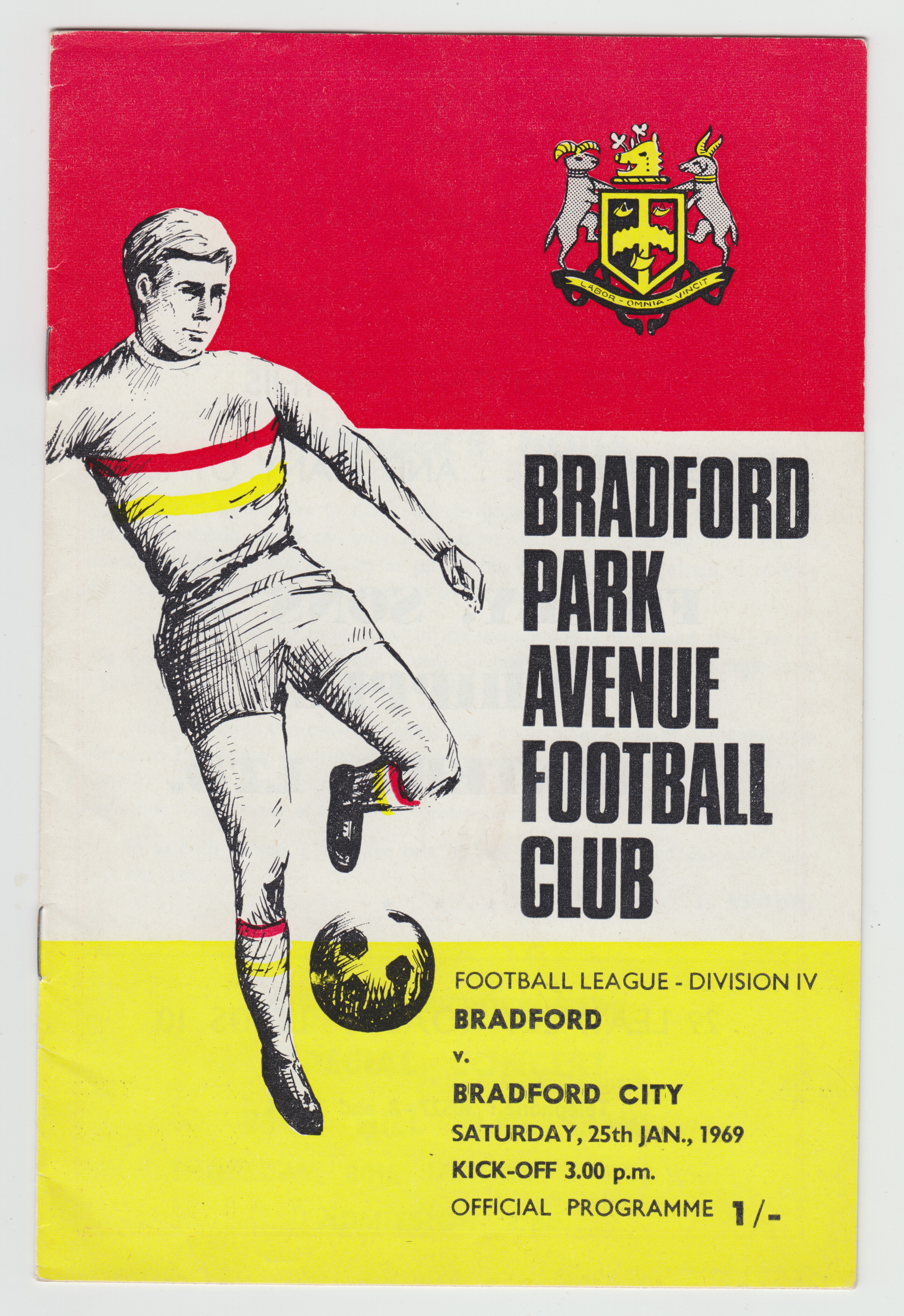
Unfortunately the historical distinction between the two Bradford clubs who were rivals in the Football League between 1908-70 tends to be overlooked in media reports and on the internet. It is now common orthodoxy for Bradford City AFC to be known as just ‘Bradford’. The irony is that as long ago as December, 1907 the Valley Parade management committee had unsuccessfully appealed to the Football Association about the Park Avenue club being called Bradford AFC.

More recently the broadsheet press declared how outrageous it was that the owner of Hull City AFC should abandon tradition by not respecting that club’s historic name. How ironic then that the identity of Bradford City is overlooked in the same newspapers which refer to the club (incorrectly) as ‘Bradford’ in match reports and classified results.

As should be expected, the press is able to differentiate between the two Bristol clubs and those in Cambridge and Oxford are always referred to as City and United as applicable. It is therefore difficult to accept that if journalists can get it right for those clubs, they fail to do so in respect of Bradford City. The point being is that when you refer to a football club, ‘Bradford’ is Bradford (Park Avenue) and not Bradford City. A similar gripe has existed in Nottingham where the Forest club is invariably referred to as Notts Forest. Pity poor Workington AFC who were often called Workington Town when in fact that is the name of the nearby rugby league club and they ended up appending Reds to their name to avoid the confusion.

The Bradford / Bradford City distinction irritates myself and many other City supporters although it needs to be highlighted that younger generations are sadly indifferent about the matter.

The followers of the former Park Avenue club share the same frustration about the ‘Bradford’ identity. They highlight the fact that the gables of the old main stand at Park Avenue, constructed in 1907, incorporated the monogram ‘BFC’ and the Bradford arms to demonstrate that Park Avenue remained the home of the senior club in the district with the de facto status of ‘the town club’. Indeed this was a deliberate design feature in homage to tradition at Park Avenue given that gables had been included in the original Victorian grandstand demolished after the decision to convert to soccer. At the time the new grandstand was commissioned, chairman Harry Briggs was desperately wanting to win over the senior membership of the Bradford Cricket, Athletic & Football Club to support his controversial betrayal of rugby; the design of the stand and its use of the monogram was a sop to this. There is no ambiguity that the Park Avenue club was known as ‘Bradford’ and reported in the media as such.

An issue of brackets

However a particular issue that has been a cause of irritation to ‘the Stans’ (the nickname given to the club’s surviving supporters after the appearance in 1988 of the ‘Boring Stan, Avenue fan‘ cartoon strip in the sister City Gent publication, Bernard of the Bantams) has been the placement of brackets in the name of Bradford Park Avenue / Bradford (Park Avenue). It is a matter that has inflamed passions.

I covered the origins of the name ‘Bradford Park Avenue’ AFC in my book LIFE AT THE TOP. From what I have established, the name ‘Bradford Park Avenue’ was registered with the Southern League in 1907/08. Those in charge at Valley Parade objected to the rival club being known as ‘Bradford’ but the Park Avenue leadership appealed to the Football Association on account that the name ‘Bradford’ had been registered previously (1895-99 and then renewed 1905). For the commencement of the 1908/09 season, following election to the Football League, the club actively promoted the name ‘Bradford’ as distinct to ‘Bradford Park Avenue’.

The brackets – as in ‘Bradford (Park Avenue)’ originated in 1909 at the time of incorporation as a limited company. This was presumably a pragmatic solution to recognise the club’s traditional institutional identity as well as to differentiate from Bradford City. My suspicion is that the Football League had insisted on the retention of ‘Park Avenue’ in the club’s name.  For example in all other towns in England where there are two Football League clubs, each has a distinct suffix. I believe that the use of brackets was a way for the club to save face and achieve some form of compromise position. To my knowledge, no other FL club has had brackets in its name.

The original rugby club had been known as Bradford ‘FC’ but after 1907 the leadership was at pains to stress that the new soccer club was referred to as ‘AFC’ given that ‘football’ remained the colloquial term for rugby until World War One at least. Likewise, at Valley Parade, there was insistence that the club be known as Bradford City AFC rather than simply Bradford City FC.

With the revival of rugby union in Bradford in the first decade of the twentieth century, as early as 1906 the Bradford Wanderers club was being referred to as ‘Bradford’. This was acknowledged to be a cause of confusion and arguably influenced future naming practice. For example, in 1907 the phoenix Northern Union club appended ‘Northern’ to its name to advertise the fact that the game was still played in the city; this followed the ‘Great Betrayal’ when rugby was abandoned at Park Avenue.

So far as the new soccer club was concerned, the adoption of the suffix ‘Park Avenue’ was as much a case of differentiation relative to Bradford City as a reminder that the Bradford club had inherited Park Avenue, considered by tradition to be the civic sports ground in the city. In fact, the motive for Harry Briggs launching soccer at Park Avenue was principally to safeguard the stadium with a game that would be profitable. Hence an argument can be made that the soccer club existed principally for the benefit of the stadium and in turn, Park Avenue was central to its identity.

On the basis that the club had previously bracketed the name of its ground and that Park Avenue is sadly no more – there is a logical case that ‘Bradford (Horsfall) AFC’ is more appropriate than ‘Bradford (Park Avenue) AFC’. It can also be argued that ‘Bradford Park Avenue AFC’ is an identity far more capable of commercial exploitation than one including brackets. Those who lobby for the retention of brackets say that this allows the club to emphasise its ‘Bradford’ identity. Sadly, that has been misappropriated by default to Bradford City and the name ‘Bradford FC’ has been registered by an independent local side with no knowledge of its provenance. Surely the fact that the Horsfall club is now known as ‘Bradford Park Avenue’ and not simply ‘Bradford’ is reason enough that ‘Bradford Park Avenue’ should be its name.

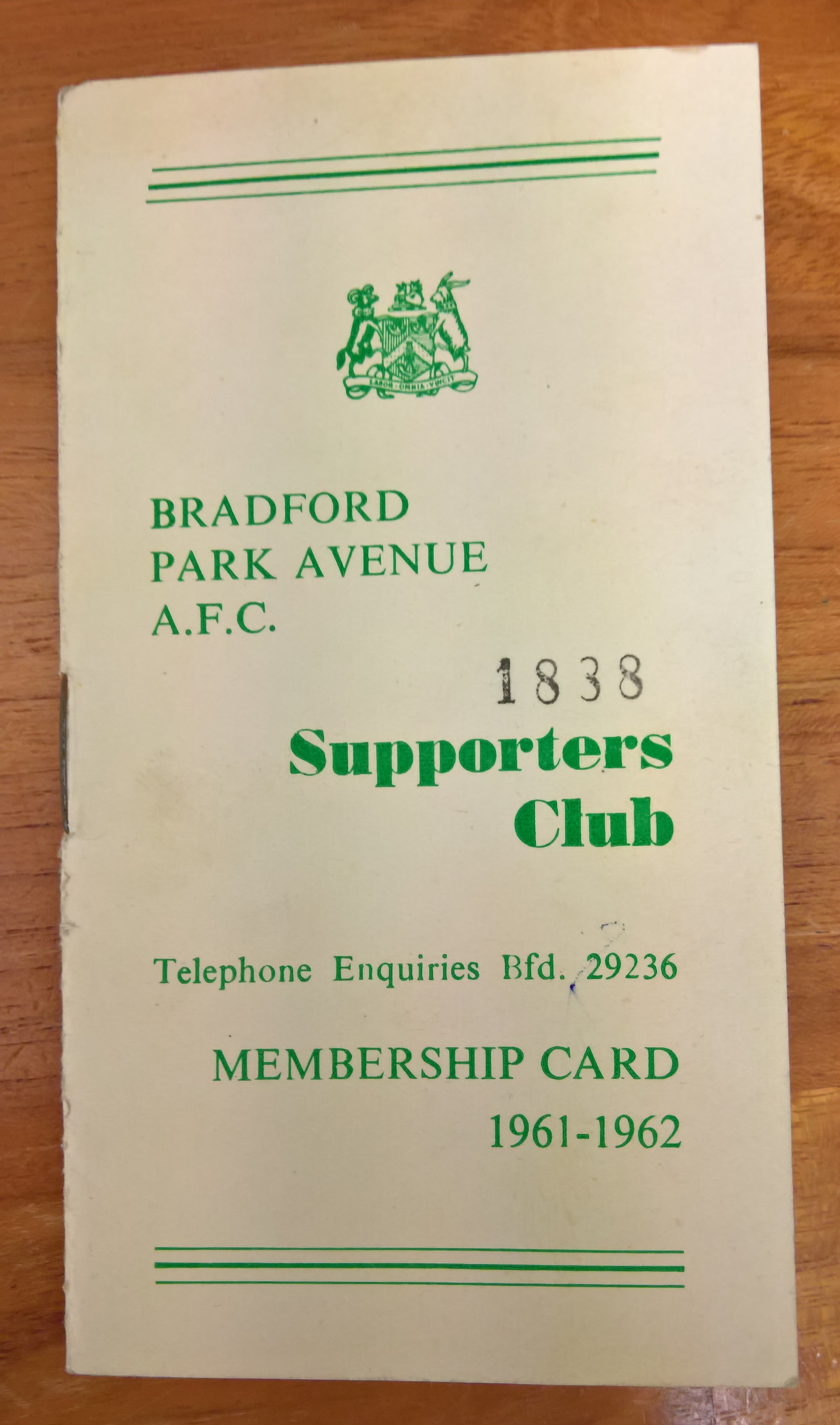
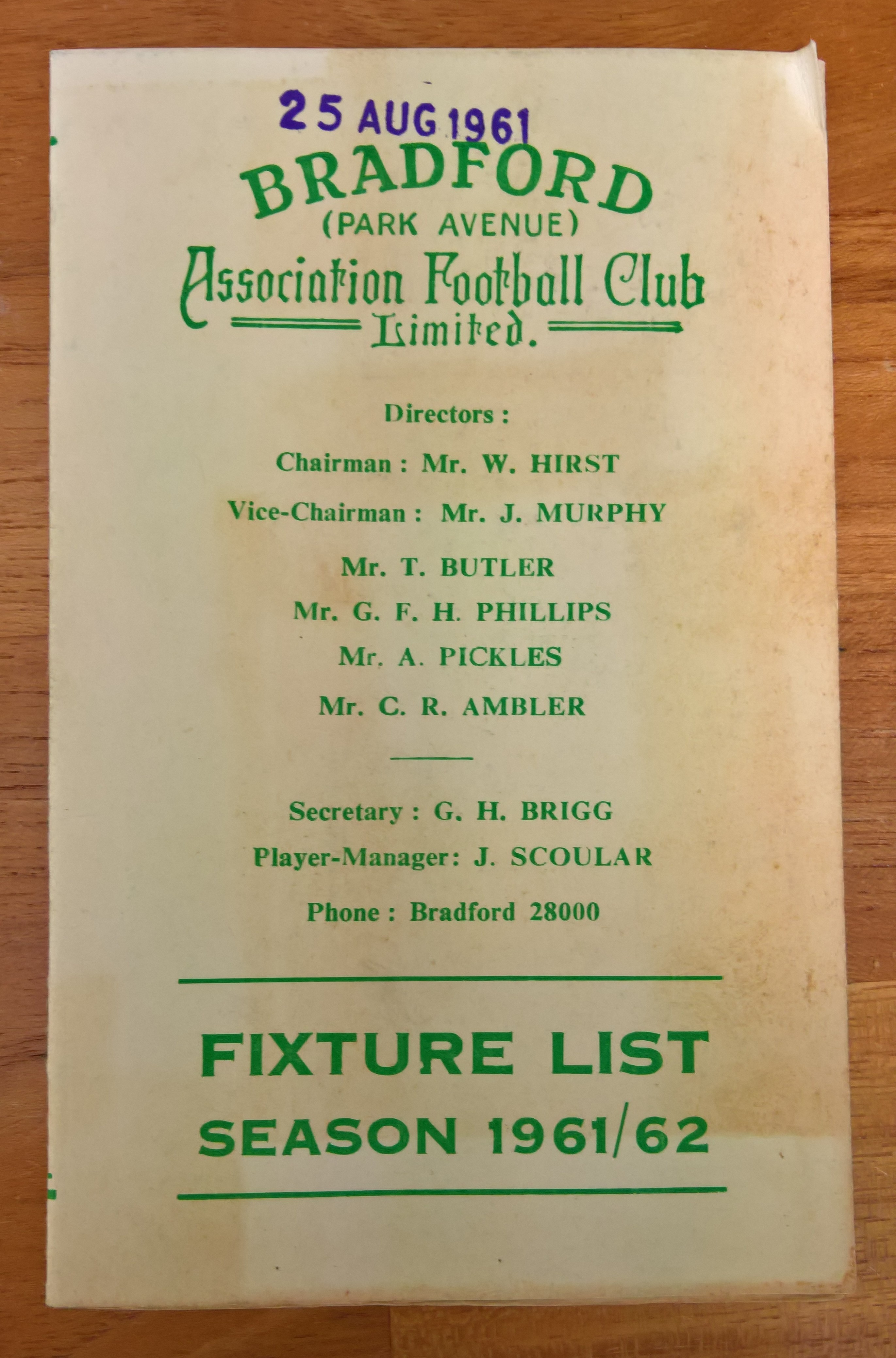
The Avenue internet forums attest to the sensitivity of the brackets issue among a significant proportion of Stans. In case anyone had noticed, the Horsfall club had been renamed the Bradford Park Avenue Community Benefit Football Club – without brackets – as part of a makeover with the new organisational structure. In other words, just as in 1909 when the club had a change of legal structure, so too in 2016. The defence of the brackets by supporters is justified in terms of protecting the tradition and heritage of their club. Notwithstanding, it is notable that the original club which existed between 1907-74 (prior to liquidation) was by no means consistent in its application of brackets as these illustrations from 1961/62 demonstrate.

WP_20170416_22_07_56_Pro_LI (2)           WP_20170416_22_09_49_Pro_LI (2)

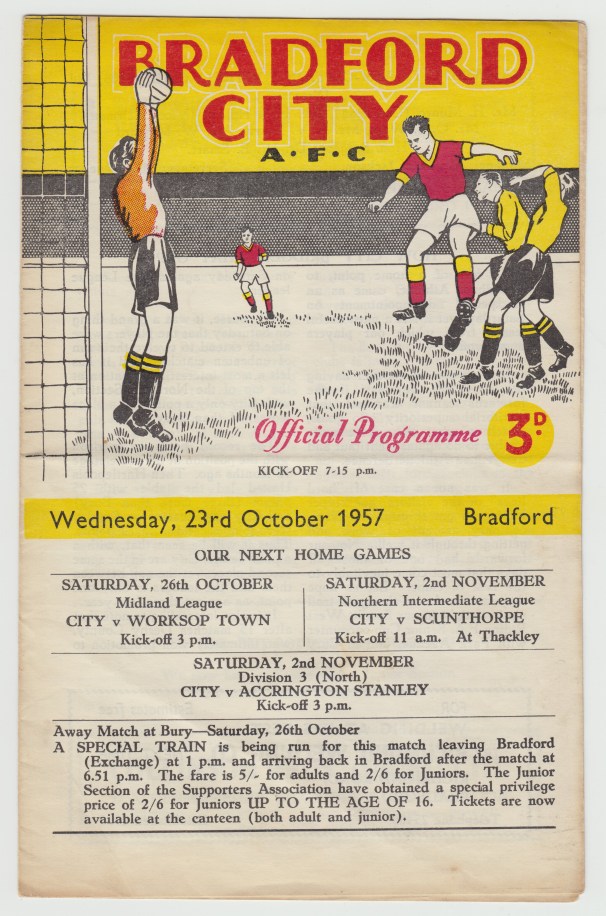
Nevertheless, the fact that the club’s name was originally ‘Bradford Park Avenue’ – without brackets – and that there has been inconsistent use of brackets during the club’s history gives weight to the counter-argument that there is tradition with and without them. By the same token, the club’s traditional red, amber and black colours were overlooked in favour of green and white by the revived club in 1988 to the extent that the latter are now considered to be equally traditional.

Scan_20170706.jpg    Scan_20170706 (2).jpg

Changing names

Of course, all of this becomes a matter of semantics but it is an illustration of how club identities can change by stealth. The point is that if an organisation itself does not safeguard its brand it can hardly expect others to do so on its behalf. The internet is also capable of redefining identities simply by rebroadcasting what is written elsewhere: it propagates bad grammar in the same way that it spreads false news. The chances of the surviving Avenue supporters being successful in enforcing the placement of brackets is slim. Likewise, those who support the senior club will find that the ‘Bradford FC’ identity – as opposed to that of ‘Bradford City AFC’ – will be dominant before too long (if not already) despite all the best efforts of the Valley Parade commercial department, particularly if people are not prepared to say otherwise and it does not offend their sensibilities.

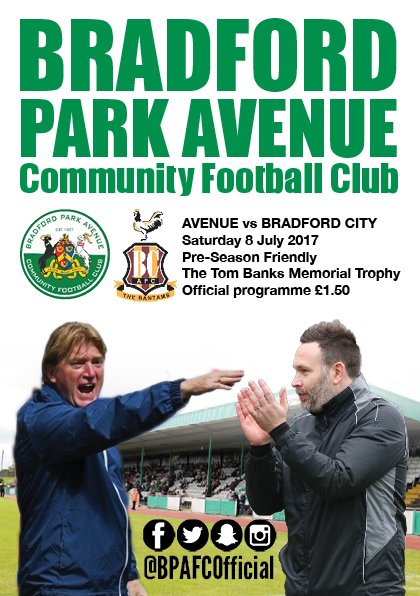
BPA v City Jul-17

Has Bradford FC given up calling itself Bradford?

Ultimately change and evolution is inevitable and no football club can be frozen in a single point in time. So far as Bradford Park Avenue / Bradford (Park Avenue) is concerned it is worth recalling the actions of the club’s founder, Harry Briggs. He was most certainly not a slave to history as demonstrated by his championing of soccer after 1905 and eventual conversion from rugby in 1907, as well as his decision to abandon the club’s red, amber and black colours in 1911. These were decisions that were made for commercial reasons rather than for tradition or nostalgia. Whisper it quietly at Horsfall, neither was Briggs precious about the club’s name and in May, 1907 had proposed that a merged club at Park Avenue would be known as  ‘Bradford City‘!

By John Dewhirst

POSTSCRIPT: In June, 2018 it was announced that the brackets are being restored.

Discover more about the history of professional football in Bradford in ROOM AT THE TOP and LIFE AT THE TOP by John Dewhirst (Bantamspast, 2016).

Scan_20170706 (3).jpg

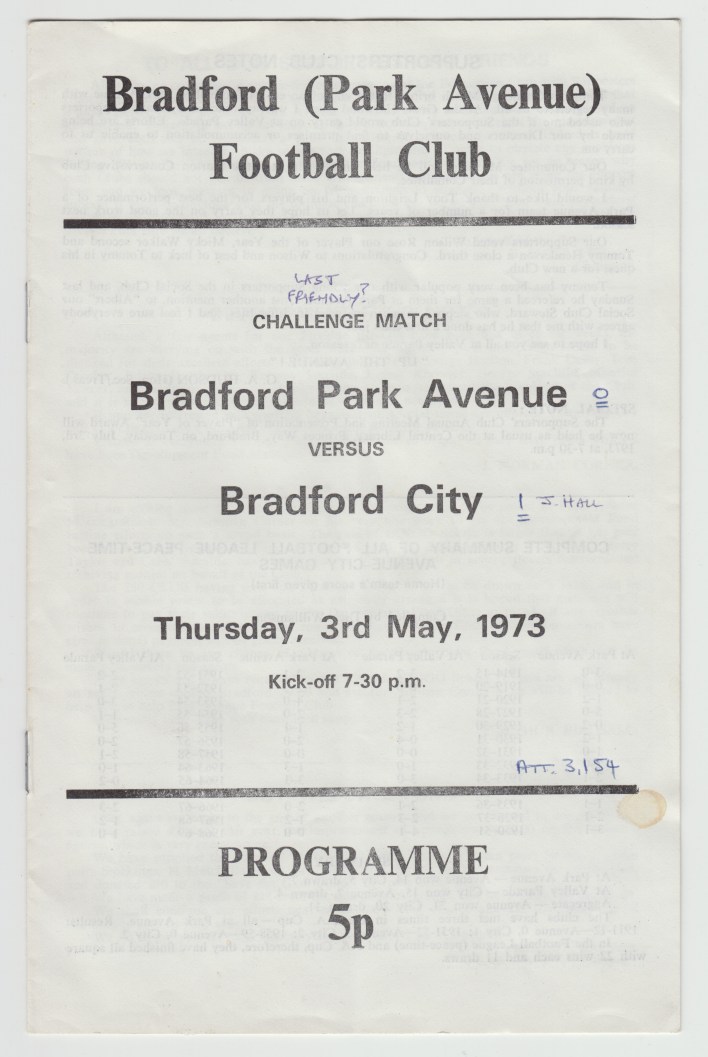
The last friendly game at Park Avenue between Bradford / Bradford Park Avenue / Bradford (Park Avenue) and Bradford City in May, 1973.

The Foulke Effect

THE FOULKE EFFECT
By Ian Hemmens
After the euphoria of Bradford City’s sensational entrance into the world of league football in 1903 where they were elected before even playing a game, things by 1906 weren’t quite going as expected and to plan. Under the stewardship of first Secretary-Manager Robert Campbell, the newly formed club made a solid start with players signed mainly on recommendation without ever really challenging for the promotion to the first league that the committee were hoping for within the first 5 years.

The fact that following Citys election, Chelsea had also been elected and gained promotion within 2 years put pressure on the Manager and after the sale of star winger and England International Jimmy Conlin to Manchester City for the second largest ever transfer fee, and a fading league performance, October 1905 saw the board lose patience and Campbell resigned his post and left by mutual consent.

Whilst the club looked for a replacement, senior player Peter O’Rourke was asked to look after the team. He was at the time team Captain and centre half but after the game in the FA Cup against Darlington, he handed the captaincy over to George Robinson and Gerald Kirk took over at centre half so O’Rourke could concentrate his efforts on the team. The board were so impressed with his efforts he was rewarded with the post of Secretary-Manager on a full time basis and proceeded to start a rebuild for a promotion push which would finally be achieved in 1908. Still a magnificent achievement for a club only 5 years old with no previous experience in the world of association football.

O’Rourke always emphasised the need for a strong defence and a dominating custodian behind them. When he took over, the No. 1 was the excellent and highly promising Jimmy Garvey but the team was dealt a blow when Garvey was hit by a long term injury and also a bout of rheumatism which eventually caused him to retire prematurely when on the brink of a highly promising career. His deputy was the experienced Edwin Daw who, whilst competent, was prone to lapses of concentration and poor mistakes. Daw eventually lost his place to local product Eddie Gott who was mainly a back-up until his release in 1906.

The goalkeeping situation, the atmosphere around the club that appeared after an exciting start to its life seemed to be beginning to tread water needed to be addressed.

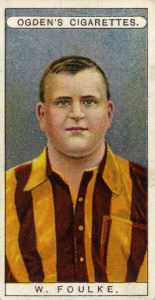
Peter O’Rourke was a thorough and forward thinking manager who had a nationwide list of contacts and scouts on the look out for talent and using his contacts, news got to him that Chelsea’s goalkeeper, the legendary William Foulke was looking to return North. William had signed for Chelsea as a marquee signing and had done much to establish the team and gain popularity with the capitals football fans with his undoubted talents and well known antics.

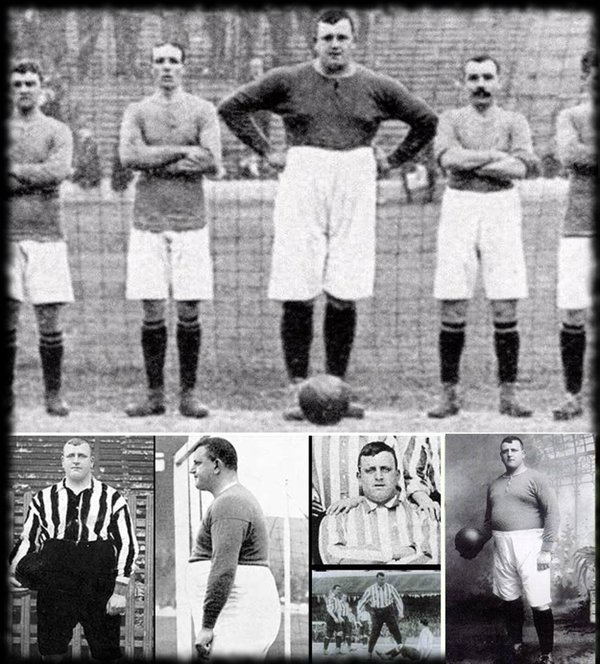
William Foulke was for the Victorian/Edwardian eras an absolute giant of a man physically. Boorn in the Derbyshire mining village of Blackwell he rose to fame as the last line of defence for the excellent Sheffield United side who were a power in the game in the Victorian era. His career with the Blades lasted 11 years from 1894 to 1905 when he was signed by Chelsea. Also an accomplished cricketer to county standard with Derbyshire he stood at 6’4” tall when the average male height was around 5’8”. Photo’s of the time show him dominating the images with his sheer size. Highly athletic despite this, he played for England in 1897 at the height of his powers. A penchant for good living and a drink saw his weight rise to a huge 24 stones before his retirement. A kind and gentle man, he also had a hint of eccentricity which endeared him to fans all over the nation. Stories of his antics were legendary and have passed into folklore and although some were possibly embellished and exaggerated by a hungry press, most of the stories have an element of truth in them. Probably the most well known of them was the case of polishing off the whole teams breakfasts on an away trip after being the first into the dining hall. On another occasion enraged by an apparent injustice by a referee, he proceeded to chase the terrified official down the corridor at Stamford Bridge stark naked. When Liverpool striker tried to charge William & ball into the goal, the giant was so affronted he proceeded to lift the much smaller man up by his feet and dumped him head first into the muddy turf.

Whilst in the capital, if he visited the music halls, crowds would stand and applaud him whilst he took his seat hoping he wouldn’t be sitting directly in front of them.
His wife Beatrice and their children remained in their Sheffield home running the family shop during his years sojourn at Stamford Bridge. This was seen as the main reason for him wanting to return North although by 1906 his burgeoning bulk and advancing years meant despite his reputation his powers were on the wane.

During his career, just about every description of any thing large was given to him, as well as several names William, his given name, Willie, Billy, the endearing Little Willie and the less endearing Fatty.

Foulke montage
After agreeing with Chelsea a fee of £50 on the proviso that Foulke could train at Bramall Lane during the week, Foulke signed for Bradford City and Peter O’Rourke got his man. The West Riding press went into overdrive with the news of his impending arrival at Valley Parade. His debut came in the last fixture of the 1905-06 season in the home game against Yorkshire rivals Barnsley. City were on for a mid table finish and William gave the club the shot in the arm it needed and when he ran out first there was said to be huge cheering from the gathered throng which was said to be around 3000 up the on seasons average. In the end, a goalless draw was played out but the crowd anticipated good times were ahead if the club could show such ambition with future signings.

As mentioned, the loss of Conlin was a big blow but the fee received went a long way towards O’Rourke being able to rebuild the team for a promotion push the following season. William had a new defensive pair in front of him, both very competent and robust defenders in Fred Farren and future club legend with a familiar name in Robert ‘Bob’ Campbell who was to remain until retirement during WW1.

With the dominating Foulke and other new signings in place, a new optimism surrounded Valley Parade showed by the growing crowds. Barnsley were again the visitors for the first game of the new season and a crowd of around 13000 saw the team win 2-0 to set up a far more confident showing than in the previous seasons.

During the season, the Sheffield United committee refused William permission to allow him to continue training at Bramall Lane. Possibly they wanted a clean break from the past which had been a great era but now were in much leaner times. He now had to make a daily trip to Bradford to train with his new team. As well as his performances on the field, his antics continued to bring mirth to the local media and his many fans. Before the cup tie with Accrington, he had misplaced his kit bag and came out in his old Chelsea shirt. Accrington objected but a shirt large enough couldn’t be found so he appeared with a huge bed sheet wrapped around him and pinned together. Its another urban myth that the 1-0 victory led to the phrase ‘clean sheet’. It was also said that Manager O’Rourke insisted on the giant Foulke squeezing through a small gate to receive his wages when they were handed out much to the amusement of his fellow team mates.

Foulke card
After making 21 appearances, injuries started to be more frequent and conditions of a ‘rheumatic complication’ saw an even longer lay off. His deputy Albert Wise took over as City finished a credible 5th position and as problems continued, William bowed to the inevitable and in November 1907 announced his retirement from the game he had graced since the 1894 season.

City would finally gain the much cherished promotion to the top of the English game the following season and then consolidate themselves before pushing on and winning the FA Cup in 1911 but the big mans contribution to kick starting the momentum again which was starting to dissipate cannot be underestimated such was his celebrity nationwide. It is to the credit of Peter O’Rourke that he could see the club needed a focal point whilst he rebuilt the team In today’s society of huge media, social media and hype that goes with any sort of celebrity, one can only imagine how a character like William would be feted these days.

He returned to his Sheffield home to run the family shop and also run a public house.
In 1916 after watching a wartime game at his beloved Bramall Lane between Sheffield United and Grimsby Town he was taken ill and admitted to a local hospital but his condition worsened and on May 1st 1916, William Foulke died aged 42 years.
A huge crowd gathered at the citys Burngreave cemetery to bid farewell to a legend of not only the game but society itself.

The fact that he is still known today and spoken about is a wonderful legacy for one of the games early superstars.

Recommended reading – Colossus by Graham Phythian

The forgotten pot – the story of the Bradford Charity Cup

Bradford City AFC is best known for its exploits in cup competition in 1911 and as recently as the past few seasons. To a lesser extent, Bradford Northern likewise for its record in the Rugby League Challenge Cup during the 1940s. So too, Manningham FC – predecessors of Bradford City at Valley Parade – was a club whose origins and early development had much to do with participation in cup campaigns. Rightly so, the Yorkshire Challenge Cup launched in 1876 and first contested in the 1877/78 season is credited for its impact on the spread of ‘football’ in the Bradford district and the stimulus that it provided to a footballing culture in the town.

Another competition, the Bradford Charity Cup instituted at the start of the 1884/85 season, deserves to be recognised for having fuelled local interest in football despite the fact that – in its original incarnation – it had a relatively short life of only ten seasons. Its link to charitable support also embraced a key tenet of athleticism in Bradford, the conviction that financial surpluses from organised events should be donated to help fund the town’s infirmary rather than the pursuit of Mammon.

The Bradford Charity Cup has a unique place in the history of Bradford sport, a trophy that was adopted by three different football codes in the space of thirty years. It similarly provided inspiration for the Priestley Cup of the Bradford Cricket League, launched in 1904 and still in existence today. Despite its impact on the development of Bradford sport, the Bradford Charity Cup has been forgotten.

Charitable motives were critical in the development of Bradford sport and you cannot tell the history of sport in the district without recognising the importance of charity fundraising intentions. This is the story of what was called the ‘small pot’.

The ‘Owd Tin Pot’

The Yorkshire Challenge Cup – the ‘Owd Tin Pot’ – immediately captivated the minds of football enthusiasts in Bradford. The competition had been promoted by Harry Garnett of Bradford FC. On the basis that the club considered itself to be one of the leading sides in the county, there was an implicit assumption that it should be victorious which meant that defeat at the hands of eventual winners Halifax FC in the semi-final tie at Apperley Bridge in December, 1877 was notable for two reasons. Apart from shattering the complacency that Bradford had a divine right to success, it also challenged the existing order in so far as Halifax had been a completely unfancied side. The dream was thus born that cup glory was in the reach of a well-organised team and that the pedigree of a club was no guarantee of winning.

During the second half of the 1870s there was a dramatic change in the life of working men in Bradford who were now able to enjoy greater recreational time. It is no coincidence that growing enthusiasm for football – the colloquial term for rugby – came after the passing of the Factory Act of 1874 which had led to the closure of mills at noon on a Saturday.Having secured leisure time, people wanted to make the most of it and what is striking from contemporary newspaper reports is the sheer passion for ‘football’ that was shared by those who played the game. It was not just an opportunity for an idle kick-around as opposed to a pastime played with intent and for a purpose. Indeed, there was considerable competitiveness among players despite the fact that for most, their induction was recent. This soon translated into a focus on winning the Yorkshire Cup which was at the centre of football interest in West Yorkshire.

In Bradford there was an expectation that the trophy should be brought back to the town and it was considered anomalous that a team of Bradfordians could not win the competition given the extent to which ‘football’ had taken off with the emergence of new teams after 1875. This inevitably put pressure on Bradford FC, as the senior side in the district, to succeed.The failing of Bradford FC to win the Yorkshire Cup gave weight to the argument among members of other clubs in the district – which by 1878 comprised Bradford Albion, Bradford Caledonian, Bradford Rifles, Bradford Zingari, Bradford (Manningham), Bradford Juniors, Dudley Hill, Airedale, Bierley and Bowling – that the best talent was being excluded from representing the town in a single team. To what extent this amounted to prejudice on account of social background, friendship groups or partisan loyalty is difficult to say but it left players from other clubs in no doubt that they should enter their own team to fulfil their patriotic duty to their home town of being victorious in the final. (One factor that determined who played for Bradford FC was that it played its games at Apperley Bridge, hardly convenient to the majority of players a good proportion of whom lived in Manningham.)

At the beginning of the 1878/79 season a new side, Bradford United entered the Yorkshire Cup comprising players mainly from the Bradford Rifles club. Its challenge to the status of Bradford FC as the leading club in the district was given weight by the fact that the Bradford United team progressed further in the competition – Bradford FC was knocked out in the opening round at Wakefield Trinity whilst the Bradford United side was defeated in the second round at Leeds.

In April, 1879 agreement was reached between the members of Bradford United and the senior Bradford club that the latter should expand its membership to become more inclusive. What persuaded the Bradford FC captain Harry Garnett and the other leading personalities of Bradford FC to acquiesce was the prospect that the Bradford United players might otherwise be invited to play at the new Park Avenue ground rather than their own club, whose self-identity was that of being one of the aristocrats of Yorkshire rugby. In 1880 the enlarged Bradford Football Club merged with the reconstituted Bradford Cricket Club to become the Bradford Cricket, Athletic & Football Club and based at Park Avenue. Notwithstanding, the changes failed to have an immediate impact and it was not until 1884 that the Yorkshire Cup was secured, the eighth season of the competition.

The nature of football rivalry in the town

Other than Bradford FC and Bradford United, three more Bradford clubs entered the Yorkshire Cup in the early years including Bradford Albion, Bradford Juniors, and Bradford Zingari. The cup offered the possibility of glory (however unlikely that might be) and progress in the competition was considered a yardstick of standards for players to earn bragging rights. The rivalry of the original clubs was short lived owing to the restructuring of Bradford football between 1879-80 that led to the disappearance of Caledonian, the disbanding of Zingari in March, 1881 and the formation of Manningham FC in 1880. Albion disappeared in 1886 and the Rifles remained peripheral, depleted by key players joining Bradford FC. A key theme was that the nature of the rivalry between these clubs was essentially that between individual players.

The clubs who emerged in the 1880s were altogether different. In terms of social composition, they tended to have a far higher proportion of skilled working men. The other characteristic was that these clubs were defined by geographic affiliation and it didn’t take long before every village in the Bradford district had its representative. The Yorkshire Cup had the same allure and when Bradford FC finally won the competition in 1884 it encouraged the formation of yet more sides. By the mid-1880s there was already a defined hierarchy of clubs ranging from the two seniors in the town – Bradford FC and Manningham FC – to the feeder clubs who tended to play in the parks. Although there were rivalries between the players of the respective teams, the rivalry of the clubs now tended to be defined by their supporters.

In the absence of league competition, it was the Bradford Charity Cup that played a key role in the development of rivalries in the district and it should be recognised for its role in developing a football culture in the town. The junior clubs had a bit part in the Yorkshire Cup, gaining attention from participation in the early rounds and deriving credit from players graduating to the town club. The Bradford Charity Cup however allowed those clubs to taste glory and emulate the victory celebrations of their larger brethren.

There was a defined pecking order of clubs in the Bradford district but what characterised rugby in the area was the sheer strength in depth. So too, the number of teams was proof that Bradford was once very much a rugby town. We tend to believe that sport came of age in the modern era in terms of mass participation yet by 1895 there were more than one hundred rugby sides in the Bradford district. (That most of those had disappeared by the end of the century in favour of soccer was equally remarkable.) The rugby enthusiast was spoilt for choice. In addition to the rivalry of the seniors, there was strong competition at all levels with at least half a dozen decent junior sides in the Bradford district and it all amounted to variety and a rich football culture. Indeed, Bradford of the 1880s and 1890s can rightly claim to have been a sporting centre with well-established clubs catering variously to cricket, athletics, cycling, gymnastics and for that matter, chess. The Bradford Charity Cup reflected and contributed to the vitality of Bradford sport.

The small pot

In the immediate aftermath of winning the Yorkshire Cup, Bradford FC was active in charity fund-raising initiatives. One such event took place at Cardigan Fields in Leeds on 15 April, 1884 at which a Leeds & District XV played a Bradford & District side to raise money for the Leeds and Bradford Infirmaries. The following month, the Bradford Charity Cup competition was instigated by Bradford FC with the patronage of the Mayor, Isaac Smith as the club continued to bask in the glory of its Yorkshire Cup success.In the nineteenth century, sporting events had traditionally been associated with gambling and drink. As if to demonstrate the respectability of sporting activity, the athletic festivals that became increasingly prevalent in West Yorkshire from the 1860s – as indeed throughout the rest of the country – became closely associated with charitable fund-raising. In this way, sport was promoted as a force for good and for social unity rather than the sponsor of less virtuous behaviours. The link with charity also represented an alignment with the practice of the annual Whitsun galas at Peel Park which – after the final repayment in 1863 of debts arising from the purchase of the park – raised funds for the town’s infirmary.

In due course the connection between sport and charity, in parallel to that between athleticism and military preparedness, became institutionalised. In Bradford, the commitment to charitable support became an intrinsic component of football culture and from 1876 it was the focus of the annual contest between Bradford FC and a District XV team comprising representatives of other clubs.By the mid-1880s football charity cup competitions had become commonplace in industrial towns with such examples in Sheffield, Wendesbury, Blackburn, Bolton and Burnley. The most famous of all was the Glasgow Charity Cup which had been staged since 1876.

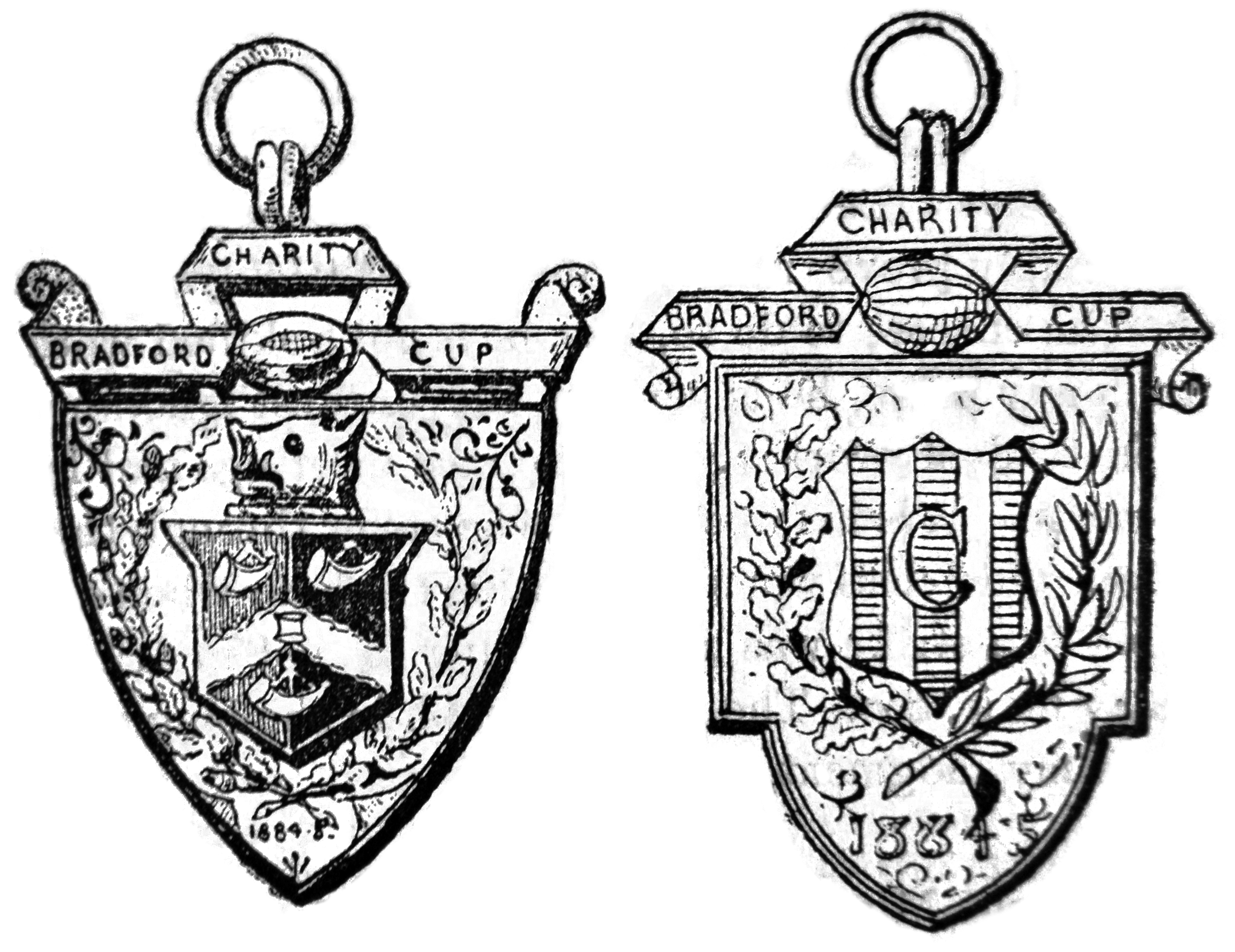
In common with the Yorkshire Cup, the FA Cup and the Rugby League Challenge Cup as well as the Keighley Charity Cup, the Bradford Charity Cup trophy was designed and manufactured by Messrs Fattorini of Bradford. The firm also manufactured the winners’ medals, description of which was reported each year in the local press with readers informed of the size, weight and composition. Even the change in design from a shield to a circular shape in 1892 was recorded. The Fattorinis proved adept at self-publicity and the medals were displayed in the firm’s shop window on Kirkgate, Bradford.
1885-05-02-Toby-Brd Charity Cup Medals MFC (3) 1

In September, 1906 the Northern Union Challenge Cup and Bradford Charity Cup trophies were rescued from the Alexandra Hotel where a fire had started in one of the reception rooms used by Bradford FC for official functions. At the time, the value of the two were quoted to be 60 guineas and 50 guineas respectively. The relative value of the trophy plainly demonstrates the importance attached to the competition at the time of its launch. Hence, although referred to as ‘the small pot’, the Bradford Charity Cup trophy sounds to have been anything but. The Bradford Daily Telegraph of 19 February, 1902 described it thus: ‘made of solid silver, 22 inches high with a football figure on the lid, and round the bowl are views of the Infirmary, the Eye & Ear Hospital, etc’. Interestingly this differs from the description in the Bradford Daily Telegraph of 28 July, 1884: ‘In the centre of the face is a representation of a football field, with two competing teams struggling for the ball, and goal posts and cross bar in the distance. A coloured shield, with the motto ‘Labor Omnia Vincit’ engraved beneath it, is placed above the centrepiece. The handles and stem are of delicate structure, and the latter rests on a substantial stand. The cup is richly decorated, and will be a handsome trophy of which the winners may well be proud.’
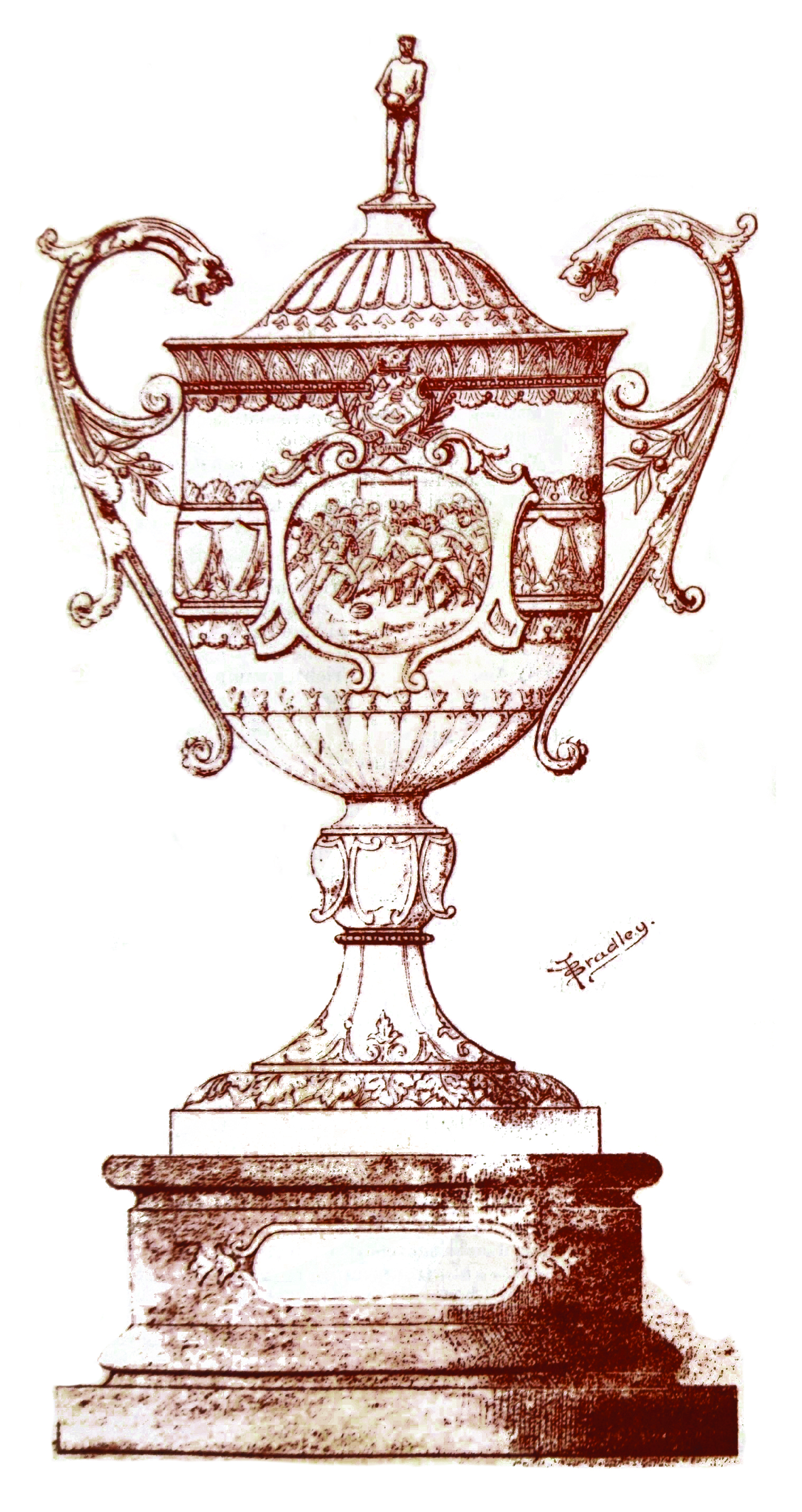
1884-08-02-Toby- Brd Charity Cup (1) 1

The Bradford Daily Telegraph of 14 June, 1884 specifically identified the Glasgow Cup competition as the inspiration and noted that the Glasgow hospitals had benefited by £5,000. It was reported that the Bradford competition was to be organised on the same lines with a governing committee comprising three members of the Bradford FC committee, four of the Joint Hospital Fund Committee and four representatives of the district. The competition was thus supervised on behalf of the Bradford Joint Hospital Fund in conjunction with the Park Avenue club. However, there was a certain pomposity about the motives of Bradford FC promoting its launch which had to do with the club wanting to demonstrate its charitable largesse as well as its paternal encouragement of football in the district.

The original concept appears to have been that the top four sides in the district should compete but doubts about whether this would attract public interest due to a gulf in standards may have led to entry being restricted to junior sides. The Bradford Daily Telegraph of 28 July, 1884 for example questioned whether it would ‘prove an effective means of raising money for the Infirmary unless the radius from which the teams will be drawn is very much widened.’ It was asked whether it was necessary to invite the likes of Wakefield, Halifax and Huddersfield to compete with Bradford FC but in the final event it was decided that it should be junior sides who entered to make it a more competitive contest. The decision probably suited Bradford FC which could underline its status as the leading side in the town by refraining from entry. Hence it was deeply symbolic that it was the Bradford FC ‘A’ team that entered the competition alongside the Manningham FC first team as well as junior clubs in the district. The two other entrants in the first season of the competition were Bingley and Cleckheaton.

The chosen format proved successful in generating public interest and the inaugural final at Park Avenue in April, 1885 was well attended with a ten thousand gate and £170 receipts. This contrasted with the crowd variously reported as twelve and sixteen thousand who watched the Yorkshire Cup final at Cardigan Fields in Leeds the previous week (between Batley and Manningham) and that of between five and six thousand’ who attended the comparable Wharncliffe Charity Cup final at Bramall Lane, Sheffield.

Manningham played Cleckheaton in that first final with the defeated semi-finalists being Bingley and the Bradford FC ‘A’ team respectively. Having been losing finalists in the Yorkshire Challenge Cup in 1885, Manningham FC were the clear favourites to win the Bradford Charity Cup but nonetheless it proved to be a close game. The Athletic News of 14 April, 1885 reported that ‘though not a ‘spite and malice’ match, (it) was about as close as they get things even in Yorkshire. At the end of the original term for play, each side had scored six minor points. In an extra 20 minutes Fred Richmond dropped a goal, and thus won the match.’

The cup success was cherished by Manningham supporters and in June, 1885 it was even commemorated by a floral display in Lister Park by Frank Richmond – Fred’s brother and himself a member of the winning Manningham team – whose father was head gardener of the park. It continued a theme from the previous year’s display which had been a tribute to the Yorkshire Cup success of Bradford FC.The Athletic News was effusive about the success of the Bradford Charity Cup in its first season and on 14 April, 1885 had reported that ‘the Bradford Charity Cup competition in which only four clubs engaged, will realise considerably over £300 for the purposes intended. Is there any other sport in kingdom which raises half so much for charities as football? If so, we do not know that particular game.’ It was not only that the competition had been successful with fund raising (NB the £300 claimed would have been the gross gate receipts as opposed to the net contribution after deduction of expenses). The competition had also helped refute criticism that rugby was associated with rough play: ‘The Mayor of Bradford, in presenting his Charity Cup to Manningham, mentioned that although there had been an immense amount of football in the neighbourhood, there had not been a single case of an injured football player being taken to the Bradford Infirmary.’

The Leeds Times of 19 September, 1885 reported that the Bradford Charity Cup prompted imitation competitions in Dewsbury, Halifax and Huddersfield. Indeed, such was the interest in the competition that in October, 1885 one enterprising trader was even advertising score cards for the Bradford Charity Cup as well as the Yorkshire Cup in the press. In the final reckoning therefore, the impact of the Bradford Charity Cup had wider reach than the confines of the Worstedopolis.

In the second season, 1885/86 the number of entrants was expanded to sixteen and comprised the following to become a truly district-wide competition: Bingley; Bowling; Bradford ‘A’; Bradford Trinity; Buttershaw; Cleckheaton; Dudley Hill; Greengates; Heaton; Keighley; Liversedge Old; Manningham; Manningham Rangers; Queensbury; Saltaire; Shipley and Skipton. Other participants later included Bowling Old Lane, Farsley, Idle, Low Moor St Mark’s, Silsden, Wibsey and Windhill. The stipulation was that they came from the area in which the Bradford hospitals drew their patients.

On 14 September, 1886 Alfred Pullin commented in the Athletic News that ‘Junior Challenge Cup competitions are becoming as thick as mushrooms. There are the ‘Wakefield Express,’ the Huddersfield, the Halliday (Huddersfield), the Halifax, the Bradford Charity, and the Wharfedale & Airedale Observer competitions all on the tapis. The Wharfedale is a new institution, and the cup is now being manufactured by Messrs. Fattorini & Sons, the well-known athletic prize manufacturers.’ It marked the high point of the fashion for charity cup competitions in the region and the enthusiasm of local newspapers to sponsor such competitions revealed their popularity. (NB entrants in the Wharfedale & Airedale Cup from what now constitutes the Bradford Metropolitan District included Bankfoot, Dudley Hill, Idle, Ilkley Rovers, Keighley Shamrocks and Wibsey.)
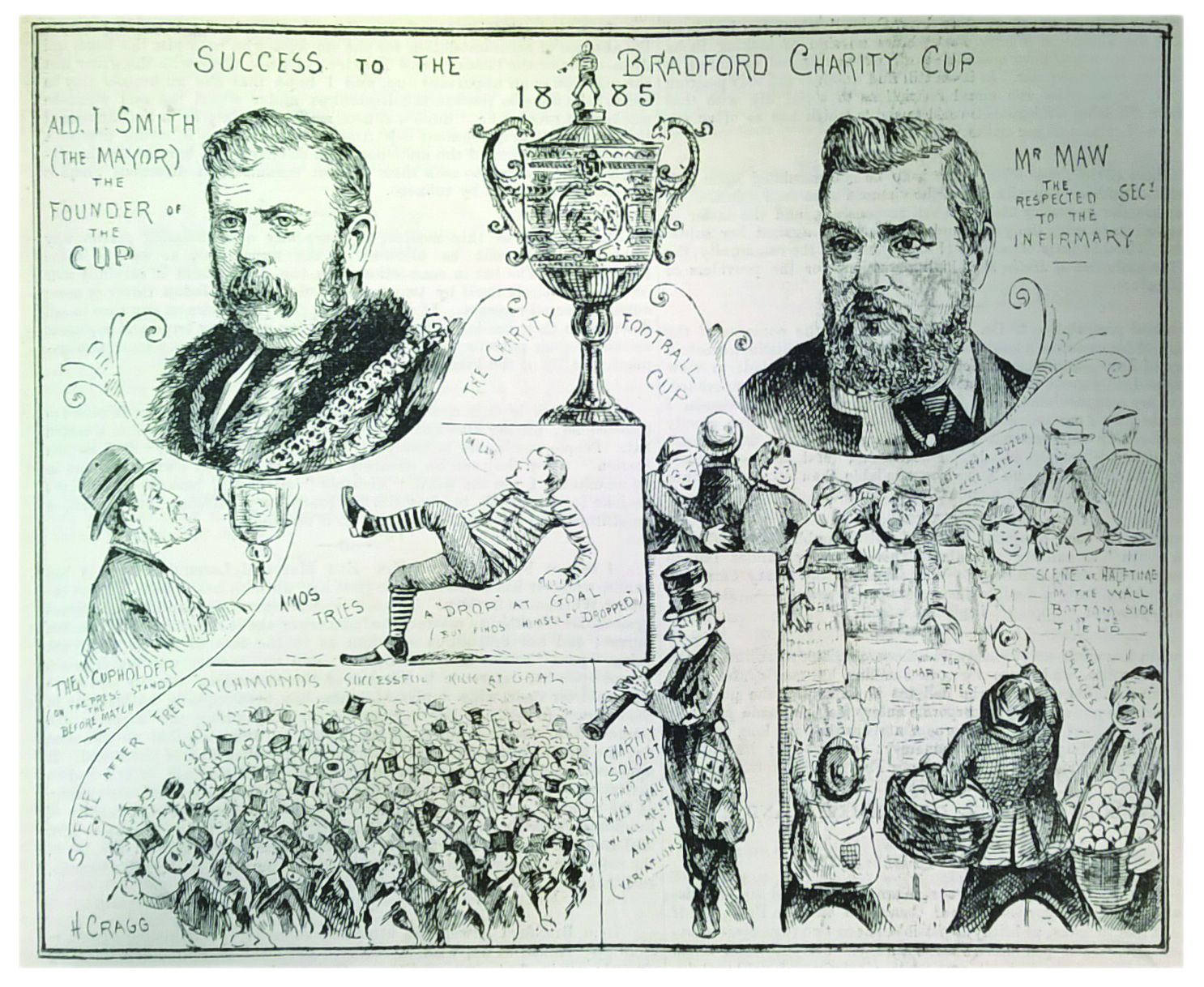
1885-04-18 BCC sketch 1

The winners

The Manningham FC side proved too strong and won the competition during the first two seasons under the captaincy of Harry Archer and William Fawcett respectively. Manningham’s defeat of the Bradford ‘A’ side in the semi-final of the Bradford Charity Cup in April, 1886 – a game witnessed by a crowd of eight thousand at Park Avenue – was a defining moment as it represented the first time victory had been achieved by Manningham against representatives of the senior club. Manningham FC magnanimously withdrew from the competition after the club’s victory over Bradford Trinity in the 1886 final and this allowed the club to make a point about its pedigree. According to the Athletic News of 25 May, 1886 ‘Manningham have decided that in future the ‘A’ team, and not the first team, shall compete. As Bradford first is barred, Manningham first have barred themselves, considering their ‘A’ team quite as well qualified as the Park Avenue ‘A’ team to represent the club.’ Manningham FC remained anxious to demonstrate its charitable largesse and in November, 1886 the recently opened Valley Parade was made available to host the derby second round tie between Shipley and Bingley.

Notable is that Manningham FC’s decision to withdraw was criticised, no doubt emanating from Park Avenue where there was little love lost for the emergent rivals to Bradford FC. The Athletic News of 8 June, 1886 for instance commented that ‘the Bradford Charity Football Cup competition has received a knock-down blow by the decision of the Manningham FC to allow their second team to represent them in next season’s contest… The general opinion is that it would have more patriotic for the Manningham first fifteen to have tried for the cup another year and then, after winning it, as they probably would do, to hand it over to the Charity Committee for competition under revised arrangements.’

The Bradford Charity Cup had certainly been popular with Manningham supporters and the club’s withdrawal would have impacted on the finances of the competition; a crowd of seven thousand had attended the second tie between Manningham and Cleckheaton at Carlisle Road in December, 1885. In April, 1886 it was also decided by the organising committee that the competition should be restricted to only eight sides, presumably on account of difficulties incurred during the 1885/86 season to arrange ties and the marginal revenue derived. Already the Bradford Charity Cup was facing constraints on its ability to generate funds.

During the eight seasons from 1886/87 to 1893/94 no fewer than six different clubs won the trophy and a total of eight different sides appeared in the final, evidence that it was a fairly open competition. The reserve teams of Bradford FC and Manningham FC surprisingly made little impact. In 1890 the Manningham ‘A’ team reached the final but was unable to play on account of the club’s Easter tour of South Wales; opponents Shipley FC refused to re-arrange the game and Buttershaw FC substituted for Manningham to set up a re-run of the 1889 final.
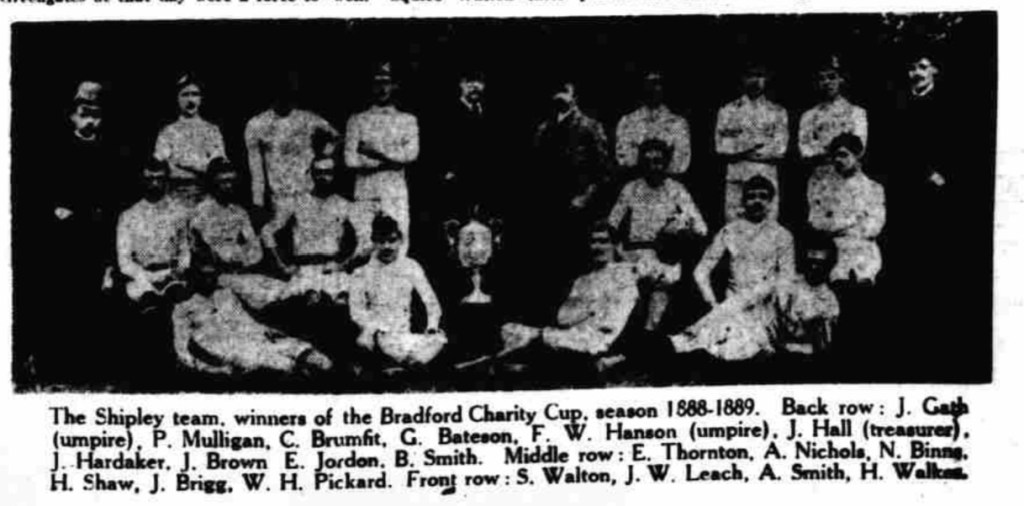
This image has an empty alt attribute; its file name is shipley-fc-1889.jpg

During the ten years of the Bradford Charity Cup, Manningham FC, Bowling and Shipley won the trophy on two occasions. Shipley and Buttershaw boasted the most appearances in the final (three) but Shipley could claim the best record with only one defeat.

Bradford Charity Cup Finalists – Rugby Union
Year Winners Runners-up
1885 Manningham Cleckheaton
1886 Manningham Bradford Trinity
1887 Cleckheaton Shipley
1888 Buttershaw Cleckheaton
1889 Shipley Buttershaw
1890 Shipley Buttershaw (NB Official records disclosed ‘beaten’ finalists to be Manningham who were replaced by Buttershaw due to being unable to participate.)
1891 Bowling Bowling Old Lane
1892 Bowling Windhill
1893 Bowling Old Lane Low Moor St Mark’s
1894 Yeadon Windhill

The demise of the competition

In its early years, the Bradford Charity Cup was popular and it was reported that the early finals at Park Avenue were attended by five figure crowds. Even though attendances declined they were reported to have remained in excess of five thousand for the final ties.

During its existence the Bradford Charity Cup was said to have raised a total of £1,116 for charity. By 1894, when the competition was abandoned the proceeds were reported to be negligible. Contrast this with the record of the Glasgow Merchants’ Charity Cup that was cited as the inspiration and which continued until 1966; during its ninety years of existence it is estimated to have generated a total of £350k whilst in the corresponding seasons, 1884/85 to 1893/94 a total of £8,860 was donated to charity. (From Remembering Us Year after Year: The Glasgow Charity Cup 1876-1966 by Wray Vamplew, University of Stirling (2008).)

The gate proceeds at the Bradford Charity Cup final in 1887 were reported to have been £158 with a crowd of twelve thousand; these fell to £116 the year after and then to £111 in 1889 when there was a reported crowd of 8,000. In 1891 and again in 1893 the finals were said to have attracted only six thousand. Accordingly, the net revenues must have declined significantly by 1894.

Of course, it was not just that gross income was declining. Clubs would have been anxious to recoup their own expenses and there is a good chance that the financial arrangements were renegotiated with the management committee of the competition. There were also fixed costs associated with staging the semi-finals and final such as advertising and the cost of medals for the winners. (The practice was that medals were funded by public subscription rather than gate receipts.)

A number of reasons may be given for the demise of the competition. The first is that after 1892, junior clubs in the district had become focused on success in league competition and the second is that after 1891 football gates had suffered the economic effect of lower disposable incomes, a consequence of trade depression. The finalists in 1894 – Yeadon and Windhill – were considered to be among the smaller clubs in the Bradford orbit and unlikely to attract a decent attendance.

The relatively low crowd for the third round Yorkshire Cup tie between Bradford FC and Bingley FC in March, 1894 demonstrated that spectators were more interested in big name fixtures; even a cup game could only attract eight thousand to Park Avenue. Besides, after 1890 most fixtures involving the two senior Bradford clubs against local opposition were for fund-raising purposes to avert their financial implosion and the novelty value had disappeared. Equally, whilst the first round cup tie between Bradford FC and a local junior team, Wibsey FC in March, 1894 undoubtedly had a romantic appeal it was something of an inconvenience for the senior side to have to go through the motions.

The one contest likely to draw a large crowd was that between Bradford FC and Manningham FC yet their focus was league competition. Neither wanted the distraction or implications of a showdown cup tie, particularly after the controversy of 1887 involving the postponed Yorkshire Cup match between the two at Park Avenue. Besides, their participation would have been at the expense of the juniors and counter-productive to wider participation and the success of smaller sides.
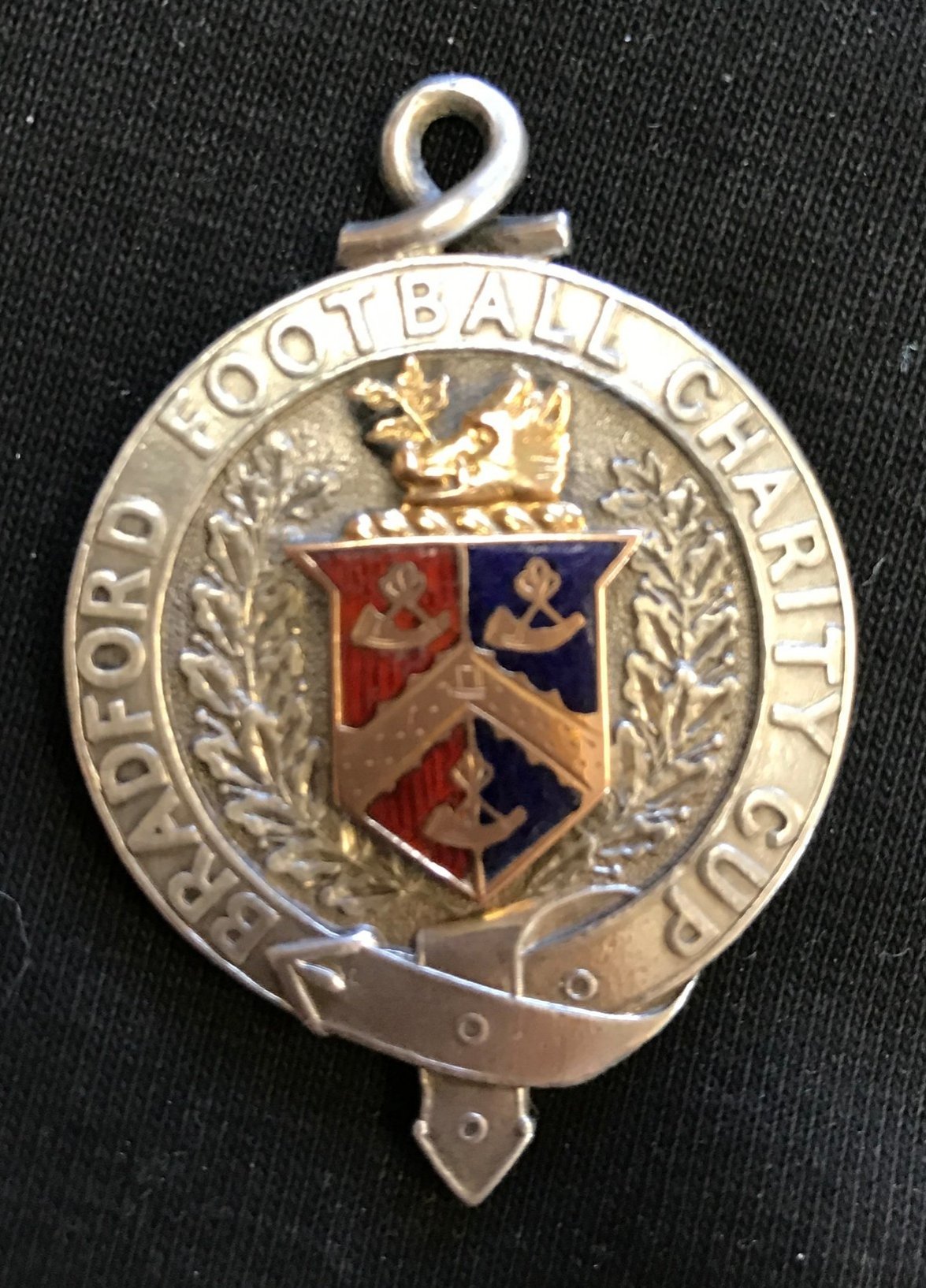
20200409_0643156652262618789218175.jpg

(Image above courtesy of Ron Watson)

However, it was not only the loss of enthusiasm among spectators and the organising committee, but among the clubs themselves. The Bradford Daily Telegraph of 4 April, 1893 mentioned that larger sides were withdrawing from the competition. Similarly, in its report of 27 January, 1894 of the Windhill v Idle semi-final the same paper bemoaned the fact that there were only eight entrants. Furthermore, none of those sides contesting the Bradford Charity Cup in 1893/94 could be described as having any sort of pedigree – Farsley, Idle, Low Moor, Saltaire, Silsden, Wibsey, Windhill and Yeadon – most of whom had abandoned the Wharfedale & Airedale Cup.

Clubs faced an opportunity cost from participation in the competition by virtue of donating gate receipts to charity and this would have been particularly felt by those reaching the semi-finals. Nor was there an economic benefit to the finalists who lost the opportunity to stage an ordinary fixture on Easter Monday, one of the prime dates in the football calendar.Alfred Pullin had written in the Athletic News on 9 November, 1886 that ‘With Manningham’s withdrawal the competition has become a barren affair, and such clubs as Cleckheaton and Liversedge are, I hear, not likely to go in for it another year. What was thus a high class competition will, therefore, sink to a junior’s level, and, seeing that the institution is a charitable one, this is much to be regretted.’

The singular criticism of Manningham FC was somewhat unfair; it failed to acknowledge the lack of a critical mass of clubs of both equal and sufficiently high standard in the Bradford district to make the contest competitive and appealing to the public.

Another matter that may have dissuaded the organising committee from continuing with the competition was that it was attracting the wrong headlines. In March, 1889 for example, the Shipley player Lister Wade died of his injuries in the semi-final tie with Saltaire FC at Park Avenue. The Bradford Daily Telegraph of 9 March reported that several rough incidents had occurred in the second half and that he had been ‘recklessly charged by two opponents’ and forced to leave the field with ‘bleeding from the ears’. (As if to underline the perils of the sport generally, on 12 March, 1889 it was reported in the Bradford Daily Telegraph – and widely circulated in the regional press – that a spectator at the Bradford / London Scottish game at Park Avenue had died having been ‘taken ill supposed from excitement’ – by which it presumably meant a heart attack.)

In April, 1893 the final between Bowling Old Lane and Low Moor St Mark’s was overshadowed by violence that involved one of the Low Moor players assaulting an opposing player. A fracas then ensued that led to the Low Moor team leaving the field and refusing to continue the match.

In a letter to the Bradford Daily Argus of 14 May, 1907 the former Manningham FC captain, William Fawcett (who was voicing opposition to the merger of Bradford City AFC with Bradford FC) blamed Bradford FC for the demise of the Bradford Charity Cup. He claimed of the Park Avenue club that ‘It was through them the Charity Cup lost its popularity, which ought to have brought at least £1,000 a year, and the pantomime carnival started at Valley Parade was soon lost to the charities when it went to Park Avenue.’ The reality was that the Bradford Charity Cup had lost its momentum and fallen out of fashion; The Athletic News of 15 April, 1901 later reflected that ‘the fever for cup competitions in a measure subsided’.

Fawcett’s comments spoke louder about partisan sentiment in Bradford. Notable however was that opponents of merger among the Bradford City membership were at pains to discredit the charity fund-raising credentials of the Park Avenue club. It was a subtle illustration that even in 1907 a notional commitment to charitable giving was a matter of self-respect in Bradford sport. (In February of that year the annual Pantomime football event had been reinstituted at Valley Parade to raise money for local hospitals, a fixture that had originated as a rugby game in 1891. In accordance with tradition it featured Bradford City players and local panto stars with everyone attired in fancy dress, described by the Bradford Daily Telegraph as a burlesque football match.)
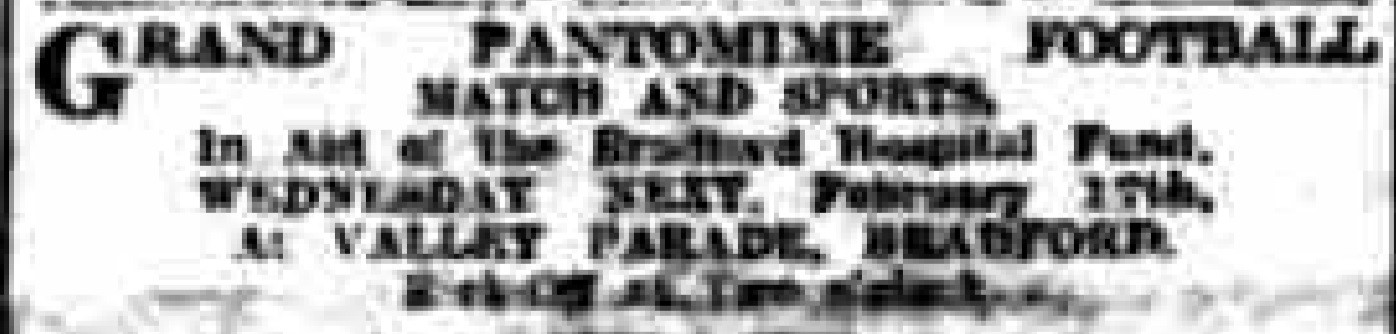
1909-02-13 BDT advert for panto match

The heritage of the Bradford Charity Cup

The Bradford Charity Cup in its original format between 1884/85 and 1893/94 symbolised the emerging football culture in Bradford, a phenomenon that captivated public interest and behaviours. The sport was elevated from being a form of recreation or just a game. For that matter it became more than a burgeoning entertainment business. Rugby football had become fashionable and began to define for itself a new role in the life of the town, celebrated for its perceived contribution to social cohesion, providing a common identity between classes. The sport derived respectability from its declared commitment to charitable giving that allowed it to counter objections about roughness, gambling or commercialism including charges of veiled professionalism. Support for charity allowed sport to be promoted as a force for good that additionally promoted the benefits of healthy activity and assisted the military preparedness of the town’s young men.
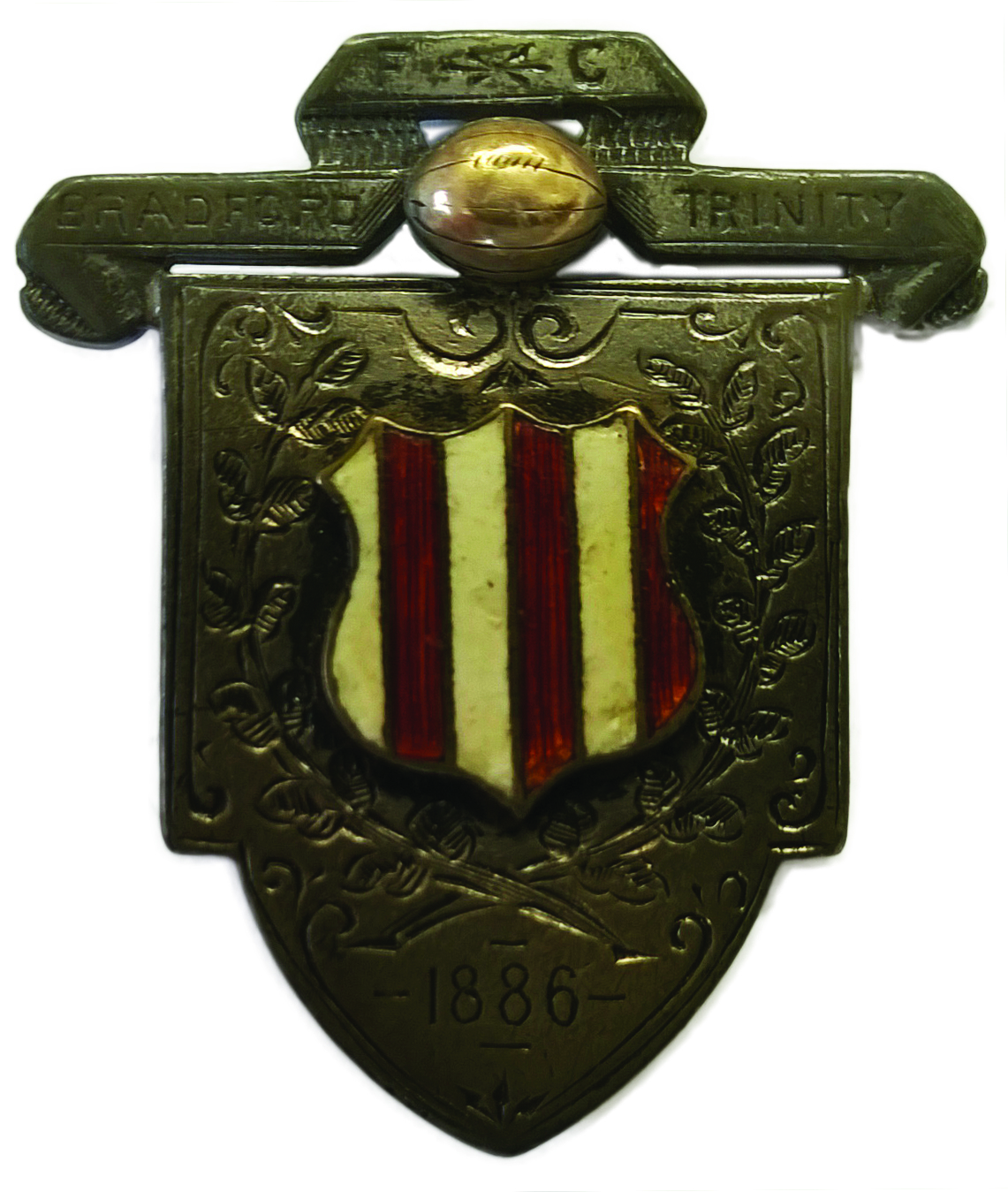
medal H.Till Bfd Trinity 1886 (19) 1

The Bradford Charity Cup also conferred importance to The Bradford Cricket, Athletic & Football Club which exercised self-interest as patron of the competition. Through its launch of the Bradford Charity Cup and the staging of final ties at Park Avenue, Bradford FC was given another opportunity to remind people of its primacy and the hierarchy of clubs in the town. (The sponsorship of cup competition for self-interest was later imitated by Manningham FC who launched the Manningham Challenge Shield competition to promote links with local rugby clubs in 1900. Likewise, in 1927 the Bradford Park Avenue Supporters Club launched its own cup competition for school soccer teams, again to encourage links and support.)

The fixture between the Bradford Rifles and the Leeds Rifles (contested by members of the respective volunteer corps) at Park Avenue in December, 1886 epitomised the spirit of the age with football embracing national and local patriotism, civic identity and charitable giving. The late 1880s was the high point of the charitable ideal; it was a time when the sport was in its infancy, when clubs had the profits to contribute and were not overburdened with other financial liabilities.

Another dimension to the charity fund raising was civic rivalry and the pride conferred to Bradford sportsmen able to boast about their charitable credentials, something that continued into the twentieth century. An example of this is provided in the report of the meeting of the Management Committee of the Bradford Cricket League in August, 1912. The Yorkshire Post of 24 August, 1912 reported that ‘the question was raised whether anything should be contributed to Leeds charities given that some of the clubs in the competition were from the Leeds District. The Chairman: Leeds has a Charity Cricket Competition, hasn’t it? The Delegate: No. The Chairman: Then Bradford is setting a good example.’ (Charity fund raising continued to be a means of mobilising civic pride in Bradford. Possibly the best example of this was the cumulative success of the various appeals that originally predated World War One and which eventually reached the £500,000 target for the new Royal Infirmary in 1934.)

The notional commitment to charitable giving remained an intrinsic component of self-identity among Bradford football clubs for the next thirty years even though amounts raised were relatively insignificant. After World War One, in Bradford at least, the principle of charitable support had to be sacrificed to the pressing issue of financial survival and the self-preservation of the clubs themselves. Even so, the tradition continued into the inter-war period of gate receipts from pre-season friendlies at Park Avenue and Valley Parade being donated to charity. More recently, the enduring efforts of Bradford City supporters in the last thirty years to raise money for the Bradford Burns Unit has much in common with the efforts of Victorian predecessors to generate sums for the town’s infirmary.
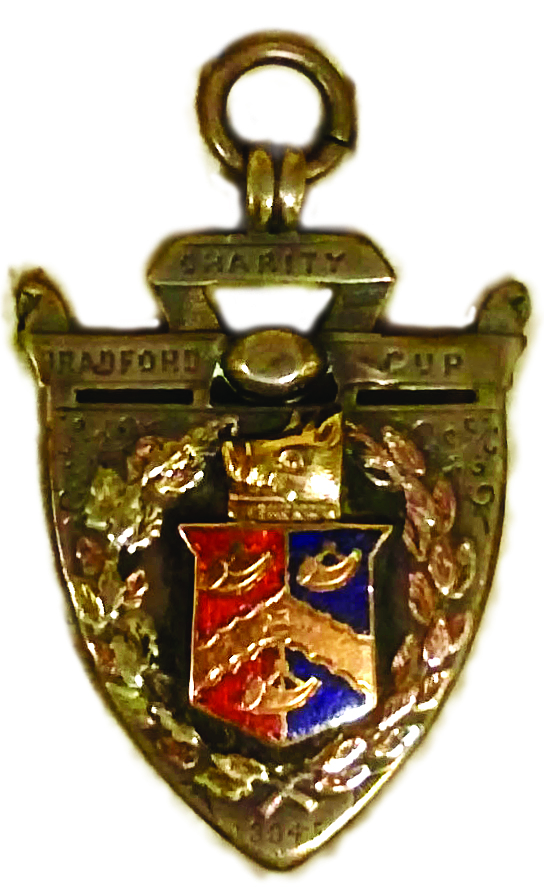
08102011018 1

The Northern Union competition

The Bradford Charity Cup had a strong emotional appeal, as confirmed by subsequent attempts to revive the competition prior to World War One including an extension of the format to cricket and soccer. In 1901 the competition was revived with the encouragement of the mayor, William Lupton with a single showpiece game between Bradford FC and Manningham FC. Lupton had been a member of Bradford FC at Apperley Bridge and, like Isaac Smith before him, may have identified the revival of the competition as a way to define his legacy as mayor. The trophy was retrieved from the Bradford Art Gallery where it had been on display and the Yorkshire Evening Post of 13 April, 1901 reported that ‘an effort was made to revive the utility of the cup as a money-earning asset’. Nevertheless, despite good advertising there was only a ‘moderate attendance’, generating in the region of £50.
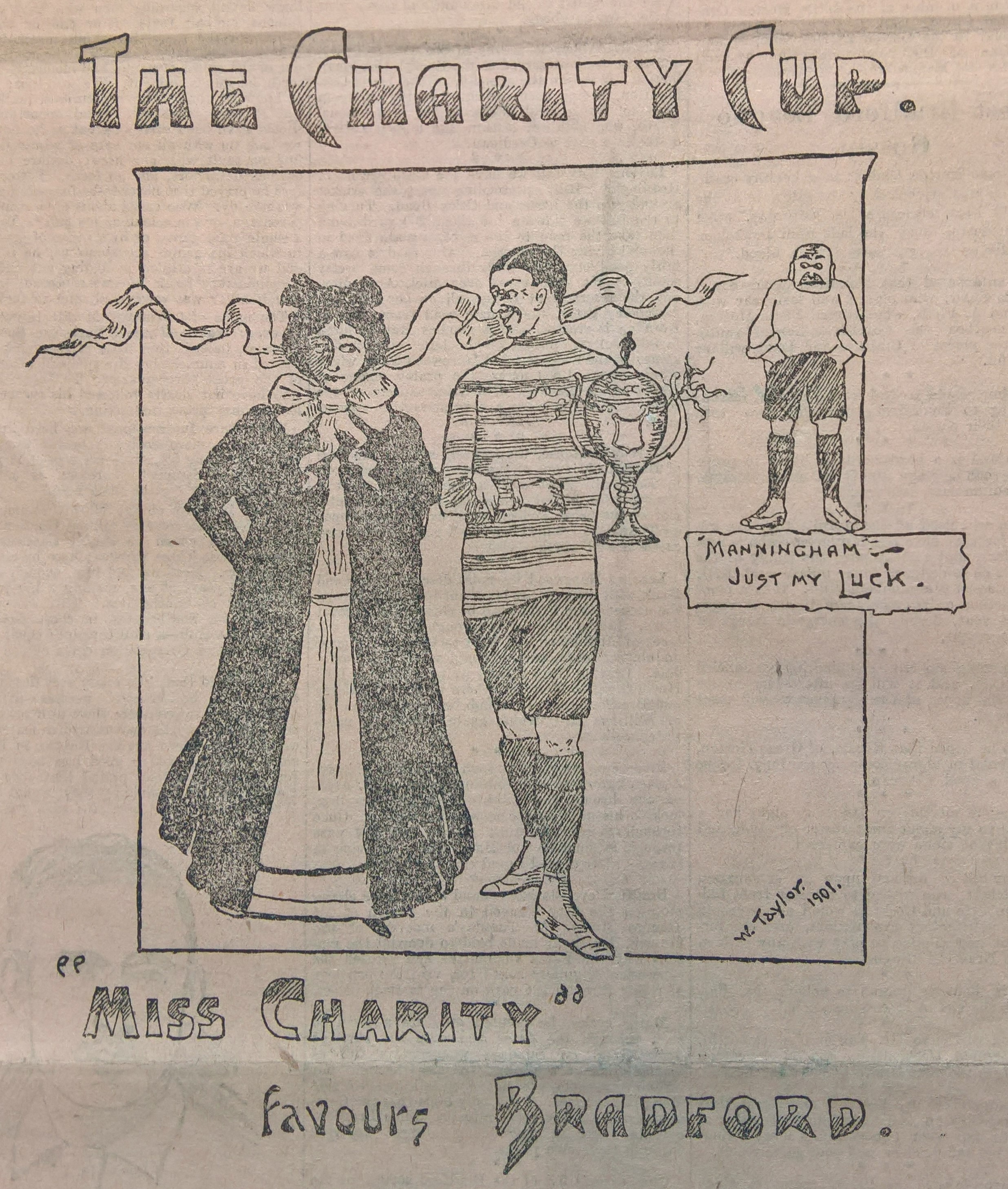
1901-04-20 BCC cartoon in YS

Yorkshire Sports cartoon 20 April, 1901

Plans to repeat the competition the following season became embroiled in the politics of the Northern Union and the refusal by members of the Yorkshire Senior Competition (the second division) to stage games with the breakaway premier division. Manningham FC in particular were bitter about having been cast aside in the lower tier despite having been champions of the inaugural Northern Union league competition in 1895/96. Notwithstanding, the Manningham FC committee lobbied for the opportunity to contest the trophy with Bradford FC in 1902 and following the intervention of the Bradford mayor, the YSC lifted its embargo for the game to be played.

The match on 1 April, 1902 proved to be the final competitive fixture between the two senior Bradford clubs. By this stage the gulf in class was pronounced and Bradford FC were comfortable winners in front of a seven thousand crowd at Park Avenue. Within weeks the Manningham FC leadership was actively planning to stage Association football at Valley Parade that led to the eventual launch of Bradford City AFC in 1903.

Bradford Charity Cup Finalists – Northern Union
Year Winners Runners-up
1901 Bradford FC Manningham FC
1902 Bradford FC Manningham FC

The ascendancy of Association football in Bradford led to proposals to launch a Bradford Charity Cup competition for local soccer teams in 1903. Recognising this as a challenge to their own code and no doubt aggrieved by the suggestion that the original trophy should be awarded to an Association club, the Bradford & District Rugby Union (the local governing body of the Northern Union) responded by organising a competition for its own members. My belief is that this was at the instigation of Bradford FC, anxious to promote rugby to counter the attraction of soccer – made even more fashionable now that the city had a Football League side at Valley Parade.

By 1903 however, there was only a handful of local Northern Union sides (and for that matter only one affiliated to the Rugby Union). Furthermore the membership of the Bradford & District Union was weighted towards outlying areas, principally Keighley as well as Pudsey and villages bordering Halifax. The clubs themselves were much lesser entities than their predecessors who competed in the original Bradford Charity Cup and the revived competition was thus a pale imitation of the first. It could be said that the primary purpose of the competition was less to do with charity fundraising and that it was more about keeping the game of rugby alive in Bradford. What a contrast to the situation less than ten years before!

The organisation of a Bradford Charity Cup competition in 1903/04 was very much a last minute affair and it was eventually decided that the winners of the first and second divisions of the Bradford & District Rugby Union – Pudsey Clarence and Shipley Victoria respectively – should play a deciding match on Easter Monday at Greenfield, the ground at Dudley Hill adopted by the phoenix Bradford Northern club in 1907. On that occasion, Pudsey Clarence defeated Shipley Victoria in what must have been a fairly low key event for such a magnificent trophy. The competition was later played on a conventional knock-out basis with finals staged at Park Avenue and on Easter Monday, 1905 the trophy was won by Victoria Rangers, considered the leading Bradford-based amateur side of the time.

The following season, in January, 1906 an impressive seven thousand crowd saw Bradford FC ‘A’ team defeat Buttershaw after having beaten Hebden Bridge in the semi-final. In order to optimise gate receipts, the Bradford club stipulated that all members should pay to attend the game – hitherto the practice was that membership conferred free admission to all fixtures. In December, 1905 there was an appeal for public subscription to defray the cost of winners’ medals. The measures helped the competition generate total net proceeds of £55 and in November, 1906 the Bradford & District Union declared its target of raising £100 in the 1906/07 season. However, this objective seems unlikely to have been achieved and it was unfortunate that the timing of the final on 1 December, 1906 coincided with the Yorkshire Cup Final in which Bradford FC defeated Hull KR.

The abandonment of rugby at Park Avenue in the so-called ‘Great Betrayal’ of 1907 led to the retention of the Bradford Charity Cup trophy by The Bradford Cricket, Athletic & Football Club. The last rugby club to hold the original cup was Victoria Rangers who defeated the Saville Green club. Not only was the Bradford & District Rugby Union left without a charity cup trophy to award but it was denied the use of Park Avenue, the traditional home of rugby in the city.

In 1907/08 the home of the Wyke club was adopted as an alternative venue for the Bradford Charity Cup final. Additionally, in August, 1907 the Halifax Charity Cup trophy (with a value deemed to be 50 guineas) was offered to the Bradford & District Rugby Union on condition that one third of all semi-final receipts, plus the whole of the final receipts net of club expenses be provided to Halifax charities.

Although a Bradford Charity Cup competition continued in existence for local (Northern Union affiliated) rugby clubs it was alongside two other cup tournaments, the Halifax Charity Cup and the Bradford Challenge Cup. Likewise, Shipley based clubs also competed for the Keighley Charity Cup and there was the seeming anomaly of Stanningley FC winning the Bradford Charity Cup in 1908 and 1909 and Victoria Rangers (of Bradford) the Halifax Charity Cup in 1908/09. Not surprisingly, amidst of all this the Bradford Charity Cup competition lost prominence. In October, 1909 the Bradford & District Rugby Union handed back the Halifax trophy to the Halifax Charity Committee, presumably because competition for the trophy similarly had limited appeal. The retention of the trophy by the Park Avenue club was a sensitive matter and it is unlikely that the replacement trophy for the Bradford Charity Cup was equally prestigious as its predecessor or that of the Halifax equivalent. To all intents and purposes, the loss of the original trophy in 1907 fatally undermined the pretence of a charity cup competition for Bradford rugby clubs and the contest continued more as a statement of the survival of Northern Union football in Bradford. By 1909/10 there were only seven entrants in the final Bradford Charity Cup competition that was won by Northern Rangers, nursery side of Bradford Northern RFC.

Although the final between Stanningley and Victoria Rangers in January, 1909 was attended by a crowd of two thousand at Birch Lane (the new home of Bradford Northern), the net proceeds are unlikely to have exceeded £20. The ascendancy of Association football in Bradford was by now undisputed, exemplified by the case of Victoria Rangers who had for a long time dominated local rugby. To my knowledge the earliest fixture involving the club was in 1893 but by the end of the decade it had established itself as one of the leading junior sides in the Bradford district with a reputation as a feeder club to senior teams. In March, 1906 it had held Widnes to a draw in a cup-tie at Park Avenue. (Photograph of Victoria Rangers below dates from April, 1907. The featured medal below is that of G. Hudson, a member of the victorious Rangers team in the 1907 BCC final.)
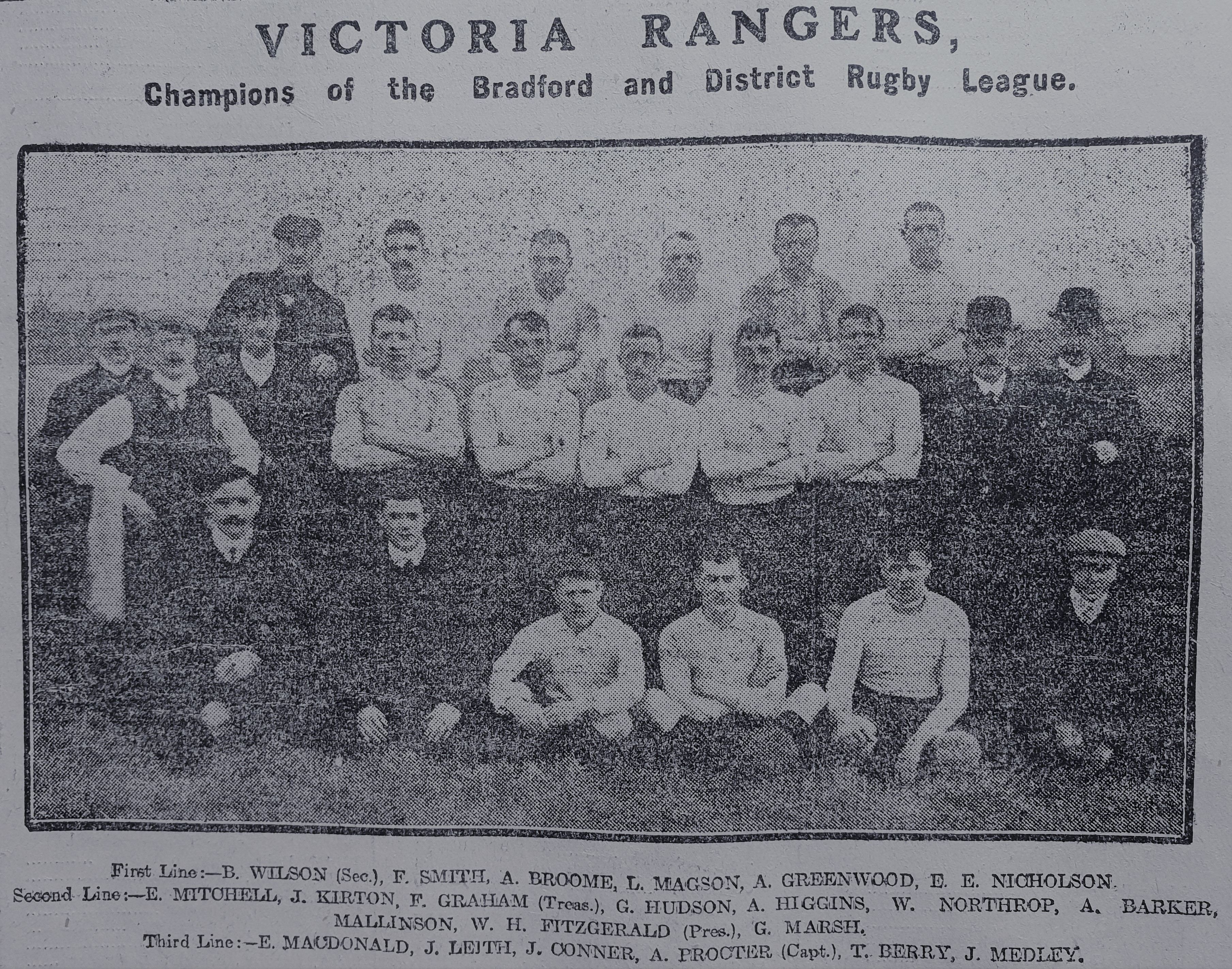
1907-05 Victoria Rangers team

In July, 1908 the club engaged the former Bradford FC player, Herbert Ward as a professional but only twelve months later the Victoria Rangers committee decided to convert to soccer. It must be assumed that this decision was driven by financial problems, the consequence of over-ambition and over-commitment (although conversion had originally been discussed in January, 1907 which was a measure of the frustration with the Northern Union). A new club – Northern Rangers – was formed to continue playing rugby and served as a nursery side for Bradford Northern at Birch Lane but the affair demonstrated the poor state of the Northern Union game at grass roots level in the Bradford district. Indeed, by the outbreak of war, surviving teams such as Wyke and Keighley Zingari were competing in the Halifax & District League.(UPDATE: Northern Rangers subsequently revived the Victoria Rangers identity. Sadly in August, 2017 the club announced its intention to disband on account of being unable to recruit new players thereby bringing to an end a long history.)
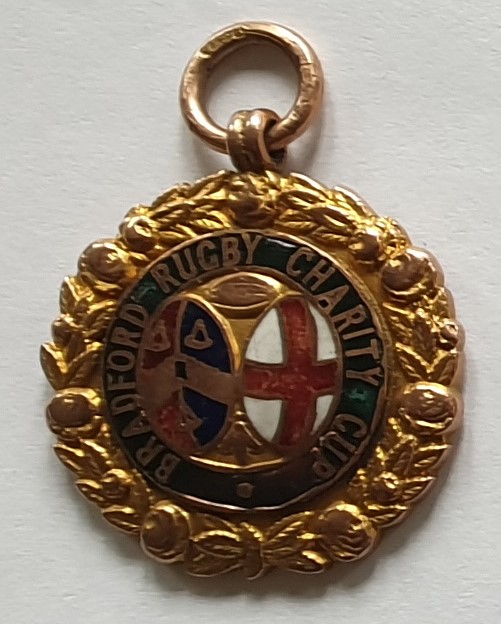
BCC Victoria Rangers winners medal 1907.jpg

Representatives of the Bradford & District Union claimed in December, 1907 that rugby had raised ‘just short of £2,000’ for charity, an amount that seems overstated given that a total of £1,116 was reported to have been raised prior to 1894. In the final six contests it is doubtful that the total net proceeds could have exceeded £300 which would suggest that the aggregate was most likely ‘just short of £1,500’. The quantum was more significant in the rivalry of soccer and rugby and it allowed rugbyites to portray their sport in a positive light, an emotive issue given the ‘Great Betrayal’. (The Bradford CA & FC had previously enjoyed the reflected glory of this funding raising achievement which it claimed was facilitated by its investment in the Park Avenue ground that was also used for athletics events, the nominal purpose of which was to raised monies for charity.)

Bradford Charity Cup Finalists – Northern Union
Year Winners Runners-up
1903/04 Pudsey Clarence Shipley Victoria
1904/05 Victoria Rangers Shipley Victoria
1905/06 Bradford FC ‘A’ Buttershaw
1906/07 Victoria Rangers Saville Green

NB winners of the Bradford Charity Cup after 1907 (albeit for a different trophy) were as follows:  1907/08: Girlington r/u Stanningley; 1908/09: Stanningley r/u Victoria Rangers; 1909/10: Northern Rangers r/u Rastrick

A Bradford charity cup for cricket

Before rugby football, Bradford had been known for its cricket prowess. The ‘old club’, Bradford CC had been formed in 1836 and by the 1860s there was a thriving and competitive network of local clubs. In 1903 came the formation of the Bradford Cricket League and the following year, the launch of the Priestley Charity Cup which is still contested by members of the league. What it had in common with the Bradford Charity Cup was that it was introduced with the patronage of a serving mayor, William Priestley (knighted in 1909). The Cup was placed under the control of the Bradford Cricket League and in the event of the competition becoming defunct, it was stipulated that the trophy should be deposited in the Cartwright Memorial Hall.
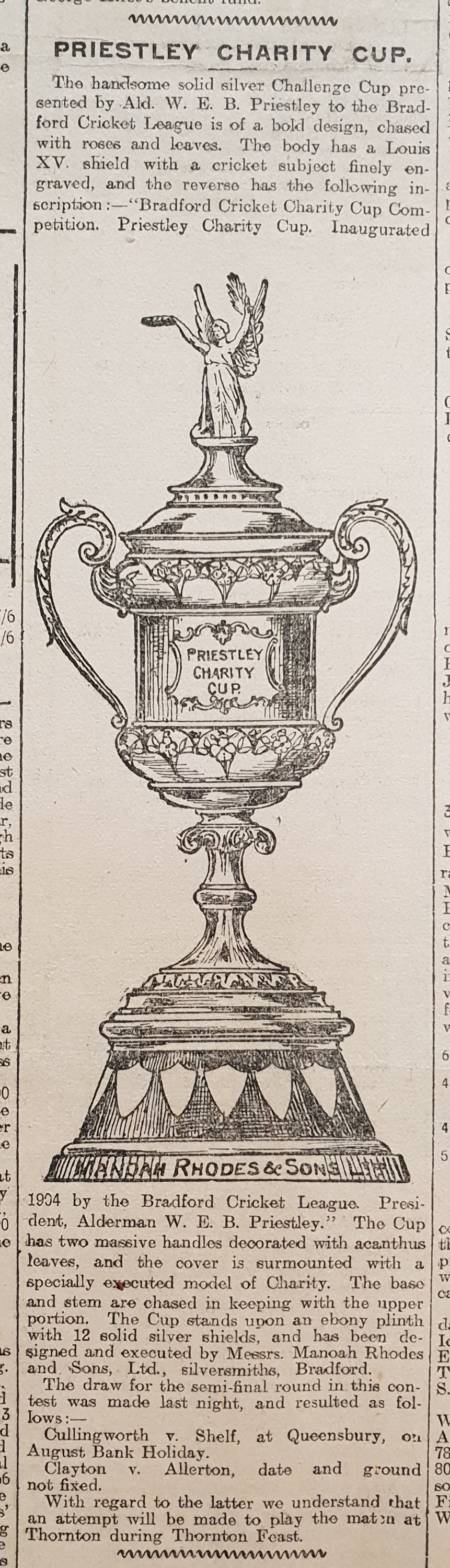
The Priestley Cup should be credited for its part in the success of the Bradford Cricket League and it demonstrated how a prestige cup contest could reinforce and sustain public interest in the rivalry of the constituent clubs. The Priestley Cup is now the longest surviving cup competition for sports clubs in the area and the inheritor of the tradition of the original Bradford Charity Cup. Another factor it had in common was the fact that finals were showcased at Park Avenue, the premier sports ground in the district.

In all probability, the launch of the Priestley Charity Cup (and associated Priestley Shield for reserve teams) was inspired by the Bradford Charity Cup and the desire to have something similar for cricket. Its introduction around the same time as efforts were being made to revive the rugby contest is surely no coincidence. What the two cup competitions had in common was the benefit of each having a prestigious trophy and institutionalised appeal. Of course both shared the virtuous goal of charitable support and the cricket administrators may have been motivated to outperform their winter counterparts with how much money they could raise.In competition with rugby football, cricket proved the winner. Ultimately the success and longevity of the Priestley Cup, which fed off league rivalries, is testament to the fact that cricket enjoyed a critical mass of clubs in the Bradford district of a similar – but sufficiently high – standard to sustain the sort of competitive environment that was not possible after the collective disappearance of local rugby clubs at the end of the nineteenth century. The Priestley Cup thus realised the potential of a local cup competition in a way that was denied to the Bradford Charity Cup.

By 1912 the Bradford Cricket League was consistently donating £100 each year to charity. Evidence of the popularity of the Priestley Cup was demonstrated by semi-final crowds of five thousand at Eccleshill and three thousand at Lidget Green in August, 1913 that generated aggregate receipts of £105. The final that month, between Bradford CC and Great Horton brought a crowd of ten thousand to Park Avenue and gate receipts in excess of £100 which was reported to be a new record for a club game in Bradford cricket. All told, a net donation of £115 was made to the Bradford Hospital Fund in 1913 and in the same year the Priestley Shield was introduced as a charity cup competition for Bradford Cricket League reserve teams.

The Priestley Cup ultimately survived by accommodating the financial needs of its entrants but this was at the expense of charity fund raising. In November, 1917 for example it was claimed that none of the clubs could afford the ‘self-sacrifice’ of participation. Accordingly, changes were made to the arrangements by which gate proceeds were divided between charity, the clubs and the Bradford Cricket League. The original concept of a charity cup competition to raise proceeds exclusively for charity was therefore limited as much by the ability of entrants to forsake gate receipts as the appeal of the competition to the public – whilst noble in its aims, by the twentieth century the economics of sport conspired against the success of a cup competition to be a successful form of charity fund raising. The symbolism of giving to charity was thus always more significant than the giving itself.

The Bradford Charity Cup becomes a soccer trophy

As far as soccer is concerned, Bradford has never had the same number of junior sides of a reasonable standard to replicate what had existed with Bradford rugby in the boom years between 1884-1897. For that matter soccer lacked the strength in depth of Bradford League cricket despite the grass roots popularity of the sport. In 1903, the Bradford & District Football Association launched its own charity cup competition for local sides (known as the Bradford Junior Charity Cup or Bradford Hospital Cup) but it was a relatively low profile affair. Alderman Priestley donated another trophy for this competition in 1904 (as illustrated below).
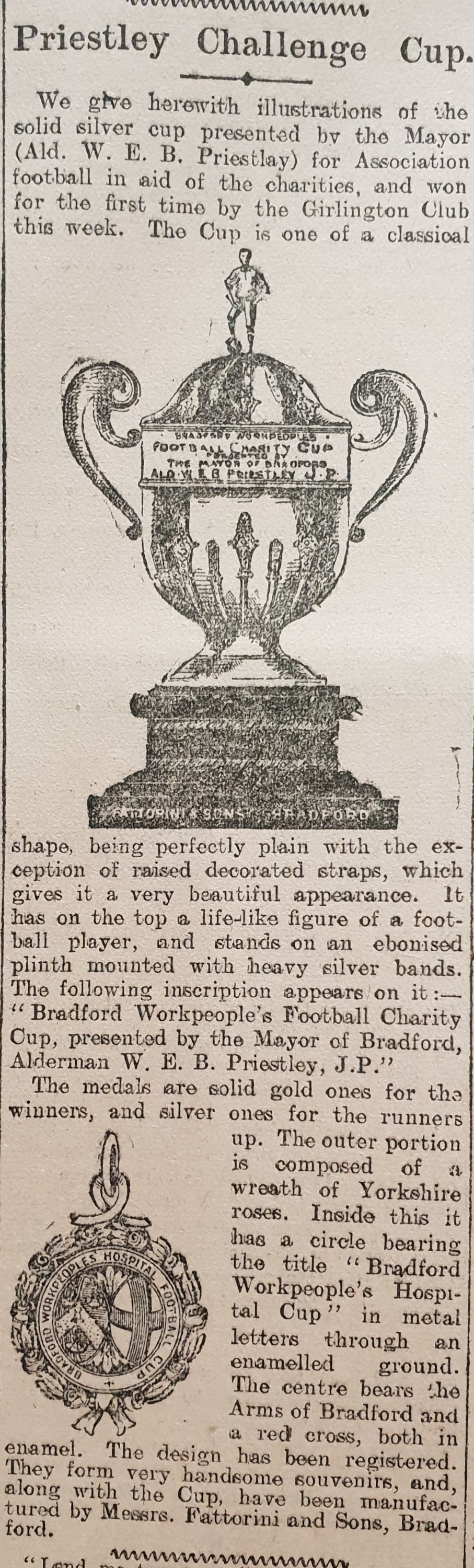
20181231_1137431430574906558761569.jpg

Meanwhile the original Bradford Charity Cup remained in the possession of Bradford FC but was not used. In 1910 came a unique initiative to bring it back to life with the adoption of the trophy for soccer. The background to this were the attempts to launch a semi-professional Yorkshire league and the efforts in particular of John Brunt and Charles Marsden, leading members of the Bradford & District FA. (Brunt had been behind the launch of Bradford City in 1903 whilst Marsden had been a founder member of the club and latterly a committee member.)

There were two objectives behind the initiative. The first was missionary, to promote the development of association football in West Yorkshire. The second was to find a practical solution of the problem faced by Bradford City AFC (as well as Leeds City) in the identification and nurturing of local youth talent through a reserve team / junior competition. Subsequent to formation the Bradford City club had discovered that the West Yorkshire League was inadequate for its needs whilst the cost of travel had made membership of either the Midland Counties or North-Eastern leagues prohibitively expensive.

Discussions had been initiated in December, 1908, the timing of which is notable given that Bradford City had just secured membership of Division One after promotion the previous season. To make a Yorkshire League a viable proposition required the leading south Yorkshire clubs to defect from the Midland League. In turn it forced the likes of Sheffield United and Barnsley to evaluate their own priorities – proselytising for the cause of soccer and leaping into the unknown through membership of a new league or sticking with their existing arrangements and maintaining loyalty to the Midland. Their choice proved to be the latter, presumably on economic grounds. However memories of the previous decade had not been forgotten and there would have been little enthusiasm to repeat the experience of the aborted Yorkshire League that had lasted only two seasons, 1897/98 and 1898/99. (The ill-fated competition had originally included the reserve teams of Sheffield United, The Wednesday, Doncaster Rovers, Mexborough, Barnsley St Peters and then Sheffield FC. With the collapse of West Yorkshire sides who had proved to be weak opposition, the South Yorkshire clubs had resigned to form the South Yorkshire League and the Yorkshire League collapsed. Further detail is told in my book, Life at the Top.)

The Sheffield Daily Independent of 28 December, 1908 reported that ‘There is little disposition among the clubs of this part of the county to throw over the interesting and well-managed Midland League in order to add more missionary work to that which they have already accomplished. Certainly in Sheffield itself there is none.’ The reluctance of the Sheffield clubs to get involved required a change of format and the promoters were forced to look north of Bradford / Leeds instead of south.Eventually, in 1910 came the launch of the Yorkshire Combination League with a reach beyond West Yorkshire to incorporate clubs in what is now North Yorkshire. It was a strategic venture, intended to strengthen the game in the region. The late development of such a league was a legacy of the fact that West Yorkshire had traditionally been a rugby stronghold and the same factor was responsible for a lack of strength in depth among its soccer clubs. Alongside the two Bradford clubs, the eight other founders of the league included up and coming sides such as Goole Town, Heckmondwike, Knaresborough, Mirfield United, Morley and Starbeck alongside future Football League members Scarborough and York City.

By 1908 Bradford Park Avenue AFC had been elected to the Football League. Eager to derive goodwill, the Bradford Charity Cup trophy was made available for a new competition that was intended once more to generate funds for the Bradford Infirmary. By endorsing its use, the Park Avenue club was able to position itself as a patron of sport and charity once again. It was a convenient arrangement and Brunt and Marsden seized upon the opportunity to utilise such a prestige trophy to compensate for the fact that the Yorkshire Combination might be dismissed as a lesser competition. There was also symbolism in adopting the Bradford Charity Cup for a new high profile county-wide soccer competition as if to demonstrate that association football and not rugby was the dominant sport. Sponsorship of the revived Bradford Charity Cup by the Bradford Daily Argus also reveals an eye to marketing and hints at the ambition of the promoters.In February, 1911 the Bradford Charity Cup committee was able to boast that the association game had raised a total of £1,095 for charities in eight years compared to £1,940 in nineteen years of rugby. It is impossible to validate the accuracy of the claim and both figures were probably overstated – the soccer contribution was presumably generated by the ‘Junior Charity Cup’ that had run since 1904 given that this sum could not have come from the revived (senior) tournament in 1910/11 alone (which was reported to have not been particularly successful in terms of monies raised). Nonetheless it provides an illustration of how the competing football codes gauged their status according to charitable giving.A cup competition was regarded as a vital ingredient to raise interest in the new Yorkshire Combination League and its members. It also provided a degree of equality for all clubs who otherwise competed in different county or local charity cup contests. The members of the league were therefore invited to compete in a new cup competition and the Bradford Charity Cup was provided as its showpiece trophy. To make up sixteen competitors with two rounds prior to the semi-finals, the invitation was extended to others. The competition was intended to raise money for charity and became variously known as the Bradford Charity Cup / Bradford Hospital Cup – with the beneficiary being the Bradford Workpeople’s Hospital Fund – despite the fact that it embraced clubs far beyond the Bradford district. (By contrast, the Junior Charity Cup was open only to clubs within a twelve mile radius of the Town Hall.)

It spoke volumes about the stature of Bradford soccer and the prestige of the trophy that the new competition attracted entrants and in 1911/12 a newly formed club by the name of ‘Leeds United’ participated. Even so, only eleven clubs entered the Bradford Charity Cup in 1910/11 which was won by Bradford (PA) AFC who defeated Mirfield United in the final. (Photo shows Park Avenue full back, Sam Blackham with the trophy.) In so doing, it meant that the rugby club, Bradford FC and its successor had each been triumphant – the first instance perhaps of the same trophy being awarded to the same organisation in two different football codes.
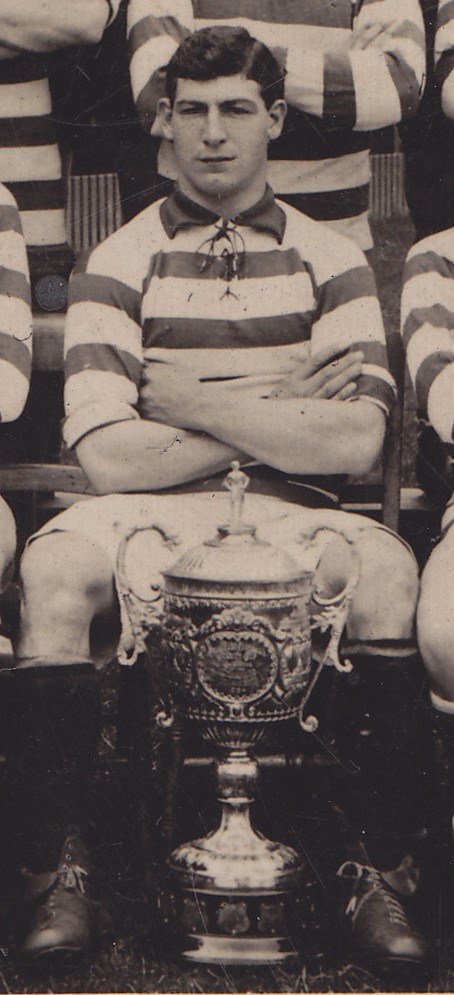
BPA Bfd Charity Cup 1911

Bradford City AFC similarly emulated Manningham FC with victory in 1911/12 (defeating Mirfield United 4-1 at Sandhall Lane, Halifax) and then in 1912/13 (defeating Morley 6-0 at Valley Parade). The final contest was in April, 1914 when Halifax Town beat Scarborough in the final tie at the ground of York City (who happened to be one of the defeated semi-finalists, the other being Heckmondwike who alone of the four semi-finalists never secured Football League status).

Bradford Charity Cup Finalists – Association Football
Year Winners Runners-up
1911 Bradford (PA) AFC Reserves Mirfield United
1912 Bradford City AFC Reserves Mirfield United
1913 Bradford City AFC Reserves Morley
1914 Halifax Town Scarborough

It was no coincidence that the Bradford Charity Cup was won by clubs outside the Yorkshire Combination during the final two seasons of the competition. The winners in 1913 were Bradford City, members of the Central League and in 1914 the cup was won by Halifax Town (pictured below with the trophy) who had resigned from the Yorkshire Combination at the end of the previous season to join the Midland League. Ultimately the short duration of the final chapter of the Bradford Charity Cup was due to the weakness of the Yorkshire Combination League. Bradford City AFC for example had remained members of the league for only two seasons and joined the Central League in 1912/13. (The Central League had been launched the previous season, 1911/12.)
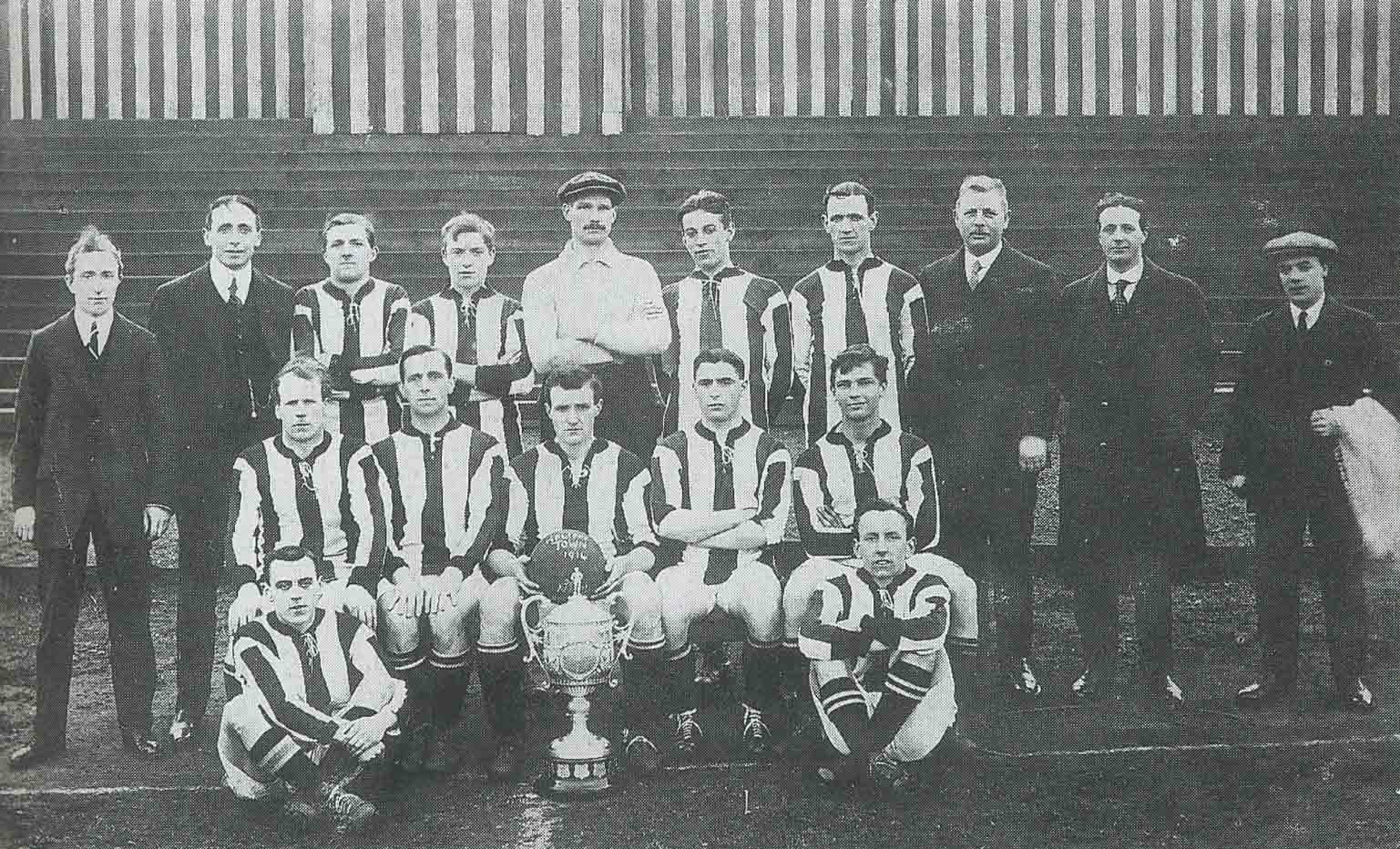
wp-15979580198146797204218804385522.jpg

Although the Yorkshire Combination had been increased to 14 members by 1911/12, with no disrespect to the likes of Fryston Colliery FC and Thornhill Lees Albion FC, it proved unable to attract quality sides and the Valley Parade reserves had little difficulty winning the championship in both seasons of membership. By April, 1913 it was being reported that the league suffered from the problem of fixtures having to be regularly rearranged, presumably on account of smaller sides struggling to stage a game.

Nonetheless the league allowed players in junior clubs to come to the attention of the seniors, possibly the best example of which was Donald Bell who signed for Bradford (PA) in October, 1912. Six months before he had been a member of the losing Mirfield United team in the final of the Bradford Charity Cup against Bradford City reserves. Bell subsequently achieved fame as the only English professional footballer to be awarded the Victoria Cross for his bravery in the Somme in 1916 where he was killed.

At the end of the 1912/13 season the Yorkshire Combination suffered a further loss in members, among them Huddersfield Town reserves who had been champions in the only season they competed. Surprisingly perhaps, Bradford (PA) AFC remained as members until the end of the competition in 1914 (when they finished as champions) and this may have had something to do with financial constraints that limited the option of joining another league. (Finally, in 1914/15 the Park Avenue reserves enrolled in the Midland League.)

The Yorkshire Combination League was disbanded in the summer of 1914 and the Bradford Charity Cup was similarly discontinued, in all likelihood because it had failed in its singular purpose of raising funds for charity and had lost its catchment. Crucially, in 1913/14 the cup competition had failed to attract quality entrants. Even in 1910/11, the first season of its revival, it was reported that the proceeds had been disappointing. The loss, or rather the absence, of a constituency of decent sides to create a contest capable of attracting public interest made the Bradford Charity Cup a non-commercial proposition. Furthermore it had also found itself competing with other cup competitions. Most reserves teams or junior soccer clubs of that era entered a number of cup contests in a season; it was simply unrealistic to expect that the Bradford Charity Cup could command the emotional loyalty of sides outside the Bradford district in relation to other emergent charity cup competitions.

Besides, it was inevitable that Bradford’s football influence in the region would eventually wane with the emergence of other centres. In 1910 for example, Bradford was the only place in West or North Yorkshire with two senior soccer clubs, let alone one of them a Division One member and in 1911 an FA Cup winner. Indeed, at the beginning of 1910, Bradford City AFC had even topped the first division. Yet whereas in 1914/15 there were two Division One clubs in Bradford, within ten years Huddersfield Town – and to a lesser extent Leeds United – became the leading sides and Bradford soccer was left behind in the doldrums.

A trophy for three different codes

It is remarkable that the same trophy was adopted for sporting competition by three different football codes – Rugby Union, Northern Union and Association. During the twenty years it was competed for, the apportionment between those codes had been ten, six and four seasons respectively. The cup had been brought back to Valley Parade and Park Avenue on four occasions each, under Rugby Union rules twice by Manningham FC, under the auspices of the Northern Union three times by Bradford FC and then as a soccer competition twice by Bradford City AFC and once by Bradford (PA) AFC.

Equally remarkable is the influence of the Bradford Charity Cup for its role as a stimulant of sport and, in its earliest format, the encouragement of local sporting rivalries. It was thus a precursor to the impact of the Bradford & District Football League after 1899 and the Bradford Cricket League from 1903 – two competitions which inherited much the same passion of local, intra-district sporting rivalry. Quite literally, any history of the origins of modern sport in Bradford cannot be told without giving recognition to the significance of the Bradford Charity Cup.

Modern variants

As in 1902, the launch of the Bradford Championship in 1961 was intended to fill the vacuum in the fixture lists of Bradford City and Bradford (PA) to provide the public with a derby game. It was intended to satisfy the blood feud of the declining band of partisan supporters who continued to attend games at Valley Parade and Park Avenue. The fact that the competition was introduced said more about the financial desperation and reliance upon derby fixtures to boost attendances. Meanwhile the concept of a sporting competition to raise funds for charity had long since been forgotten. The Bradford Championship was contested during the three seasons, 1961/62 to 1963/64 inclusive, the period in which the two clubs found themselves in different divisions following the relegation of City from Division Three and the promotion of Avenue from Division Four in 1960. The relegation of Bradford (PA) in 1963 after only two seasons in Division Three meant that the Bradford Championship duplicated League derbies in 1963/64.

After aggregate crowds of thirteen thousand in the opening season, two years later they amounted to no more than eight thousand which was not a convincing public endorsement. Combined with the fact that the clubs were drawn together in the League Cup at Park Avenue in September, 1963 there was a saturation of derby matches in the final season. With the renewal of league derbies, it made little sense to continue the competition and hence it was abandoned.

In 1994, the introduction of The Tom Banks trophy – a pre-season fixture between City and Bradford Park Avenue – is best described as a nostalgia fixture. On all but one occasion the contest has been staged at the home of Bradford Park Avenue yet whilst that club has tended to field first team players, the Bradford City side has typically comprised reserves and triallists which is a measure of the gulf in status between Bradford’s sole surviving League club and the reformed Bradford Park Avenue.

The historic memory

The Bradford Charity Cup is consigned to history, a phenomenon unique to its age. The link between sport and charity fund-raising was ultimately destroyed by the emergence of the Welfare State but the historic significance of the connection was actually far greater in terms of its symbolism than financial contribution. The association with charity served to mobilise interest in athleticism but the experience in Bradford demonstrates that sport, rather the town’s infirmary, gained the most.Even by 1885, Bradford football clubs were not best placed to be vehicles for charity fund raising. As I highlighted in my book Room at the Top, the leadership of The Bradford Cricket, Athletic & Football Club was becoming pre-occupied with the redevelopment and financing of its Park Avenue enclosure. Manningham FC and junior clubs had equally precarious finances even if the amounts involved were not as great. As clubs wrestled with repayment of debt and ground expenditure there was little to be handed to charity. Cynics of that era could rightly argue that the best way to assist the town’s infirmary would have been through direct donation. A cartoon in The Yorkshireman from 18 April, 1885 betrays an element of sarcasm about the full extent of charitable spirit with sellers of ‘charity pies’ and ‘charity oranges’ as well as a busker shown to be taking advantage of the crowd attending the final at Park Avenue.

There remained an enduring link between charity fund-raising and sporting activity and there were various initiatives to raise funds for the city’s hospitals, the following from April, 1919.
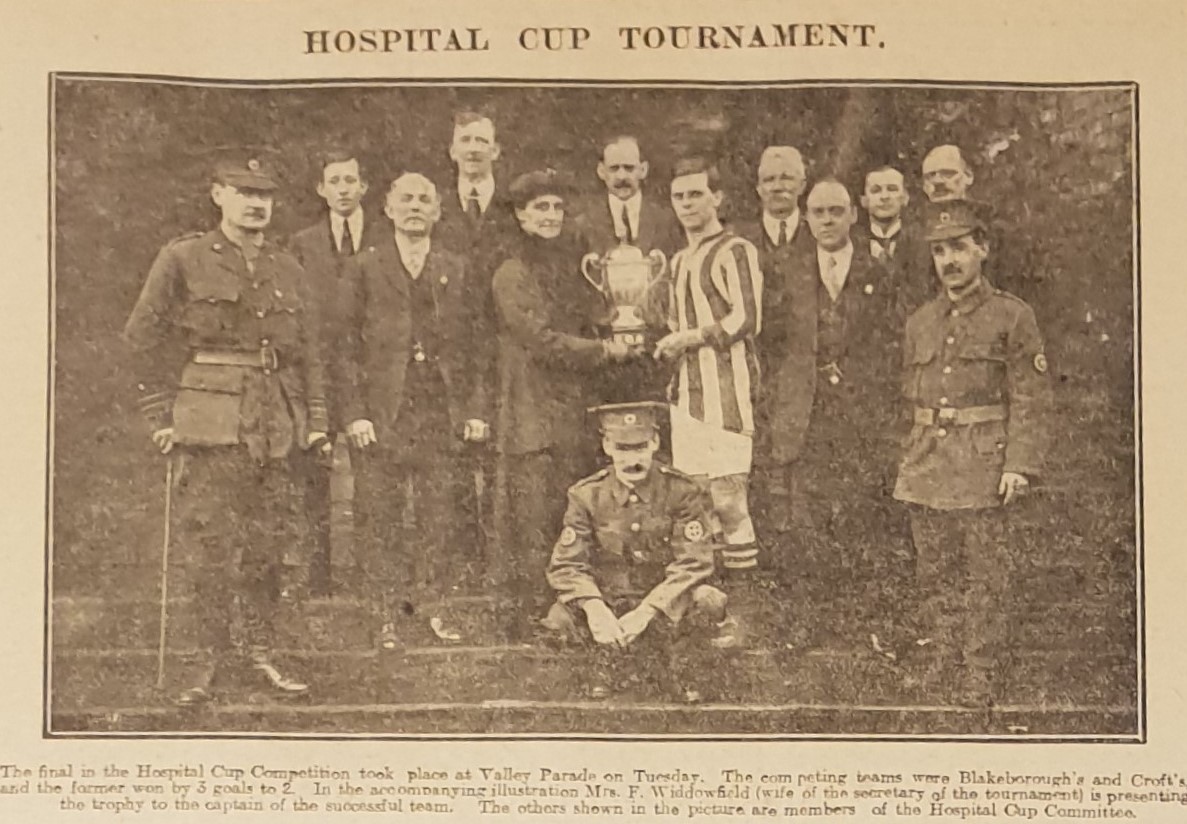
1919-04-26 ys hospital cup match at vp

An editorial in The Yorkshire Sports of 23 August, 1947 reflected that ‘One of the least happy effects of the new Health Bill which brings all the hospital services under national control, is the severance or sport from that great, endeavour to help finances of what were voluntary institutions hitherto. In that respect Bradford has set an illustrious example, through the medium of the many and varied sporting organisations, of enthusiastic effort to raise money for charitable objects. Virtually every branch of sport through special competitions has played a noble part in subscribing handsomely to hospitals, etc., with the Bradford Cricket League setting the pace through the Priestley Cup competition, which, since its inception in 1904, has contributed no less than £12,500. Football tennis, bowls, and billiards have been similarly devoted to the charitable cause, the inspiration of which has reacted most beneficially on sport itself in providing a strong competitive urge which has appealed greatly to both players and public. One can only wonder what is to happen now to the numerous special competitions with their cups and other trophies. Surely they will not be allowed to go out of existence. If for nothing else but sporting tradition they should be kept going and, with the consent of those in whom the trophies are vested, the funds diverted to other forms of charity.’

Although the Priestley Cup continues in existence, the Bradford Charity Cup is lost to memory and the whereabouts of the trophy is, to my knowledge, unknown. Yet even if the Bradford Charity Cup competition in its different permutations never emulated the financial contribution of the original Glasgow Charity Cup contest, it still deserves to be remembered for its impact on the development of Bradford sport and football culture. At Park Avenue it also fed into the high and mighty, supercilious outlook of the Bradford club by which it had become known in the second half of the 1880s.

However quaint it may seem nowadays, there is no denying that it must have been an incredible spectacle to witness the victorious Shipley FC team returning home with the cup from Park Avenue on Easter Monday in April, 1890 in an open top horse drawn waggonette. The reception from a holiday crowd enjoying a day at Shipley Glen. The Saltaire Brass Band with its rendition of the anthem ‘See the Conquering Hero Come’ – the Victorian equivalent of Tina Turner’s ‘You’re Simply the Best’ or Queen’s ‘We are the Champions’. The moment of fame, celebrated by a generation, a fond memory when in 1901 the club’s ground opposite the Ring Of Bells was sold for housing development.

By John Dewhirst

Discover more about the history of professional football in Bradford in ROOM AT THE TOP and LIFE AT THE TOP by John Dewhirst (Bantamspast, 2016). Details from the following link about these books and other volumes in the BANTAMSPAST HISTORY REVISITED SERIES

.Other online articles about Bradford sport by the same authorJohn contributes to the Bradford City match day programme and his features are also published on his blog Wool City Rivals You can also find book reviews and archive images on his blog.

===============================================================

John ‘Jack’ Nunn and physical aesthetics in Bradford

One of the most fascinating people connected with the history of Bradford sport was John ‘Jack’ Nunn who lived through a period of extraordinary change in his adopted hometown. Born in 1841, Nunn was not only witness to the emergence and transformation of sporting activity in Bradford, he was an influential figure in bringing it about. By the time of his death in 1929 he had seen first hand the remarkable growth of the city and the sporting revolution that had taken place.

His parents had been actors – his father had opened the first music hall in Bradford and his mother was relatively famous. They had settled in Bradford and he was educated at Watson’s Academy in Cheapside. The least sensational aspect of his life was that he became a civil servant and worked for the Bradford postal service until retirement in 1901.

Nunn was one of the original members of the Rifle Volunteers, promoted to sergeant and became president of the NCO’s mess [1]. In April, 1866 he acted as a special constable during the Fenian disturbances in White Abbey, Bradford. His membership of the Volunteers proved instrumental in developing his passion for athleticism and he was a prime mover in gymnastic displays, assaults-at-arms, and shooting competitions. In 1866 he was also one of the promoters and the original captain of the first swimming club in Bradford. In October, 1876 Nunn arranged for Captain Webb, who had swum the English Channel the previous year, to give a talk at St George’s Hall at which the 3rd West Yorkshire Rifle Volunteer Corps band entertained the public during intervals.

He was known as an all-round athlete who ‘excelled in all manly games except cricket.’ He achieved success in activities as diverse as boxing, running, club swinging, quarter staff, fencing, hammer throwing and weight putting as well as rifle shooting. He also played (rugby) football, originally with Bradford Caledonian FC as a full back and then with Bradford FC at Apperley Bridge (although he was not a first team player, probably on account of his age). He later became a non-playing member at Park Avenue in 1880.

In June, 1877 Nunn had been involved in the organisation of a spectacle at the Valley Parade Skating Rink in which an American pedestrianist, E P Weston attempted to walk 400 miles in five days. The event was reported to have attracted a fairly large crowd and it seems fair to say that it was the focus of gambling interest. Weston used the Belle Vue Hotel for rest and refreshment and was said to have been successful in his feat with 90 seconds to spare. The following month Weston was unsuccessful in his attempt to walk 180 miles in two days with Nunn acting as a promoter.

Nunn became heavily involved in the organisation and judging of athletics festivals, gymnastic displays and swimming competitions not just in Bradford but throughout West Yorkshire. In addition to his athletic accomplishments he was also a proficient violinist who was said to be able to play several other instruments. Additionally, he found time to promote and play in one of Bradford’s first amateur dramatic societies and was the dramatics correspondent and Yorkshire representative of the Dramatic Authors’ Society.

Upon leaving Bradford FC in 1882, Nunn had joined Manningham FC and remained a leading member at Valley Parade, instrumental in the conversion to association football and abandoning rugby. According to the Bradford Telegraph & Argus: ‘he visualised the popularity which the Association game would attain, and in 1903 helped to form the Bradford City AFC, which was the pioneer ‘soccer’ club in the West Riding. Since that time Mr Nunn had been actively identified with the club, and saw its rise to pre-eminence by the winning of the FA Cup and its later decline to the Third Division… At Valley Parade he was a director of the new Bradford City until 1928 and was the instigator of what became the Spion Kop. He had plans made up for the erection of a two-tier stand at the South Parade side of the ground and cherished the hope that he could see this carried out.’

plans for Kop 1

A portrait of ‘Old Jack’ hung in the Valley Parade board room and his efforts overseeing the development of the ground between 1906-08 were rewarded with the kop being known as ‘Nunn’s Kop’.

jack-nunn

Jack Nunn appears to have been the archetypal physical aesthete and obituaries published after his death in March, 1929 paid tribute to his influence and painted a picture of a colourful character for whom athleticism had been a form of self-expression and lifestyle. This from the Telegraph & Argus: ‘In the fullness of time Jack Nunn, a great sportsman, has gone to his rest, and now there is none left in our city who can claim that supremacy in all-round sport that was him…

‘By the death of Jack Nunn Bradford has lost the last of the old Bohemian type of a former generation. A few of those who went before him were ‘Charlie’ Atkinson, ‘Teddy’ Dobson and Major Shepherd. Those names may not mean much to the present generation, but to a former generation they were symbolic of all that was meant by manly sport and unconventional life. Nunn had been amateur actor, author, athlete, and many other things, and his figure was as picturesque as the life he had led. His parents were famous players in the days of the old Yorkshire circuit of theatres… Jack was captain of the first swimming club formed in Bradford, he was one of the earliest volunteers, crack shot and a famous fencer. He was one of the earliest supporters of the Bradford Football Club, and had been everything that one can be in the world of manly sport, in which he retained his interest to the very end.

20190114_1317346632344464764600674.jpg

Sadly Jack Nunn has long been forgotten despite his legacy. Aside from his contribution to the formative years of Bradford City AFC, Nunn’s life is a reminder of the common roots of sporting activity in the district and the fact that the origins of modern sport in Bradford date back to the 1860s. If any local sportsman deserves to be remembered by history, surely it should be him. Like many other Bradford legends he is buried at Undercliffe Cemetery.

From ROOM AT THE TOP: The History of Professional Football in Bradford by John Dewhirst. Details: Bantamspast History Revisited

[1] Read more about the Bradford Rifles in this VINCIT feature

Other articles by the same author on Bradford sport history

*** Thanks for visiting VINCIT – you will find other articles about the history of Bradford sport on this site including speedway, rugby union and rugby league in addition to soccer as well as the origins of local sport in the nineteenth century. Forthcoming articles include features on Bradford City, Bradford Park Avenue, cricket, the Priestley Cup, junior rugby, Bradford Rowing Club and the story of Shipley FC. Contributions are welcome! ***

Eddie Parris – A Welsh Pioneer

These days, the sight of a coloured or even mixed race footballer is nothing unusual for fans at just about every level. Despite the recent incidents and regarding certain players over racial accusations, these problems are thankfully few and far between. That is not to say we should ever lower our guard and let the foul & disgusting bigotry gain the upper hand. Players of all colours & creeds and a wonderful diversity to our game which we should promote to the highest extreme. I think the last frontier to be crossed is the arrival in our game of a couple of home-grown lads of Asian descent to make our game fully proud of its diverse future.

Bradford as a city can be proud of its acceptance of a multitude of cultures from all over the globe. The citys sports teams are no exception to this with Bradford City signing mixed race Scotsman Willie Clarke in 1906. 1911 also saw City sign Lithuanian born wingman Louis Bookman who had become a naturalised Irishman.

Across the City in Horton, the Bantams cross-city rivals Park Avenue took a chance on a young trialist in John Edward Parris, a 17 year old winger playing for Chepstow Town. Born near Chepstow in January 1911 to a white mother and a black father.

parris-1

Eddie made his debut for Park Avenue in an F.A. Cup Game against Hull City in January 1929 when he scored the teams only goal in a 1-1 draw. He went on to make 8 appearances that season scoring 4 goals. The following season,1929/30 he followed up with 16 appearances scoring 5 times. 30-31 he appeared 13 times scoring 3 goals.

1931/32 finally saw him becoming a first choice pick in the Avenue side who were regular top half finishers and prolific goalscorers in Division 2. He Appeared 36 times and finished as the clubs Top scorer with 13 goals. No mean feat for a winger and he had a formidable partner on the other wing in future England International Albert Geldard, at one time the youngest ever Football League debutant.

1932/33 saw Eddie go even better with 15 goals in 39 appearances as Avenue finished in 8th place. The following season, 1933/34 saw Eddie maintain his place making 21 appearances and scoring 3 times before being hit with a serious injury. His place was taken by Tommy Lewis and he never appeared for the Bradford Park Avenue first team again.

His Avenue highpoint was to be the 1931/32 season which saw him receive an International Cap for Wales against Northern Ireland in Belfast. A huge honour and credit to the Welsh selectors for their enlightenment in selecting Eddie when one considers the English FA’s treatment of the Plymouth Argyle Centre Forward Jack Leslie.
parris 2.jpg
After several seasons as a prolific goalscorer with Plymouth Argyle, he received a call-up for the England national team. His manager Bob Jack told him of the honour and the town was thrilled for their hero. Somebody in the corridors of power must have then mentioned that Leslie was ‘a man of colour’ and his invitation was swiftly withdrawn. A scandalous act which obviously wouldn’t be allowed these days but sadly indicative of the less enlightened times. It would be 1978 before VivAnderson became England’s first black International.
parris 3.jpg
Here is Eddie with the Park Avenue team.

After he recovered, Eddie struggled to regain his place due to Tommy Lewis’ consistency and in the Summer of 1934 he headed South to Bournemouth to continue his career. He remained at Dean Court for 3 years till 1937 saw him move on again to Luton for a 6 month stay before heading for Northampton.

At the outbreak of WW2 and now into his 30s, Eddie played for Northampton, Bath City & Cheltenham Town before ending his career. He worked in the munitions industry and after the war continued to work in the aeroplane industry.

He settled in the Gloucestershire town of Sedbury where he died in 1971 aged 60.
parris 4.jpg
In 2008 a County Councillor for Chepstow in Monmouthshire heard about Eddies story and made moves to officially recognise Eddies contribution as a pioneer in Welsh Football. His contribution should be viewed with pride at a time when black people found it near impossible to gain public recognition as shown with the Jack Leslie episode. The Councillor was hoping to get a plaque erected at Chepstow Towns ground in recognition of Eddie Parris.

Looking backwards from today’s viewpoint , I think huge credit should go to firstly the Bradford Park Avenue FC for their foresight in ignoring any prejudices and seeing in Eddie Parris a player of no little talent and to the Welsh FA for seeing his talent and selecting him on merit alone, Something the English FA clearly didn’t have the courage to do.

Eddie Parris was by his talent alone a pioneer for showing he had the personality to maintain a career at a time when all sorts of obstacles and to a degree an inherent fear of anyone not of the norm would be thrown in his path.

By Ian Hemmens

Fall from the Top – the Wool City Rivals and the story of the City / Avenue rivalry, 1908-74

Plans for the next volume in the BANTAMSPAST HISTORY REVISITED series, WOOL CITY RIVALS are advanced and help is requested to bring the project to fruition.

The book features the twentieth century soccer rivalry of Bradford City and Bradford Park Avenue, continuing the story from LIFE AT THE TOP by the same author, John Dewhirst. There will be a high image content with a comprehensive selection of City and Avenue memorabilia, but in particular a large number of team and action photographs – a significant proportion of which will be in colour. Mindful of the fact that before too long the Wool City soccer rivalry will be forgotten and no longer part of living memory, this is the opportunity to record the past for posterity. Hence the appeal to anyone who has old City or Avenue relics or photographs that could be featured. Scrapbooks would also be appreciated.

Additionally, Bradford rugby memorabilia will be included in the book to provide a broader context to the soccer rivalry – old Northern as well as Bradford rugby photographs / memorabilia are therefore also wanted.

Please contact the author, John Dewhirst by em: books at bantamspast dot net or tweet @woolcityrivals

A good selection of items has already been accumulated and much of the narrative history is written but the objective is to be exhaustive in the search for old memorabilia and archive content. The book will require considerable artwork and design which will ultimately determine the publication date. Further details will be provided on the BANTAMSPAST website where you can find details about other books in the HISTORY REVISITED series

John Dewhirst

Abe Rosenthal – The story of a Maverick

By Ian Hemmens
In the history & folklore of Bradford City, many characters have left their mark for all sorts of reasons. Some are forgotten as time passes and some are fondly remembered as their tales are passed on from generation to generation.
One such player from the immediate post WW2 era was one Abraham W. Rosenthal, known to one and all as ‘Abe’. Despite losing several years of his career to the Second World War , he made a name for himself in the game right up to the mid 1950s . Also, he was not your archetypal athlete, at one point he touched 14 stones on the scales and his robust, burly appearance hid a body swerve that Sir Stanley Matthews would have been proud of, ball skills like a post war Matt Le Tissier, and a bludgeon of a shot. So why isn’t he remembered like the great Tommy Lawton or other superstars of his day? Here is his story!
Abe was born in Liverpool, 21 of October 1921 to a Jewish family, he had an elder Brother , Gordon. The Boys were very sport obsessed, Abe representing Liverpool & Lancashire Schoolboys in football and Gordon representing Liverpool in swimming. Abe signed for Liverpool on Amateur terms firstly but frustrated by his lack of progress, he and Gordon moved across the Mersey and signed for Tranmere Rovers in January 1939 both managing a single 1st team appearance and 3 in the aborted 1939-40 season before War was declared and their immediate careers were put on hold.

abe-18
Abe at 18 years
Abe and his Brother Gordon both joined the Parachute regiment, Abe as a glider pilot. Abe eventually rising to be a Commisioned Officer but tragedy struck in August 1942 when Gordon was killed. The Spitfire he was piloting came down in the River Dee and whilst he was an excellent swimmer, he was concussed by the shattered cockpit and tragically drowned. He was 22 years old.
Wherever he was stationed, any leave time was used to turn out for the local clubs, Abe making appearances for Plymouth Argyle, Bath City, St. Mirren and Swindon Town. Returning to Prenton Park after the war, his attitude had changed. Realising he had lost vital years of his footballing career to the conflict, he and his Brother-in-Law showed true entrepreneurial style setting up a company producing ices & lollipops eventually becoming the 2nd largest manufacturers in Britain. Roscana Lollipops had factories in Bradford and Manchester employing up to 50 people in the Summer months. He once said his £9 a week wage from Tranmere Rovers all went in tax due to the money he was making with Roscana.
After 8 goals in 26 appearances for Rovers, in April 1947, Bradford City tabled a £2000 bid for his services after losing their own goalscorer Alf Whittingham to Huddersfield Town. His 1st spell at Valley Parade lasted 18 months with a return of 11 goals in 44 games before moving to Oldham for 5 months and then back to Tranmere Rovers in August 1949. Back at Prenton Park, Abe hit the ground running. On opening day 1950 he hit 4 goals in a thrashing of York City and followed that with 10 in his next 16. He was capable of spectacular goals but could also be very frustrating leading to fans shouting for him to start selling lollies or ice creams to the crowd rather than stand around on the pitch. Taking the criticism in good heart he would then usually ‘wow’ the crowd with a bit of magical skill or a superbly struck goal to shut them up.
January 1952 and his outside business interests saw him move back to Yorkshire once again signing for Bradford City and probably at the height of his career scored 17 goals as part of a double act with the small and nippy Eddie Carr who hit 20. The following season after Carr had moved on, Abe led the attack scoring a further 15 goals to head the charts.

big1952-53-copy

BCAFC 1952/53 – Abe middle front row with ball

Like a homing pigeon, August 1954 saw him return yet again to Tranmere Rovers. Now 33 years old and approaching 15 stones, he was now playing purely for fun and his powers began to wane as more athletic players began to take over the game. In 1955, new City manager Peter Jackson brought him back once again to Valley Parade for an incredible 3rd spell which to go with his 3 spells at Tranmere Rovers made him a record breaker as the only player to appear 3 times for 2 clubs. After a single final appearance, he turned out fro Bradford amateur side Salts before finally hanging his boots up for good.
Upon retiring he sold the Lollipop & Ices business and moved back to his native Liverpool settling in the Woolton district.
abe-rosenthal

Thanks for visiting VINCIT, the online journal of Bradford Sport History. You’ll find features about both City and Avenue as well as other sports – follow links from the menu above.

The 150th anniversary of competitive football in Bradford

February, 2017 marks the one hundred and fiftieth anniversary of the first competitive fixture played by a Bradford ‘football’ team against representatives of another club / town. It deserves remembrance as the beginnings of rugby in the area but on the basis that soccer had common roots with rugby, the anniversary has as much relevance for followers of the round ball game in Bradford. The key point is that Bradford’s sporting tradition dates back much further than soccer or rugby league followers have previously recognised. It will therefore be something of a surprise to many that Bradford was a pioneering centre of sport.

The occasion of that first football fixture was 2nd February, 1867, a contest between the Bradford Football Club – affiliated to Bradford Cricket Club – and opponents from that place to the east, Leeds Clarence FC. It became another dimension of the rivalry between the towns, hitherto defined by commercial as well as civic achievements and to a lesser extent by cricket. Whatever Leeds could do, Bradford sought to do better and during the remainder of the nineteenth century sport came to represent a core component of Bradford identity and local patriotism. For the record, the game was drawn as was the return match in Leeds a week later.

Cricket had been established much longer and the earliest reference to the game in the district dates to 1830 although that is not to say that it was not played before that. The original Bradford Cricket Club had been formed in 1836, originally intended to promote political support for the Tories. By the time that Bradford had been granted its charter in 1847, the club was known for its pluck and during the 1850s was regarded as one of the strongest in Yorkshire. The 1850 Factory Act and the institution of the Saturday afternoon holiday had a profound effect on leisure patterns and in its wake other clubs were formed elsewhere in Bradford such that by 1860 there was a vibrant cricket network in the town. Two surviving cricket clubs in the Bradford district can trace their origins to the 1860s with Bowling Old Lane CC being the oldest, established in 1863 and Saltaire CC which dates from 1865.

Until the mid-1860s, organised sport in Bradford was essentially summer based and there were no outside alternatives to cricket. The second half of that decade however was a period that witnessed the emergence of other organised sports in the district. It was a time when Bradford was an industrial frontier town witnessing unprecedented growth and prosperity. Sport became an antidote to work and there was acknowledgement of the fact that leisure time was a healthy, productive option. Athleticism had been promoted within public schools as a means of character building and was given spiritual endorsement through Muscular Christianity. Further impetus came from the fact that in the aftermath of the Crimean War, this was a decade of military renewal. Ultimately it was the formation of the territorial Volunteer army in 1859 that had much to do with a change in outlook towards sporting recreation and this development – intended to protect the country against the possibility of armed invasion – placed a new focus on physical fitness.

Bradford must have been one of the first towns to have a gymnasium when Sergeant Thomas Sheffield opened his gym on Salem Street in 1853. Thereafter came the formation of the Bradford Gymnastics Club and in 1865 the Bradford Athletic Club which satisfied the growing interest in gymnastics and drill as a form of fitness training, a fashionable option for young men in the town who enjoyed the privileges of money and recreational time. Those of German descent were already familiar with the culture of gymnastics and it seems likely that members of the immigrant community in Bradford were well represented.

Gymnastics was actively promoted by the Volunteers who encouraged and sponsored various public displays. Those who could not afford to attend the private gym on Salem Street could participate in exercises in the gymnasium of the Drill Hall at Belle Vue on Manningham Lane. The Volunteers played a big part in encouraging athleticism as a means of military preparedness. Whereas the so-called ‘Old Club’ – Bradford Cricket Club – had traditionally been considered the leading sporting institution in Bradford, it was the Rifle Volunteers who assumed that role. The formation of the 3rd West Yorkshire Rifle Volunteers in 1859 was later recognised by contemporary observers as a key factor in depriving the Bradford Cricket Club of leadership. The club’s financial difficulties in the second half of the 1860s was another issue that may have persuaded sportsmen in the town to consider other activities.

A Bradford football club had been formed on an ad hoc basis for kick-arounds and footballing exercise as early as 1863. Its link with the cricket club was demonstrated by the fact that it members played on the cricket field off Great Horton Road. The club’s founder captain, Oates Ingham is known to have played football at school – the Bramham College – and presumably he had been motivated to organise ad hoc get-togethers as a social activity with former school friends as well as a means for keeping fit. It was not until the 1866/67 season that the Bradford Football Club could be said to have been organised on a formal basis, playing games with other clubs. Oates Ingham meanwhile severed his connections with the club in 1869 to concentrate on managing the family’s dyeing business and later interviews confirm that he never had any driving ambition to expand the scale of the club’s activities. In other words, he could hardly be described as a football entrepreneur or visionary. (The individual who should be credited with raising the stature of the club as one of the leading sides in Yorkshire was Harry Garnett, 1873-80.)

The early development of ‘football’ in Bradford had lagged behind that in Leeds where a football club had been formed in April, 1864 (and in the same year the game was being played by Leeds Grammar School). Before long however, Bradford had taken the lead at football thanks to a concentration of energy and resources that quickly raised standards. There were two crucial differences between the evolution of football in Bradford and Leeds. The first was that most participants in Bradford tended to be young men beginning their careers in industry, whilst in Leeds they tended to be students (overwhelmingly medics but also law students). In Bradford, a relative shortage of flat sites on which to play served to focus efforts rather than fragment activity. All told, the culture of playing football in Bradford was likely to have been quite different and subsequent events would suggest that it was played in earnest with a single minded emphasis on winning.

Newspaper coverage of what was happening in Leeds undoubtedly acted as encouragement to those in Bradford with Leeds papers being widely read in the town. An impetus towards competition came from awareness of contests such as the first reported match between Sheffield FC and Hallam FC in December, 1862 or the Varsity match which was first staged in 1863. In 1865 there had been a challenge match between the recently formed Leeds Football Club and Norfolk FC of Sheffield. It was hardly surprising that a Bradford team should seek to defend the town’s honour in sporting challenges and this was the background to the first game staged by Bradford Football Club in February, 1867. In fact the contest appears to have been connected to a curling match the previous week and it may have been the case that football was an extension of the earlier challenge. That first football fixture was followed by a series of games with other sides on successive Saturdays – the opposition including Leeds Clarence once more, Leeds Grammar School and the 51st Kings Own Light Infantry.

Quite literally, organised football had taken off and this was the origins of the competitive game in Bradford with rugby and soccer sharing the same roots. What was played would be unrecognisable to ourselves and seems best described as having been a mix of Association and Rugby rules. There were also links with cricket. Given connections between the Bradford Football Club and the Bradford Cricket Club it was no coincidence that the first opponents should be Leeds Clarence, itself a cricket club – and rivals of Bradford CC – for whom football was a winter activity.

Participants regarded football as another option for exercise or ‘athleticism’ in the widest sense. A number of those involved with the Bradford athletics and gymnastics clubs played with the Bradford Football Club and were similarly connected with other activities including rowing, cycling and swimming. The gymnasts were enthusiastic to diversify in other activities and defined themselves as athletes in the wider sense without necessarily limiting themselves to a single activity. The formation of organisations such as Bradford Swimming Club in 1866 and Bradford Rowing Club at Saltaire – which celebrates its own 150th anniversary this year – are testament to the fact that there was demand for new forms of exercise. Similarly, in 1869 came the inaugural Bradford Athletic Festival.

Cycling in Bradford can likewise trace its origins to this era. The pastime became a popular pursuit from the spring of 1869, only twelve months after the first appearance of bicycles in Paris. Manningham Lane was witness to cycling activity which had as much to do with it being flat as the fact that it was a busy boulevard in the midst of a thriving community. In 1869 a velocinasium – an indoor cycling rink – was opened on Manningham Lane on the site now occupied by the derelict night club opposite Bowland Street.

The man who epitomised the new age of athleticism in Bradford was John ‘Jack’ Nunn (1841-1929), a Post Office clerk who became celebrated as a local bohemian. His sporting accomplishments were those of legend and in later life he was involved with the abandonment of rugby by Manningham FC in 1903 and responsible for the redevelopment of Valley Parade. His role in the construction of the vast terrace behind the Manningham end goalmouth in 1906 for example was commemorated in it being christened ‘Nunn’s Kop’. Nunn was known for his participation in a multitude of sports (with the exception of cricket) during the 1860s as well as amateur dramatics.

The Bradford Football Club relocated from the cricket ground in 1870 and was based at a number of venues including Peel Park, North Park Road and Four Lane Ends, before moving to Apperley Bridge in 1874 where it remained until 1880 when the Park Avenue enclosure was opened. The ground at Apperley Bridge survives, adjacent to the Stansfield Arms. By the mid-1870s the Bradford club was regarded as one of the strongest in Yorkshire and by the end of the 1880s was ranked among the best in the British Isles. Notable is that by 1890 the club was reputedly the richest in England. In 1895 Bradford FC seceded from the Rugby Union to become a founder member of the Northern Union and by 1907 changed codes once more, abandoning rugby for soccer.

Bradford FC was not alone however and by the mid 1880s, Bradford ‘football’ – the colloquial description of rugby – was defined by the intense rivalry that existed between the Park Avenue side and Manningham FC (formed in 1880 and likewise, founder members of the Northern Union). The relationship was described as a blood feud and persisted into the twentieth century when rugby was abandoned at Valley Parade in 1903 and the two Bradford clubs became rivals in the Football League between 1908-70.

Within a couple of decades of that first season of competitive fixtures, rugby football in Yorkshire had been transformed into an entertainment business, from a game based on the supply of enthusiasts to the demand of paying spectators. It was a remarkable development that justifies talk of a sporting revolution of which Bradford was a leading player. Yet whereas historians have written about the influence of non-conformity and religion as well as German immigation on the life and workings of nineteenth century Bradford, the importance of sport to the social history of the district has been overlooked. This is despite the fact that rugby had a major role in defining a Bradford identity and a ‘work hard, play hard’ ethic that captivated popular opinion.

The cultural spirit of the city’s motto – labor omnia vincit (work conquers everything) – was applied to sport and the success of Bradford’s rugby clubs was considered an expression of local patriotism and pride. If we accept that Bradford has an identity problem nowadays then surely there is a lesson to be learned from the nineteenth century and its proud sporting heritage.

By John Dewhirst

Other features by the same author published on VINCIT about the origins of Bradford sport:

The origins of Bradford Amateur Rowing Club, established in 1867

The origin of athletic festivals in Bradford

The origins of cycling in Bradford

How cricket provided the DNA of Bradford sport

John is author of ROOM AT THE TOP and LIFE AT THE TOP which narrate the origins of professional football in Bradford. Details at www.johndewhirst.wordpress.com

Contributions to VINCIT are welcome – visit the rest of the site to find content about soccer, rugby and speedway.

Other online articles about Bradford sport by the same author

John contributes to the Bradford City match day programme and his features are also published on his blog Wool City Rivals

The history of Bradford rugby and the case to reassess the split in the English game in 1895

by John Dewhirst

There has been a temptation to romanticise the formation of the Northern Union in 1895 (forerunner of what became known as the Rugby League in 1922) as a sporting revolution in the interest of the working class. By that time the game of rugby – known in West Yorkshire colloquially as ‘football’ – had been transformed from a sport based on the supply of enthusiastic participants (that is, players) to an entertainment business based on the demand of spectators.

My research of what happened in Bradford in the years leading up to the formation of the breakaway league gives weight to the argument that the split is better described as having been an industry restructuring. In my opinion the motivation of the founder clubs was first and foremost to optimise their profitability rather than the welfare of players. Lingering affections for rugby union in Bradford at the beginning of the twentieth century might also suggest that things were more complex than the generally accepted version of history. Specifically, I challenge the official claim of the Rugby Football League that ‘The breakaway was caused by the northern clubs’ desire to pay players which was outlawed at the time in Rugby Union’.

Further findings of how football evolved in Bradford challenge a number of other ‘long-established truths’ about rugby history. This leads me to believe that local study is vital to enhance understanding of the history of sport in Great Britain and in particular, reasons for the pivotal split in English rugby in 1895. 

A matter of monopoly control

My argument is that the formation of the Northern Union was entirely consistent with previous developments regulating sporting competition in Yorkshire in the nineteenth century, specifically the tendency towards behaviour associated with monopoly competition, or to be precise traits more commonly associated with cartels. The same instinct towards concentration of power was also revealed in the relationship between Bradford FC and Manningham FC. The Park Avenue club actively sought to extinguish the threat of the emergent rival after 1883 in order to preserve its local hegemony. This was the making of a blood feud between the two clubs who were essentially business competitors. In my opinion the overarching theme of nineteenth century rugby in Bradford was about the exercise of monopoly power.

Bradford’s sporting DNA was derived from cricket which set the pattern for sport to become an expression of civic patriotism and loyalty. [1] My research has also revealed a link between the Bradford Cricket Club and the Young England movement in the 1840s [2] that was mirrored in the connection between members of the Primrose League and leadership of Bradford’s senior rugby clubs in the 1890s. As an industrial frontier town in the nineteenth century, sport played an important role in defining a Bradford identity and providing a degree of social unity – themes that appear to have been overlooked in economic and social histories of the town. There were parallels in the way that the leading Yorkshire cricket clubs jockeyed for power and with what happened in Yorkshire rugby. By the 1860s for example, the Bradford Cricket Club had established a reputation of assertiveness in protecting its interests and challenging Sheffield as the dominant player. In the 1870s the Bradford Football Club was no less hesitant it asserting its influence over Yorkshire rugby as a founder member of the Yorkshire County Football Club in 1874. The pentarchy of clubs comprising Bradford, Huddersfield, Hull, Leeds and York was a magic circle that dominated Yorkshire rugby at the expense of smaller clubs who began to lobby for representation and an expansion of the ruling body in the first half of the 1880s. (Of course, when we speak of ‘Yorkshire’ rugby it was essentially about West Yorkshire and the East Riding with Sheffield entirely pre-occupied with Association rules football.)

Following the formation of the Yorkshire Rugby Football Union in 1887 and then the creation of district bodies, Yorkshire rugby politics was dominated by the tension between the senior and junior clubs. A consistent gripe was that in matters of adjudication relating to grievances or disputes, the Yorkshire committee favoured the senior clubs. Indeed the larger organisations were unapologetic in their defence of economic interests, resisted proposals for gate sharing in cup games and ultimately, demanded control over promotion and relegation to the Yorkshire Senior Competition league. The junior clubs were said to be placated by being granted the opportunity to compete in the Yorkshire Challenge Cup (launched in the 1877/78 season).

The YSC league was formed in 1892 in response to financial pressures arising principally from a trade depression and the need to protect income. From the outset, there was exclusivity in who was selected for membership and in Bradford, the senior Park Avenue club came close to achieving its objective of excluding Manningham FC. The junior clubs objected to being left out of the league and responded by creating new divisions such that by 1895 Yorkshire rugby had four tiers – the senior competition had 12 members and 38 junior clubs comprised the three subsidiary divisions.

The issue of broken-time payments

The payment of broken-time to those forced to take time off work to play competitive rugby became an emotive topic for the senior Yorkshire clubs. This was because of the demands placed upon players to play an increasing number of games in a season, coinciding with a period of job insecurity. Financial pressures had forced clubs to increase the number of games to optimise gate receipts and this was sustained by league competition. As a headline issue, broken-time payments came to symbolise the divisions between north and south but it was not the only cause of disagreement. Yorkshire clubs for example resented the southern opposition to rule changes and resistance to the staging of alternate RFU annual general meetings in the north. Those divisions had become raw by the time of the Rugby Union’s annual meeting in September, 1893 when proposals for broken-time to be legalised were defeated. On their part, the southern clubs could be forgiven fears about the domination of English rugby by wealthier northern clubs and the ill-winds of capitalism that left them ill-prepared and impotent to compete. The legions of northern working class players were a bogey for the smaller southern clubs for whom rugby was seemingly threatened with transformation at their expense.

Nevertheless, it is wrong to suggest that northern clubs were united in support of the issue of broken-time payments being allowed. This was demonstrated in 1893 by the fact that a sizeable number of Yorkshire clubs opposed the motion for broken-time at the RFU meeting. A representative of one of the junior Bradford clubs, Bowling Old Lane FC is recorded to have expressed his opposition at that meeting. Contemporary newspaper interviews confirm that other junior clubs in the Bradford district feared a free-for-all at their expense if broken-time was introduced. Once more, the issue revealed the tension between the junior clubs and the seniors in Yorkshire (who had the economic power). Notable however is that on the issue of broken-time payments, a club such as Bowling FC – the third ranking side in Bradford whose membership was solidly working class – had the same economic fears as any of its middle class counterparts in the home counties. In fact, in Yorkshire those fears were even more acute thanks to the proximity of the big clubs. Arguably a similar degree of paranoia exists nowadays in English soccer among followers of lower division clubs who fear the implications of wealth becoming increasingly concentrated in a smaller number of big sides.

Even within the larger clubs, the issue of broken-time appears to have been a divisive issue and on various occasions it was a cause of jealousy between different player cliques at both Manningham FC and Bradford FC. It is also mistaken to suggest that all players in the north demanded broken-time payments. Aside from a small and declining number who had the private means to play without the need for compensation, a good number of leading players in the two senior Bradford clubs were pub landlords and thus, self-employed.

The decision to secede

The history of the two senior Bradford clubs is a case study in democracy and decision-making within nineteenth century sports organisations. Although the football publicans had no personal requirement for broken-time payments they became an influential lobbying group in favour of Bradford FC and Manningham FC joining the breakaway Northern Union and seceding from the Rugby Union.

The football pubs allowed player celebrities the chance to command a personal following to secure influence within their clubs whose decision-making was determined by the one member, one vote member organisation structures. Yet what concerned them was not broken-time per se as opposed to the concern that their clubs might be left behind by others forming a rebel league. Their stance was partisan in nature, to ensure that their clubs would play in any elite northern competition and thereby maintain parity.

Although Bradford FC in particular arranged fixtures with leading southern and Welsh clubs, subsequent to the launch of the Yorkshire Senior Competition in 1892, it was league fixtures that drew the biggest crowds. Whilst value was attached to international selection and the status derived from membership of the RFU, there was a growing irritation and contrariness among members of the senior Yorkshire clubs towards increasingly antagonistic attitudes that were building in the south.  Maybe a fin de siecle mood encouraged thought of radical change with the example of the northern based Football League providing the inspiration for a northern rugby union.

In the case of Bradford FC, the commitment to the Northern Union was very much at the stroke of midnight. The club’s leadership agonised over the financial implications and in the final event it was popular opinion – and the influence of the footballer pubs – that probably swung the decision. Members of the club’s committee had grave misgivings about joining the breakaway competition and subsequent events surely vindicated their concerns.

Opposition within the club to the proposed Northern Union was not an issue of class politics, nor was it necessarily based on affection for the Rugby Union – the concern was that the new body was a rushed affair and too narrow in its composition. Crucially the Bradford leadership favoured a broad based northern union and not simply a league.  The Park Avenue committee also knew that a breakaway would not be universally popular. In 1896 it was reported that Bradford FC suffered a sizeable reduction in membership and a likely reason for this is that these people valued the club’s status in the rugby world and its ability to stage prestige fixtures with touring sides. The loss of such fixtures removed an important differentiator with Manningham FC and henceforth, rugby followers would pick and choose between games against the same (northern) opposition at either Park Avenue or Valley Parade.

The future of Manningham FC had been safeguarded by membership of the Yorkshire Senior Competition and its leadership committee knew that the club could not afford to be left out of a new Northern Union. The new competition also ensured equality with Bradford FC and helped safeguard the future of Manningham FC. The decision to secede from the Rugby Union was thus based on practical, economic grounds rather than ideological. The consensus among the northern rebels was that it was impossible to remain a member of the RFU with the likelihood of falling foul of stringent anti-professionalism regulations. The Manningham officials knew that their club was in the firing line given that in December, 1894 it had been singled out at an RFU meeting and implicitly accused of professionalism on account of a trip to Paris (where Manningham FC had played Stade de Francais).

The belief in Bradford was that the southern establishment was standing in the way of progress and that change was unavoidable. On its part the Manningham FC committee was reconciled to the breakaway in the belief that any split would not be permanent and that the RFU would eventually come to its senses.  The belief among northern clubs that this might be the case could explain why the Rugby Union was particularly dogmatic, as if to demonstrate that there would be no compromise over professionalism in rugby.

Our knowledge of what happened during the summer of 1895 is likely to remain incomplete. Many of the meetings were conducted in secret, in smoke-filled rooms and my sense is that many of the newspaper reports were speculative in their content. There is also the suggestion that club jealousies encouraged the spread of false information. The football pubs in Bradford assumed importance as a source of news and rumour and I believe it safe to conclude that many opinions were formed from incomplete information.

The Rugby Union out-manoeuvred the rebel clubs but the tactical failure of the latter had more to do with the fact that they were far from united. Historic jealousies among the northern clubs undermined mutual trust and the Bradford FC leadership committee for example resented that the initiative was driven by clubs with lesser pedigree than itself, with less at stake financially and specifically without the same debt commitments. Similarly, populism would have forced the negotiating position of individual club representatives. As a collective body, it was too much to expect that the northern clubs could have matched the political initiative of the RFU leadership in what became a high stakes contest. The likes of William Cail and William Carpmael, acting on behalf of the RFU, calculated that they held the advantage in the game of poker due to divisions not only between the senior northern clubs, but also from antagonisms that existed between them and the junior clubs – for example arising from denial of promotion to the Yorkshire Senior Competition which was an emotive issue in the 1895 close season.

An industry restructuring

It is important to recognise the connection in Yorkshire between the promotion issue and broken-time in the events of 1895. What they had in common was that they were both key drivers of the profitability of the senior clubs – the first being the protection of income (through regulating membership of the YSC to bigger clubs capable of attracting good crowds); the second being the control of wages and, crucially also a safeguard against full professionalism (and the risk of wages being increased to the level paid by soccer clubs). Contrary to what has been claimed, the new Northern Union was not universally acclaimed in the north and in Yorkshire it aroused considerable animosity among the junior clubs who saw it as a cartel, contrary to their interests. In this sense, it was yet another instance of senior clubs promoting monopoly competition and excluding smaller rivals. Again, in 1901, a subsequent restructure of the Northern Union was interpreted as a further example of large clubs instinctively protecting their self-interest at the expense of others.

The formation of the Northern Union (NRU) disturbed the equilibrium that had emerged after the formation of rugby leagues in 1892. The hierarchy of clubs served as a food chain whereby local sides existed as feeders to junior and senior organisations. Once the RFU forbade relations between its members and the rebels, that delicate chain was broken. Perhaps not surprisingly it was the smallest clubs in Yorkshire who next joined the NRU, seceding twelve months after the original schism. The junior – or medium-sized – clubs held back as long as possible and even enjoyed a temporary new lease of life, until financial necessity forced them to switch as a means of self-preservation because rugby union in Yorkshire lost critical mass. [3]

What has been overlooked is that, in Yorkshire at least, the body of the Northern Union was hollowed-out in the shape of an egg-timer with senior clubs at the top and local clubs at the bottom. The absence of numerous medium-sized, junior clubs denied the NRU a pyramid structure. The reason that most of the former junior clubs did not join the Northern Union, or were members for only a couple of years, was that they succumbed to financial failure. The mass insolvency of these clubs in the second  half of the 1890s was thus the equal and opposite to what had happened in the first half of the 1880s when they had mushroomed. In this regard the NRU was not a cause of their failure but the schism of 1895 certainly hastened their disappearance. By the 1890s the finances of the smaller clubs were already precarious and this had a lot to do with the impulsive enthusiasm and naivety behind their emergence in the previous decade – which in the Bradford district came from the excitement of the Yorkshire Challenge Cup. In West Yorkshire their space came to be filled by soccer and in Bradford, sports fields were lost to rugby.

By the 1890s the Yorkshire rugby industry was characterised by over-supply and in this context, the formation of the Northern Union in 1895 occasioned an industry restructuring.  (It could even be argued that the defence of amateurism by the RFU was an equivalent economic strategy to control competition.) With regards to the Northern Union, parallels could be made with what happened in soccer such as the launch of the Premier League in 1992 or in northern rugby, the Super League in 1996. First and foremost, it was about optimising profitability for the members – these were all examples of naked sports capitalism just as the formation of the Yorkshire Senior Competition league in 1892 had been. Subsequent to 1895, the changes to the Northern Union – professionalism, rule changes and thirteen aside – were driven by commercial criteria to attract crowds as the sport came under increasing competition from soccer. The need for change is evident from analysis of gate receipts at Valley Parade (home of Manningham FC) and at Park Avenue (Bradford FC) with a plateauing of aggregate revenues after 1892 and – on the basis that more games were being played – a drop in average attendances. It was the decline in profitability that ultimately led to the eventual abandonment of rugby at Valley Parade and Park Avenue in 1903 and 1907 respectively. There is no other town in England in which two leading sports clubs have switched codes on two separate occasions.

 The issue of class in Bradford (rugby) football

The intensity of the Bradford / Manningham rivalry – described in contemporary reports as a blood feud – gives the temptation to suggest that, as in Glasgow there was an ulterior tension between the two. The claim has been made that the rivalry between Bradford FC and Manningham FC was one based principally on class. In my view this is incorrect and says more about the political agenda and partisan loyalty of modern writers, failing to recognise the actual circumstances of the two clubs and the fact that neither was ever a homogenous body. As I explain in my books, Room at the Top and Life at the Top, the relationship between the two was essentially that of business rivals.

The emergence of the Manningham club arose from the fact that it was located in the centre of a populous district and urban geography dictated allegiance; the convenience of a local club was preferable to those who were time constrained and unable to head across town to Horton Park Avenue (which was more accessible to the south of the district). Both clubs relied upon backyard support but each had its own appeal with distinct personalities and reputations: Bradford FC was known for its celebrity players whilst Manningham had a strong record of developing its own. Similarly, the entertainment facilities and covered accommodation at Park Avenue, as well as its status as the senior town club, made Bradford FC a fashionable option. Ultimately both benefited from floating supporters who were attracted by the standard of football on offer and the fixtures of the day. Suburban stations at Manningham (Midland Railway) and Horton Park (Great Northern) extended the catchment of Valley Parade and Park Avenue beyond the Bradford district to places in Wharfedale, Airedale and even Calderdale.

The politics of those in charge at both Park Avenue and Valley Parade was remarkably similar and reveals the influence of ‘One Nation’ Conservatism. In fact the distinction between the two clubs was more akin to that of religion: the Bradford club representing an established church that played its games at a cathedral and Manningham was the non-conformist whose home was a chapel. In my opinion blanket generalisations about class are not only misleading but represent a gross simplification and superficial understanding of how the clubs functioned and evolved.

In fact, the social composition of the Bradford FC first team was remarkably fluid in the fifteen years after 1880, the year when the football club was relaunched through merger with Bradford Cricket Club and the Horton Park Avenue ground was opened. Originally the team comprised a majority of working men whose introduction to ‘football’ had been through membership of the Bradford Rifle Volunteers. Yet by 1884, when Bradford FC won the Yorkshire Challenge Cup, Fred Bonsor personified the generation of young men from wealthy backgrounds attracted to what had become a fashionable pastime; the Bradford FC players of that time were true celebrities and known for living the high life. Critics bemoaned the influence of player cliques and the fact that team selection invariably depended upon favouritism – in fact a number of players were said to have joined Manningham FC having been unable to secure a place at Park Avenue. Nevertheless, it is incorrect to argue that the Bradford side was exclusively middle class in its selection.

The introduction of league competition in 1892 had a profound impact on the social composition of the Bradford FC side, a number of whose leading players at the turn of the decade such as England internationals Fred Bonsor, Rawson Robertshaw and Laurie Hickson had hitherto been of solidly middle class families. In March, 1893 the reported comment of a Halifax supporter confirmed that players with ‘cuff and collars’ at Park Avenue were by now the exception and not the rule. In other words, the social transformation of the dressing room – metaphorically away from scented soaps – occurred prior to the split in 1895. The transformation at Manningham FC meanwhile was not quite so marked given that the majority of its players – although not exclusively – were from more modest backgrounds.

After 1892 the two clubs were actively competing against each other for the same players and league competition brought with it a bidding war to secure the best talent. This heralded a new phenomenon for Bradford rugby with the introduction of more ‘foreigners’ to the two leading sides. Whilst ‘imports’ were not new, their numbers were and no longer was it the case that a team would be comprised mainly of locally born players.  At Park Avenue in particular, any suggestion of prejudice among club members had more to do with the reliance upon ‘alien’ players from outside the district representing the town club than working class men per se.

During the previous decade, there had already been a trend towards greater representation of players from a working class background. In Bradford, the crowding out of middle class players was not unique and arose from a variety of factors, the most obvious of which that working men proved more deserving of team selection. In Bradford, a not insignificant issue encouraging those who had the option to pursue a career was economic uncertainty. After 1873, the textile industry was subject to a series of trade depressions attributable to foreign tariffs being imposed upon British exports. Increasingly, fathers could no longer afford to subsidise their prodigy offspring to indulge in football and besides, there would have been a filial duty to sustain a family business. By 1890 a tipping point had occurred and thereafter, new players introduced to both the Bradford and Manningham teams were predominantly working class. The comments of the headmaster of Bradford Grammar School, quoted in 1889 to the extent that football (ie rugby) was a ‘vulgar, rough game’ highlight that the sport was no longer deemed an acceptable pastime for the respectable young men of the district.

In 1892, the formation of the Bradford Old Boys under the leadership of former Bradford captain, Fred Bonsor was a case of middle class players decamping to establish their own side. Bonsor struggled with retirement from the game as well as the loss of attention and the creation of the club allowed him the means to continue playing with his cronies. The Bradford Old Boys played a number of local fixtures but the venture was short lived.

 Personality and culture: Bradford FC v Manningham FC

A measure of the stature of Bradford FC was the standard of fixtures that the club could command. The Bradford club was the team to beat and in the ten years prior to 1895 consistently provided at least two members of the England XV team every season. This alone gave the club and all associated with it a degree of swagger, no different from that surrounding one of today’s Premier League giants. The fact that the Barbarians were formed in Bradford in April, 1890 reflected the status of the club and town as a rugby centre. (Founder, William Carpmael used the Alexandra Hotel in Bradford as a base for his touring party who played games with Yorkshire sides and two Bradford FC players became founder members.)

The personality of the Bradford club was quite distinct from that of Manningham. Other than its fame, this arose from three other key factors: (i) its relative size; (ii) its wealth; and (iii) its original purpose as the town’s senior representative in the pursuit of civic sporting glory. As a commercial organisation it was much bigger than Manningham and this was reflected by the fact that attendances tended to be higher at Park Avenue than Valley Parade. By 1890, the Bradford Cricket, Athletic & Football Club was reputedly the richest in England, a measure of commercial success. Its size, with roughly double the number of members as Manningham and its scale of activities, embracing cricket and athletics as well as football, made it a more complex and political organisation. In practice this meant that the experience of membership would have been much different to that of Manningham FC and that the two clubs would have appealed to people in unique ways. In addition to the rivalry of the seniors, the existence of half a dozen decent junior sides in the Bradford district offered tremendous choice and variety for rugby followers as well as a rich football culture. (Indeed, Bradford of the 1880s and 1890s can rightly claim to have been a sporting centre with well-established clubs catering variously to cricket, athletics, cycling, gymnastics and for that matter, chess.)

Many of those involved in positions of leadership at Park Avenue were self-made men and this surely helps explain what became known as the club’s brash ‘high and mighty’ attitude to other sides. Indeed, Bradford FC was not universally admired in other Yorkshire towns on account of its arrogance and unashamed pursuit of self-interest. However, Bradford members tended to view criticism in the Leeds press – and the Yorkshire Post in particular – as jealousy.  It ensured that Yorkshire rivals – Wakefield, Huddersfield, Halifax and not just Manningham – were sufficiently well-motivated to raise their game. After 1892, derbies with Manningham were described as ‘hair and skin’ affairs which was a measure of the passions and the fact that the smaller club considered them an opportunity to prove itself.

The Manningham club tended to eschew the so-called ‘masher’ culture more commonly associated with Park Avenue and its leadership tended to be more cultured and educated. To some extent this mirrored the social rivalry in late nineteenth century Bradford of mill owners on the one hand (who were more prevalent at Park Avenue) and the more cosmopolitan wool merchants on the other (who provided the leadership of Manningham FC by the end of the nineteenth century). Valley Parade was always a basic, utilitarian ground with limited facilities but had the advantage of central location. Park Avenue was by contrast much bigger and more developed but the Manningham membership expressed pride in self-help and the fact that their ground had been built from limited resources. Park Avenue was originally part-funded by public subscription but Bradford FC was always reliant upon debt – something to which the Manningham members remained averse.

 The Manningham FC ethos is thus better described as that of Samuel Smiles. It was certainly not that of Keir Hardie and indeed, the awkward fact for the individual [4] who has enthusiastically peddled the myth that the club aligned itself with the Manningham Mills strikers in 1891 (for which there is no substantive evidence) is that the Manningham FC leadership was predominantly Conservative in its sympathies and its secretary sat on the Bradford Police Watch Committee.

 The Northern Union and class identity in Bradford

 The language of class permeated the dispute over the split in English rugby in 1895 and beyond. Perhaps not surprisingly, historians have focused on the schism having been driven by class conflict but I question whether an obsession with class has served only to impede the study of rugby history. I do not dispute that for many in the south, the working class player from an unknown Yorkshire village was symptomatic of how northern rugby was in the ascendancy and casting a shadow over the fate of the national game. However, I suspect southern commentators vilified working class players as the scapegoat because to do so was the easiest way to narrate economic developments in the sport and mobilise opinion against professionalism. For example, the subtlety of broken-time compensation payments as distinct from wholescale, full professionalism was not fully understood in the south whereas the scourge of working men playing rugby was. It represented the gross simplification of a wider issue much in the same way that today’s tabloid press has preferred to castigate east European labourers in Britain as a proxy when opposing immigration.

 In Yorkshire, contemporary reports allude to the condescending attitude of the RFU’s southern leadership after 1893 and it was openly acknowledged at the time that the dispute with the south was about influence and control of the direction of English rugby. Even so, as far as Bradford was concerned, I have seen nothing to suggest that class was a defining issue at the time of the breakaway in 1895 and it is notable that at Park Avenue and Valley Parade there were no resignations among prominent members of the respective leadership committees in protest. Indeed, emotive language about class only started to become reported in the local Bradford press after 1905 when rugby union began to make a recovery in Yorkshire and Northern Union followers were inclined to make disparaging remarks about the amateur game and its participants. This is hardly surprising given that at the start of the century there remained examples of working class Rugby Union sides in West Yorkshire whereas by 1905, Yorkshire rugby union was predominantly a middle class sport, played in the main by boys educated in independent schools.

 The Rugby Union had not helped itself with its dogmatic and uncompromising defence of amateurism. In the north, this had prevented contact between players or teams of the rival codes and the RFU cordon sanitaire invited accusations of elitism. Not surprisingly, in 1907 when Bradford FC members debated a return to the Rugby Union, there was a bitter reaction among those who supported the Northern Union game. Correspondence in the press confirms that opposition was driven by class prejudice with mocking references about the social mores of rugby union.

 In Bradford, the events of 1907 were far more divisive among rugby followers than what had happened in 1895. Thereafter, the Northern Union game was inextricably linked with a working class identity. Yet, even if the division within English rugby came to be seen as a matter of class conflict, that is quite distinct from suggesting this dimension was the true cause of the schism in 1895.

 My belief is that in Bradford at least, the Northern Union actively fostered a class identity as a defensive mechanism to kindle popular support in the wake of criticism following the disappearance of so many junior sides. In the Bradford district, the Northern Union game was unable to compete with soccer and after 1895 never captured the public imagination in the same way as the traditional code prior to the split. People were lost to rugby with the disbanding of junior clubs in the district and blame for their failure was widely attributed to the breakaway Northern Union. The criticism was unfair and equal blame could be apportioned to the policy of the RFU in preventing co-operation between the two codes. However, the Northern Union was the scapegoat for having been the agent of change.

 It is notable that after World War One, and certainly prior to the opening of Odsal Stadium (home of the Bradford Northern club) in 1934, it was the reformed Bradford Rugby (union) club that held the initiative and commanded popular support in the district. In the meantime, Bradford Northern struggled to survive and the club attracted only meagre crowds until relocating to Odsal, a massive ground formed out of a municipal rubbish tip. In other words, it was hardly the case that in Bradford, Rugby Union was handicapped by popular bias for the rival code or that the Northern Union game was held in high affection locally.

 The Great Betrayal

 When rugby was eventually abandoned at Park Avenue in 1907 it became known as ‘The Great Betrayal’ and it was with heavy heart that rugby followers came to terms with the prospect of an end to forty years of competitive rugby in Bradford. However, by 1907 there was considerable disillusionment with the Northern Union in the city and it is telling that Jimmy Wright, one of the original ‘football pub’ landlords in 1895 who had lobbied to join the breakaway, was later wholesome in his support of the rugby union revival in Bradford. This was not some form of revanchist, counter-revolution with class undertones. At its heart was frustration with what the Northern Union had become and a perceived tendency on the part of the code’s administrators towards forever tinkering with the rules of the game.

 Bradford FC had seen itself as the Blackheath of the north but lost its aristocratic self-image as a member of the Northern Union. Neither could Manningham FC claim that its sojourn in the Northern Union had been satisfactory, this was despite the club having been inaugural champions of the new competition in 1896. Ultimately neither club could make rugby pay – or at least not to the level needed to meet financial commitments. In January, 1907 the Bradford FC committee had forced the other senior Yorkshire clubs to vote on a return to the RFU rules and a reversion to fifteen aside. The unanimous referendum in support of the Northern Union alternative represented a milestone for that competition, ending speculation about mass re-entry to the Rugby Union (however unlikely it seemed). In Bradford, the Park Avenue club members split three ways in an acrimonious divorce that led to the formation of the Bradford Park Avenue soccer club and the Bradford Northern rugby club; those who favoured rugby union joined either of the two local amateur clubs. 

Shades of Grey

From the vantage of the twenty-first century, the formation of the Northern Union appears to have been a fairly clean-cut event that invites a romantic narrative of it having been a popular revolution, motivated to protect the interests of the working man and enjoying universal acclaim in the north. All told, from the evidence of what happened in Bradford, it was far from being such a black and white affair but then revolutions are rarely what revolutionaries claim them to have been. In the final reckoning, I doubt very much that the leadership of either the Manningham or Bradford clubs – or other smaller clubs in the Bradford district – would concur with what modern historians have said about the cause of the split in 1895. I therefore believe that the Bradford case study validates the call for more bottom-up, local analysis to challenge existing narratives about sporting history.

[1] Cricket – the DNA of Bradford Sport

[2] The political origins of Bradford Cricket Club

[3] The story of Shipley FC and Bradford’s other c19th junior rugby clubs

[4] Dr David Pendleton – review of his book from this link

=======================================

Postscript. To an outsider such as myself (with no particular enthusiasm for either code of rugby) the history of the Rugby League seems dominated by dogma and the myths of 1895. Whether cultural or ideological it reflects the bitterness of the Great Split and all that followed. The orthodoxy of thought about the causes of the breakaway is emotionally upheld and little quarter has been given to revisionist thought that there was more to it than class tensions in Victorian society. My suggestion that capitalist instincts and the defence of profit was a factor in the formation of the Northern Union has proved difficult for some people to stomach. It therefore seems ironic that a current theme for discussion among followers of Rugby Union is the proposal to ring-fence the RU Premiership and put a stop to promotion / relegation to and from the second tier. And for what purpose other than to protect profit and investment?? Surely it is a re-run of an earlier controversy going back more than 120 years.

John Dewhirst is author of ROOM AT THE TOP, A History of the Origins of Professional Football in Bradford and the rivalry or Bradford FC and Manningham FC (Bantamspast, 2016) and LIFE AT THE TOP, The rivalry of Manningham FC and Bradford FC and their Conversion from Rugby to Soccer (Bantamspast, 2016). Refer BANTAMSPAST website for details. Anyone seeking quotes or references to substantiate his observations as above is encouraged to refer to the books.

The following features by the same author offer further insight into the early history of  Bradford rugby:

Centenary of the Bradford Rugby revival in 1919 and the Scholemoor ground at Lidget Green, Bradford

The influence of the Rifle Volunteers on Bradford sport in c19th

The role of the railways in the development of Bradford sport

The story of Shipley FC and Bradford’s other c19th junior rugby clubs

The significance of sport in shaping a Bradford identity

History of the Bradford Charity Cup and the makings of a football culture in the district


Other articles by the same author on the history of Bradford sport